Imagine the peace of mind that comes from knowing your loved one is safe and sound, all through the night. That’s the heart of overnight care, a thoughtful service that bridges the gap between living independently and moving into a residential home. It’s a vital safety net for those who can feel most vulnerable when the lights go out.
What is Overnight Care and Who is it For?
Overnight care is far more than just having someone in the house; it’s a dedicated service that provides support, safety, and reassurance during the night. Think of it as a protective presence, ensuring help is right there when most of the world is asleep. This kind of care is a lifeline for individuals whose needs don't simply pause when the sun goes down.
For families, it offers a chance to finally get some proper rest. So many family carers find themselves in a state of high alert, sleeping with one ear open and waking at the slightest noise. That constant watchfulness quickly leads to burnout. For older people themselves, poor sleep can have a huge impact on their health. You can learn more about the real sleep deprivation effects on health and your body to understand just how important a good night's rest really is.
Who Benefits Most From Having a Carer at Night?
Every person's situation is different, but overnight care is particularly helpful for those facing specific challenges that become more pronounced after dark.
This support is often essential for:
- People recovering from an operation or illness: Those first few nights home from the hospital are a critical time. A carer can help manage pain, assist with getting to the bathroom, and keep an eye out for any problems, which can help prevent a return to the hospital.
- Those living with dementia or Alzheimer's: Conditions like 'sundowning' can bring on confusion, anxiety, and a tendency to wander at night. An overnight carer offers a calm, reassuring presence and makes sure they stay safe inside their home.
- Individuals with limited mobility or a high risk of falling: Getting to the toilet in the dark can be treacherous. A carer is there to provide steady support for getting in and out of bed, dramatically reducing the risk of a dangerous fall.
- Family carers who desperately need a break: Looking after someone is incredibly demanding. Overnight support allows the main carer to get a full, uninterrupted night's sleep, protecting their own health so they can be at their best during the day.
At its core, overnight care for an elderly loved one is about preserving dignity, promoting safety, and giving everyone involved genuine peace of mind. It ensures that help is always on hand, turning a time of potential worry into a period of secure rest. This proactive support is often the key that allows an older person to keep living safely and comfortably in the home they know and love.
Navigating the Different Types of Overnight Care
Trying to figure out the right kind of overnight support for an elderly loved one can feel overwhelming. It’s a bit like a puzzle, but once you understand the main pieces, it all starts to click into place. Each type of care is built to meet different needs, from someone needing constant, watchful attention to just a little bit of gentle reassurance.
Think of it like choosing the right level of security for a home. You could have a guard actively patrolling all night, one on standby to respond if an alarm goes off, or a full-time manager who lives on-site. Let’s see how these ideas translate to overnight care.
A Snapshot of Your Overnight Care Options
To make sense of the different services, it helps to see them side-by-side. Each one offers a distinct level of support, tailored to specific situations and needs.
| Care Type | Carer's Status | Best Suited For | Typical Cost Level |
|---|---|---|---|
| Waking Night Care | Awake and on duty all night. | Individuals needing frequent, hands-on help (e.g., repositioning, medication, managing dementia-related confusion). | Highest |
| Sleeping Night Care | Sleeps but is available if needed. | Those who are mostly independent but need the reassurance of someone being there 'just in case' for occasional help. | Moderate |
| Live-In Care | Lives in the home, provides 24/7 support. | People needing significant help day and night, offering continuity with a familiar carer. | Varies (often cost-effective for 24/7 needs) |
This table gives you a quick overview, but let’s dive a little deeper into what each one really involves so you can feel confident in your choice.
Waking Night Care: The Most Attentive Option
Waking night care is exactly what it sounds like: a carer who is awake, alert, and on duty for the entire night, usually for a shift of 8 to 12 hours. This is the most comprehensive and hands-on form of overnight support.
This level of care is vital for anyone who needs regular assistance after dark. We often see this being the right choice for individuals who need to be repositioned frequently to avoid pressure sores, have a complex medication schedule with night-time doses, or experience distress and confusion when they wake, which is common with advanced dementia.
A waking night carer is there to provide immediate help with things like:
- Helping with regular trips to the toilet, reducing fall risks.
- Giving medication at specific times through the night.
- Gently comforting and reorienting someone who wakes up upset or disoriented.
- Keeping an eye on vital signs or other specific health conditions.
It’s a proactive approach that ensures any need is met the second it arises, providing the highest level of safety and peace of mind.
To help you think through whether this is the right step, the flowchart below covers some of the key questions to ask.

As the chart shows, if common night-time risks like wandering or falls are a concern, looking into overnight care is a very sensible move.
Sleeping Night Care: For Peace of Mind
On the other hand, sleeping night care (often called 'sleepover' care) is for someone who doesn’t need constant attention but would benefit from knowing help is at hand. It’s all about providing a reassuring presence.
In this setup, the carer has their own bed and expects to get a proper night's sleep. They are, however, available to be woken up to help out once or twice during the night if needed—perhaps for an unexpected trip to the loo or a moment of anxiety.
A good way to think of it is as a safety net. The carer is there 'just in case', ready to step in but not actively watching all night. This makes it a fantastic option for people who are mostly independent but feel vulnerable being alone overnight.
This is often a more affordable choice when the main goal is simply reassurance. Many families find it's a great temporary solution, too, especially when a primary family carer needs a well-deserved break. If that sounds like something you need, you might find our guide on what respite care for the elderly is and why it is so important helpful.
Live-In Care: The All-Encompassing Solution
Finally, there’s live-in care. This is a complete, round-the-clock support system where a dedicated carer lives in the home. While it’s a 24-hour service, overnight support is naturally a core part of the package.
The live-in carer is there for companionship and practical help during the day and remains in the house at night, working on a basis similar to a sleeping night carer. Having that consistent, familiar face around the clock can be incredibly comforting and stabilising.
This option works best for those who need quite a bit of support throughout the day as well as the security of knowing someone is there at night. It's a wonderful way to help someone stay in the comfort and familiarity of their own home while receiving truly personalised, constant care.
What an Overnight Carer Actually Does
When we think about overnight care, it's easy to picture someone just sitting in a chair, keeping an eye on things. But in reality, the role is so much more practical and hands-on. It’s about actively making sure a person is safe, comfortable, and has their dignity respected during the most vulnerable hours of the day.
A professional carer's responsibilities go far beyond simple supervision. They’re there to provide proactive support that’s shaped around an individual's unique needs, turning what could be a long and anxious night into a secure and restful one. Their work is a real blend of practical help, emotional reassurance, and skilled observation.
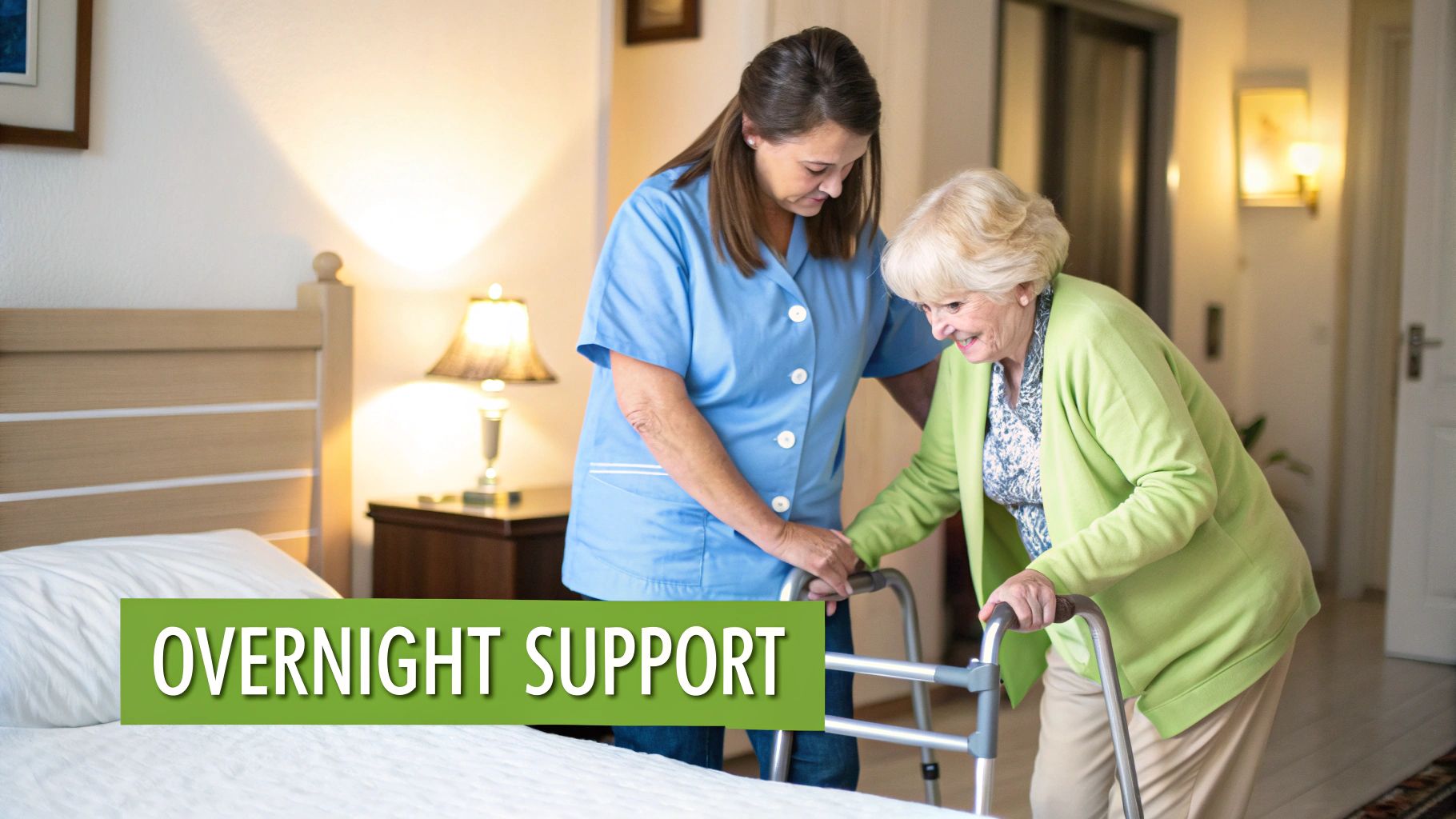
Providing Dignified Personal and Mobility Support
One of the most critical parts of the job is helping with personal care and getting around safely. Waking up in the middle of the night to use the toilet is a high-risk moment for many older people. Poor lighting and that groggy feeling can easily lead to a fall.
A carer is on hand to help with:
- Safe Toileting: They provide a steady arm to lean on for the journey from the bed to the bathroom and back again, making it a much safer trip.
- Incontinence Care: If needed, they can assist with changing pads or bedding discreetly and respectfully, always prioritising comfort and hygiene.
- Repositioning: For someone who is bed-bound, a carer will gently help them change position regularly through the night. This simple act is vital for preventing painful pressure sores.
This kind of hands-on support does more than just prevent accidents; it preserves a person's dignity. It's a specialised type of care, and it's useful to understand the distinction—you can learn more by comparing personal care vs home help to see just how specific this support is.
Ensuring Health and Well-being Through the Night
Beyond physical support, an overnight carer is key to managing health needs that don't just stop at bedtime. This often involves meticulous medication management and offering comfort to those who feel distressed during the night.
An overnight carer's presence is a comforting anchor for those who feel lonely or anxious in the dark. This emotional support is just as important as the physical tasks they perform, often leading to better sleep and improved mental well-being.
They might be responsible for giving medication that has to be taken at a specific hour, like pain relief or tablets for conditions such as Parkinson's. For individuals living with dementia who might experience "sundowning," a carer provides a calm, reassuring presence, gently reorienting them if they wake up feeling confused or agitated.
Preparing for a Calm and Organised Morning
The support often carries over into the early morning, helping to set a positive and peaceful tone for the day ahead. This bit of preparation ensures your loved one has a smooth, stress-free start.
These light duties might include:
- Getting a glass of water ready and laying out morning medication.
- Helping with washing and getting dressed for the day.
- Making a welcome cup of tea or preparing a simple breakfast.
This seamless transition from night into day helps maintain a comforting, predictable routine. Of course, some situations may benefit from more advanced training. Knowing that a carer has skills like an essential BLS certification can be incredibly reassuring in an emergency, showing the level of professionalism involved in high-quality care.
At the end of the day—and through the night—the carer’s role is to make sure the night passes safely and calmly, allowing everyone in the house to rest a little easier.
Navigating the Costs and Funding for Overnight Care
Let’s talk about the financial side of things. It’s often the biggest hurdle and a real source of worry for families looking into overnight care. Getting to grips with the likely costs and figuring out what financial help you might be entitled to is a crucial step. This section is designed to give you a straightforward, jargon-free overview of the costs and funding landscape in the UK, helping you plan with a bit more confidence.
The first thing to do is work out a realistic budget. The price of overnight care for an older person can vary quite a bit, depending on a few key factors. The main one is the type of care needed – whether it's a waking night or a sleeping night service – but where you live in the country also plays a big part. Regional differences in wages and the demand for skilled carers mean that costs can fluctuate significantly.
What Does Overnight Care Typically Cost?
To give you a clearer picture, let's look at some average figures. It's no secret that the demand for professional care is on the rise, especially with an ageing population and the ongoing pressures on the NHS. The costs naturally reflect this.
Here in the UK, as of 2025, you can expect sleeping night care to average around £178 per night. If that care is needed seven days a week, it works out to about £1,246 per week.
For waking night care, where the carer is on duty and active throughout the night, the cost is higher. The average for this more intensive support is around £230 per night, which comes to £1,610 per week. You can find more details on these home care cost averages and how they're calculated.
Remember, these numbers are just a starting point. The final price tag will always come down to the specific level and complexity of care your loved one actually needs.
Navigating the financial landscape of care can be complex, with costs varying significantly across the country. The table below provides a snapshot of the average weekly costs for both sleeping and waking night care in different UK regions, highlighting how location can impact your budget.
Average Weekly Cost of Overnight Care Across the UK
| Region | Sleeping Night Care (Weekly Avg.) | Waking Night Care (Weekly Avg.) |
|---|---|---|
| London | £1,400 | £1,820 |
| South East | £1,330 | £1,750 |
| North West | £1,225 | £1,575 |
| Scotland | £1,260 | £1,610 |
| Wales | £1,190 | £1,540 |
| Northern Ireland | £1,155 | £1,505 |
Note: These figures are illustrative averages and can vary based on the provider and specific care needs.
As you can see, planning for care requires a clear understanding of the local cost structure, which is why getting quotes from local providers is always the next step.
Exploring Your Funding Options
The good news is that you might not have to shoulder the entire cost on your own. There are several routes to getting financial support in the UK, specifically designed to help families access the care they need. Knowing what's out there is the key to making overnight care affordable.
- Local Authority Funding: Your local council is the best place to start. You can ask for a free Needs Assessment for your loved one, which is simply a process to determine their eligibility for care. If they qualify, the council will then do a Financial Assessment (a means test) to work out if they can help pay for it.
- NHS Continuing Healthcare (CHC): If your family member has significant, complex, and long-term health needs, they may be eligible for NHS Continuing Healthcare. This is a package of care that’s fully funded by the NHS, which would include any overnight support required. The assessment for CHC is quite detailed and focuses purely on health needs, not on your financial situation.
- Attendance Allowance: This is a tax-free benefit for anyone over State Pension age who needs a bit of extra help with personal care or supervision due to illness or disability. It isn’t means-tested, so your savings or income don't affect it, and it can be a great help towards the cost of overnight care. There are two different rates, depending on the level of help needed.
Securing the right financial support can feel like trying to solve a complicated puzzle. Your first move should always be to contact your local authority's adult social services department and request a Needs Assessment. It’s the gateway to finding out exactly what help you're entitled to.
Self-Funding Strategies
If it turns out that your loved one isn't eligible for public funding, or if the funding only covers a portion of the costs, you’ll need to look at self-funding the rest. This usually involves drawing on savings, investments, or pension income.
In this situation, it is always a good idea to get independent financial advice from someone who specialises in later-life care planning. They can help you map out a sustainable financial strategy, giving you peace of mind that the funds will last as long as they are needed. Planning ahead is truly the best approach.
How to Find and Arrange Personalised Overnight Care
Taking that first step towards arranging overnight care can often feel like the biggest hurdle. It’s easy to feel a bit overwhelmed by the process, but if you break it down into smaller, manageable steps, you can find a service that feels less like a transaction and more like a true partnership. It all starts with a really honest look at what’s needed.
This initial assessment goes deeper than just the obvious. Of course, you’ll think about practical things, like needing help to get to the toilet safely. But it's also about the emotional side of things. Does your loved one feel anxious when they're alone at night? Do they sometimes wake up feeling disorientated or confused? Getting a clear picture of their nightly routine and specific challenges is the foundation for finding the right kind of support.

Researching Reputable Local Providers
Once you have a good idea of the support you need, it's time to start looking for local agencies with a solid reputation. A quick online search for "overnight care for elderly near me" is a decent place to start, but you absolutely have to dig deeper. Focus on providers who are well-established in your community, like us here at Cream Home Care in Stoke-on-Trent and Newcastle-under-Lyme.
In England, every reputable home care provider is regulated by the Care Quality Commission (CQC). The CQC inspects services and gives them a rating—Outstanding, Good, Requires Improvement, or Inadequate. Make a point of checking a provider’s latest CQC report on their website. It gives you an unbiased, expert view on their safety, effectiveness, and how well they’re run.
It's worth knowing that finding a provider can sometimes be tricky due to high demand. The unmet need for overnight care in the UK is partly down to workforce shortages, with 48% of home care providers reportedly unable to meet all requests in 2024. This has meant more families stepping in and an increased reliance on more costly options. You can find more domiciliary care statistics in the UK to understand the current picture.
Essential Questions to Ask Potential Providers
After you’ve shortlisted a few agencies, the next step is to pick up the phone and have a proper conversation. This is your chance to really vet them and make sure they’re a good fit for your family’s needs and values. A good provider will be happy to answer all your questions and be transparent with you.
Think of this as an interview for one of the most important jobs you’ll ever fill. Your questions should cover everything from the practicalities of care to the organisation's culture and emergency protocols.
Here’s a checklist of key questions to help guide that conversation:
- Carer Training and Qualifications: What specific training do your overnight carers receive, especially for conditions like dementia or mobility support? Are all your staff DBS checked?
- Matching and Consistency: How do you match a carer to a client's personality and needs? Will my loved one have the same carer consistently, or will it be a different person each night?
- Emergency Procedures: What’s your protocol if a medical emergency happens during the night? How do your carers contact emergency services and keep the family informed?
- Care Planning and Reviews: How do you put together the initial personalised care plan? How often do you review and update it to reflect any changing needs?
- Communication and Reporting: How does the carer log their activities and any issues that crop up overnight? How and when is this information shared with the family?
- Costs and Contracts: Can you give me a clear, itemised breakdown of all the costs involved? What is the notice period if we need to change or cancel the service?
Arranging overnight care is a big decision, there’s no doubt about it. But by taking a structured approach, you can move forward with confidence, knowing you’ve done your homework to find a professional, compassionate service that gives your loved one safety and you invaluable peace of mind.
Comparing Overnight Home Care with a Care Home
Choosing between overnight care at home and a residential care home is one of the biggest, most emotional decisions a family can face. It's a conversation filled with practical concerns and deeply personal feelings. There’s no single right answer here; the best path forward is always the one that fits your loved one’s unique needs, their personality, and what ultimately helps them feel safe and happy.
Both options have their own set of benefits. A care home offers a built-in community and a full calendar of organised activities, with staff on-site around the clock. For some, this structured social environment and the freedom from home maintenance is a huge relief. But for others who value their independence and daily habits, that same structure can feel confining.

The Power of Familiarity and One-to-One Support
This is where care at home really shines. It’s all about helping someone continue living their life, on their terms. The simple comfort of sleeping in your own bed, surrounded by a lifetime of memories, photos, and familiar objects, offers a powerful sense of wellbeing. It’s a concept we often call ‘ageing in place’, and it’s about protecting a person’s dignity, routine, and control over their own world.
Overnight home care also provides a level of personalised, one-to-one attention that’s just not feasible in a care home, where staff have to split their focus between many residents. A dedicated carer’s only priority is your loved one. Whether they need a glass of water, help getting to the bathroom, or just a comforting word after a bad dream, that support is immediate. For a deeper dive into this, you can read our article on how care at home can positively replace care homes.
The core difference lies in the care model: a care home provides care within a community setting, while home care brings a dedicated professional into the individual’s personal world. For many, the latter is the key to maintaining their identity and comfort.
Considering Wellbeing and Independence
Emotional wellbeing is just as important as physical health. For someone who is fiercely independent or finds change distressing, the thought of leaving home can be incredibly upsetting. Home-based care supports their autonomy, letting them stick to their own schedule and live by their own rules—something that is often vital for their mental health.
Then there’s the practical side of things. Care home occupancy in England has remained steady at around 86.2% as of late 2024, which shows the constant pressure on available places. It’s important to know this figure often includes beds that are empty but can’t be filled due to staffing or refurbishment issues. This reality often makes high-quality home care not just a preference, but a more flexible and readily available solution when families need support right away.
Your Overnight Care Questions Answered
When you're exploring overnight care for someone you love, it’s only natural to have a lot of questions. It's a big step. We've put together answers to some of the most common things people ask, hoping to make the process a little clearer and less daunting.
In An Emergency, How Quickly Can We Get Overnight Care?
It’s often much faster than people think. Most professional home care agencies can get an emergency carer in place incredibly quickly, often within 24 to 48 hours. This is an absolute lifeline if you're dealing with a sudden hospital discharge or if a family carer falls ill unexpectedly.
The process usually starts with a quick-but-thorough assessment of your loved one's needs. This means you get the right support sorted from day one, giving you that vital peace of mind when you need it most.
What Sort of Training Should an Overnight Carer Have?
You’ll want to see a solid foundation of training. In the UK, a professional carer should be well-versed in essentials like first aid, health and safety, moving and handling, and how to safely administer medication. If your family member has more complex needs, look for carers with specialist training in things like dementia or palliative care.
A critical point: Always, always confirm that the care provider has completed an enhanced DBS (Disclosure and Barring Service) check for every single carer they employ. This is non-negotiable and ensures your loved one is in safe hands.
Can We Use Overnight Care for a Short Respite Break?
Yes, absolutely. This is one of the most common reasons families arrange overnight care. It's a fantastic way to get some respite, whether you need support for a few nights or a couple of weeks. It allows family carers to take a proper holiday, manage their own health needs, or just catch their breath.
This flexibility is a game-changer. It helps prevent carer burnout by providing planned, reliable breaks, which in turn helps make the whole family care setup sustainable for the long haul.
How Do You Create a Personalised Care Plan?
A truly personal care plan is always built together. It starts with a visit from a care manager who will sit down with you and your loved one to really understand what's needed.
This isn't just a checklist. It's a proper conversation about daily routines, medical needs, likes and dislikes, and what makes your loved one feel safe and comfortable at home. A good care plan isn't set in stone, either; it’s a living document that should be reviewed and tweaked as their needs and circumstances change over time.
At Cream Home Care, we specialise in providing compassionate, professional overnight care for older adults across Stoke-on-Trent and Newcastle-under-Lyme. If you have more questions or want to chat about what a care plan might look like for your family, please get in touch with us at https://creamhomecare.co.uk.