The call usually arrives at an awkward moment. Your mum has had another fall, or your dad is coming out of the Royal Stoke with a discharge letter, a bag of medicines and a follow-up nobody wrote down, and by the next morning you're trying to work out who helps him wash and take his tablets while you're at work.
That's the point where most families start searching for home care in Stoke-on-Trent and meet a wall of jargon: domiciliary, respite, direct payments, care needs assessment, means-tested funding. None of it answers the two questions anyone asks, which are what happens on Monday morning and what it costs.
This guide works through it in the order families need it. Care types first, then what keeps someone independent, then realistic weekly budgets and funding routes, hospital discharge, support for the carer, choosing a provider, and how to begin.
Home Care Types in Stoke-on-Trent and Which One Fits
Many individuals require one of five kinds of support. When compared directly, the differences become clear.
| Type | What it covers | Typical use | How it is arranged |
|---|---|---|---|
| Companionship care | Social contact, conversation, outings and emotional support | Loneliness or low-level support needs | Private or provider-arranged visits |
| Domiciliary care | Personal care, medication reminders and household tasks | Regular daily support at home | Council assessment or private arrangement |
| Respite care | Short-term cover while the family carer rests | Planned breaks or emergency cover | Provider or council, booked in advance or urgently |
| Elderly care | Mobility support, medication and everyday tasks | Older adults needing ongoing help to stay independent | Provider after a needs assessment |
| Live-in care | Round-the-clock presence in the home | Continuous or complex care needs | Specialist provider after assessment |
Companionship care is the lightest option and the one families skip past most often. It covers conversation, a short walk, help with post and paperwork, a shared meal and the regular contact that stops loneliness hardening into low mood.
Domiciliary care is often pictured as help with washing and dressing, a prompt to take medicines, something to eat, light housework and a check that the heating is on and the cupboards aren't empty. It is arranged after a council care needs assessment, or directly with a provider if you're paying yourself.
Respite care exists for the carer rather than the person receiving support. It can be booked weeks ahead for a wedding, a hospital appointment or a rest, or pulled together at short notice when illness hits the household. Elderly care is the longer-term version of domiciliary support, built around mobility, medication and the daily tasks that keep someone out of residential placement. Live-in care puts a carer in the home around the clock, which suits continuous or complex needs where several short visits a day would leave gaps.
These categories combine more often than people expect. Morning personal care plus two afternoons of companionship is a common, cost-effective package, and it's cheaper than four daily visits if personal care is only needed once.
You're in good company if you need this. The city's adult social care local account for 2022/23 records 764,094 hours of home care delivered in the city, supporting 1,634 people between April 2022 and March 2023, alongside more than 23,000 unpaid carers. Support at home isn't a last resort here. For many households it's the arrangement that keeps someone out of a care home, and it's worth weighing domiciliary care versus residential care before assuming a move is inevitable.
How Home Care Keeps People Independent at Home
Demand is rising for a reason. Stoke-on-Trent's own strategy projects that residents aged over 65 whose day-to-day activities are limited a lot by long-term illness will rise from 14,876 in 2020 to 17,324 by 2030, an increase of 2,448 people or 16.4%, as set out in the city's place to be strategy. The same document reports that eight of ten monitored long-term conditions are more common locally than nationally, including hypertension at 16.2% against 13.9% and depression at 17.4% against 12.3%.
That mix matters for care planning. Someone with high blood pressure, low mood and reduced mobility doesn't need one specialist service. They need reliable daily help that notices change.
Independence is built from small, repeatable tasks:
- Personal hygiene and dressing. Washing properly protects dignity and reduces the risk of skin breakdown and infection, particularly where mobility makes a shower difficult.
- Medication assistance. A prompt at the right time reduces missed doses, and a carer who sees a new prescription can flag it before a fortnight of confusion passes.
- Nutrition and hydration. Someone preparing a meal and sitting with a drink notices when appetite drops, which is often the first physical sign that something else is wrong.
- Daily visits. A regular visit is also a daily check on wellbeing, so a chest infection or a bruise gets spotted in days rather than weeks.
- Companionship. Isolation wears people down, and conversation is part of the treatment, not an extra.
The practical point is that support should flex. Someone recovering from a chest infection may need two visits a day for a fortnight, then drop back to one. A care plan that can't shrink again ends up costing more than it needs to, which is why reviews matter as much as the first assessment.
Medication prompts only work if the medicines are organised in the first place. Where someone is juggling six or seven prescriptions, a UK blister packing pharmacy guide explains how weekly packs are assembled and labelled, which makes it obvious at a glance whether a dose has been taken.
Weekly Home Care Costs and What Changes the Price
Start with a number rather than a range. Stoke-on-Trent's adult social care market evidence records a stated standard council rate of £20 per hour and a median provider-submitted cost of £25.22 per hour, uplifted to April 2022 prices. Using 30-minute visits and the £25.22 median, weekly costs look like this.
| Visit pattern | Visits per day | Weekly hours | Weekly cost at £25.22 an hour | Weekly cost at the £20 council rate |
|---|---|---|---|---|
| One visit a day | 1 | 3.5 | £88.27 | £70.00 |
| Two visits a day | 2 | 7 | £176.54 | £140.00 |
| Four visits a day | 4 | 14 | £353.08 | £280.00 |
The gap between £20 and £25.22 is the first thing to understand. The council figure is a commissioning rate, the price it agrees with providers for the hours it buys. A private quote reflects the provider's real cost of staff, training, travel, supervision and insurance, so it usually sits above the council figure rather than at it. Neither number is a quote for your household.
What pushes a quote up
- Minimum visit length. Many providers charge a 30-minute minimum, so a 15-minute welfare check may still cost for half an hour.
- Travel time. Rural or spread-out rounds cost more, and some providers bill travel separately.
- Evening and weekend rates. The 7am call is cheaper than the 9pm call, and Sunday morning is dearer again.
- Bank holidays. Expect a premium, and ask whether it applies to all bank holidays or only the main ones.
- Two carers. Hoisting, some transfers or complex personal care need a second pair of hands, which doubles the hourly charge.
- Complex needs. Specialist training, equipment or clinical input carries a higher rate.
Run the numbers for your own situation
The formula is simple: visits per day × hours per visit × hourly rate × 7. Take a household needing three 45-minute visits a day at the £25.22 median. That's 2.25 hours a day, 15.75 hours a week, or about £397.22 a week. Drop to two 30-minute visits and it falls to £176.54.
Use these figures to shop, not to assume. When you request a quote, ask six things: the hourly rate, the minimum visit length, whether travel is included, the weekend and bank holiday rates, whether a second carer is chargeable, and what notice you need to give to change or cancel a visit. Compare the answers in writing against how much in-home care costs in practice rather than against a headline rate.
How Council Funding and Private Payment Fit Together
Two separate questions decide who pays, and they get answered in a set order. A care needs assessment works out what help someone needs. A financial assessment works out what they contribute towards it. They work like two separate dials: one sets the hours, the other sets who pays for them.
Families often hear the word "assessment" and assume it means a means test, so they hold back from asking. That is how people end up paying privately for care the council would have part-funded.
| Route | Who pays | How it starts | What to check |
|---|---|---|---|
| Council-funded care | Local authority, after a financial assessment | Care needs assessment | Eligibility depends on assessed need and savings thresholds |
| Direct payments | Council pays the person to buy their own care | Agreed care plan | Employer duties unless a managed account is used |
| Private arrangement | The person or family pays the provider | Direct contact with a provider | Travel, minimum visit lengths and weekend or evening rates |
| Mixed funding | Council and private payer share the cost | Agreed split of hours | Gaps when council hours do not meet the full need |
Council-funded care runs through the care needs assessment first and the financial assessment second. Ask for it in writing and note the date you asked. Direct payments hand the money to the person so they can choose their own provider. The freedom comes with admin: you take on employer responsibilities for tax, insurance and payroll unless a managed account handles them for you.
Private arrangements skip the council entirely. You contact a provider, agree the hours and pay the invoice. Mixed funding is one of the arrangements families often end up with: the council agrees, say, one visit a day, while the family privately buys the second.
A worked mixed-funding example
Council commissioning rates are set locally and they move. Staffordshire's 2025/26 fee review decision report shows the standard home-care rate rising from £23.32 to £24.95 an hour and enhanced care from £24.02 to £25.70, a 7% uplift.
Now run the split. Someone assessed as needing two visits a day, 7 hours a week, gets council funding for one visit a day at that £24.95 standard rate, worth £87.33 a week. The family buys the remaining 3.5 hours privately at the £25.22 median, which comes to £88.27. The full package costs about £175.60 a week, and the family's share of it is the £88.27.
The council figure is a commissioning rate, which differs from the hourly price a self-funder gets quoted, and rates vary between councils. The maths holds whatever the numbers: funded hours at the council rate, the remainder at the private rate.
Practical rule: ask the council to confirm the current savings thresholds and your assessed contribution before you sign anything with a provider. Then ask for an itemised quote that matches the hours, not a round monthly sum.
How to Plan Home Care After Hospital Discharge
Local home care capacity has grown in recent years, which makes discharge planning easier than it was. More providers in and around the city means a package can usually be sourced. It does not mean the package will be right.
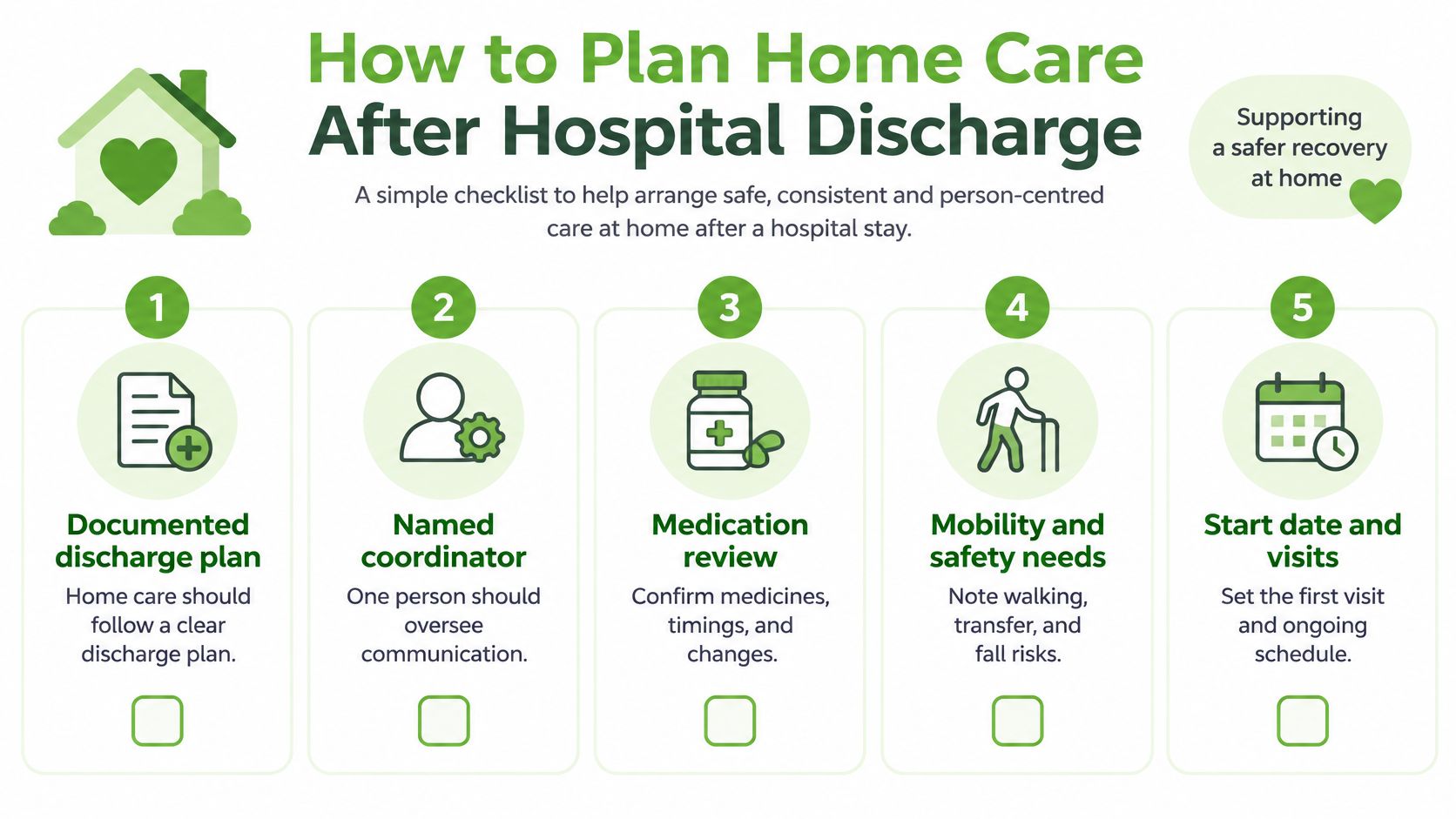
The hospital discharge and community support guidance sets the standard: arrangements must be safe, clinically appropriate, monitored across seven days and aligned with the person's most suitable destination. A home-care package should hang off a documented discharge plan covering the hours, the tasks and the weekly cost, rather than a generic set of calls agreed in a hurry.
Six checks before the first visit
- Confirm the medication list and who owns each change. Hospital charts and home supplies often disagree, and a duplicate dose is one of the quickest ways a discharge unravels.
- Record mobility and transfer needs. Note whether a second carer is required for hoisting or standing, so the first visit isn't two people improvising.
- Flag nutrition and hydration risks. Reduced appetite, swallowing difficulty or a fluid restriction all change what a carer does at mealtimes.
- Check equipment has arrived and been set up. A walking frame still in its box or a commode left in the hall is a fall waiting to happen.
- Agree escalation contacts. GP, district nurse, out-of-hours service and the family member who answers first, all written into the plan.
- Set a review date inside the first week. Recovery moves fast in both directions, and the plan should be adjusted before a fortnight of the wrong visits passes.
Cream Home Care builds care plans around each client's specific requirements, covering personal care, companionship, help with daily activities and support with medical appointments, which is the level of detail a discharge needs to survive contact with real life. Where several professionals are involved, outsourcing family healthcare coordination can keep appointments, notes and handovers in one place.
Know which signs mean calling 999 immediately: a sudden change in breathing, a serious fall, or sudden new confusion. Missed medication is handled differently: report it to the GP or out-of-hours service the same day. Follow the hospital discharge care planning process so the first 72 hours have named people responsible for them.
Supporting Family Carers Before Crisis Hits
Unpaid care in this city is intense. The 2021 Census area changes for Stoke-on-Trent show 3.5% of residents aged five and over provided 50 or more hours of unpaid care a week, compared with 2.7% across England. The share giving up to 19 hours fell from 6.7% in 2011 to 4.3%, while the 20 to 49 hour group rose from 2.0% to 2.4%.
Read those together and a pattern appears. Lighter caring has declined, but intensive caring held steady. The people most at risk are the ones doing the most hours, often while holding down a job or managing their own health.
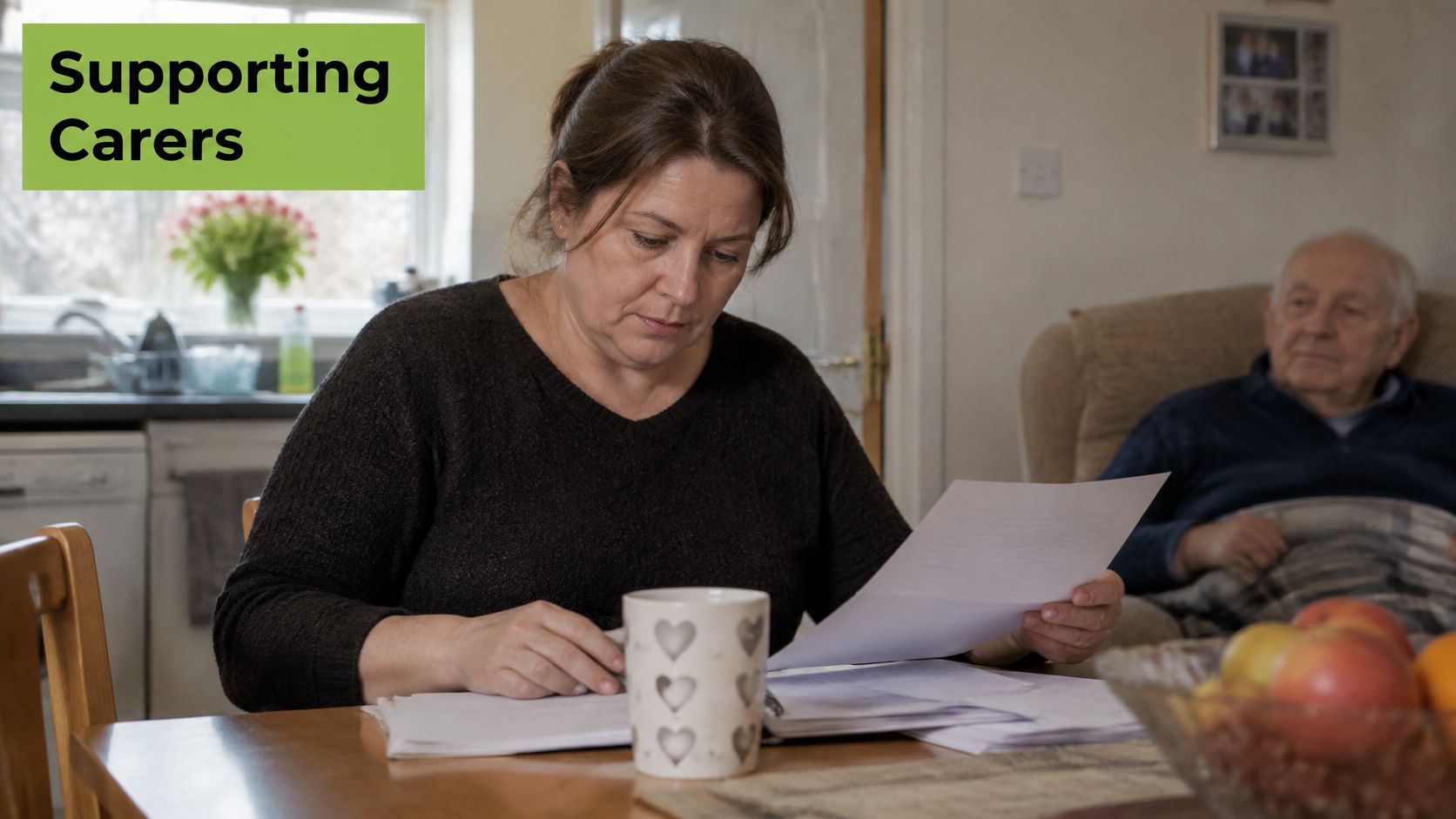
Three warning signs are worth acting on rather than monitoring: disturbed sleep for several weeks, missed appointments of your own, and growing irritability or low mood that wasn't there a year ago. Any one of them means the caring load is already too high.
Planned respite versus emergency respite
Planned respite is booked weeks ahead, covers a predictable break such as a hospital appointment or a few days away, and gives everyone time to prepare. Emergency respite happens when the carer is ill, injured or cannot continue, and it is arranged in a hurry with whoever has capacity.
The difference in outcome is stark. Planned breaks keep the arrangement stable, while emergency breaks disrupt routines, unsettle the person being cared for and can push a family towards residential care nobody wanted. Regular respite also sits more comfortably inside a weekly care budget: a recurring block of hours is a predictable line item, where a crisis admission is a cost nobody priced. Book the planned break before exhaustion arrives, and prefer short, regular breaks over one long gap, because a fortnight away once a year cannot carry you through the other fifty weeks.
The route to funded breaks is a carer's assessment, which you can request from the council in your own right.
A carer's assessment is about you, not the person you look after. It can get you respite hours, training, equipment and sometimes a direct payment in your own right.
When you request one, ask five questions: what respite hours are available, whether they can be taken as short regular breaks, whether the person you care for needs a separate needs assessment first, what happens if you become ill suddenly, and how long the decision usually takes. Private respite can run alongside this process rather than waiting on it. Cream Home Care provides flexible, personalised respite care across Stoke-on-Trent and Newcastle-under-Lyme, giving family caregivers a break while the person they support continues to receive reliable short-term care.
Continence often lands in the middle of all this, and practical guidance for UK carers on bedding, washing and dignity is worth keeping to hand.
Choosing a Home Care Provider in Stoke-on-Trent
Choice has opened up. The council's own announcement on the boost to care provision reports that the number of companies providing home care grew from 11 in 2022 to 41 in 2024. More providers means more availability and more variation, so the judging is now on you.
- Is the provider registered with the Care Quality Commission? Registration is a legal requirement for personal care, and the inspection report tells you what happened at the last visit rather than what the brochure promises.
- How are caregivers trained, and how often is training refreshed? Ask specifically about moving and handling, medication, safeguarding and dementia. Training that happened once in 2019 doesn't cover today's client group.
- How are clients matched with caregivers, and can the match be changed? Continuity matters most where memory is affected, because a rotating cast of unfamiliar faces causes distress and refusals.
- Will there be a written care plan, and who reviews it? A plan agreed in person and reviewed on a set date is the difference between individual support and a rota slot.
- How flexible is scheduling for evenings, weekends and short notice? Ask what happens when a visit needs to move by two hours, and whether the same carers cover weekends.
- How are complaints handled, and how quickly are they answered? A provider with a clear process will tell you the timescale without hesitating.
Our team consists of trained caregivers and we've worked in social care for more than 20 years, which matters most at the point where a rota meets a person who won't get out of bed for a stranger. We match clients with caregivers whose personalities and skills align with their needs, and we'll change a match if it isn't working.
Ask for recent feedback from current clients rather than relying on a provider's own summary, and put the same six questions to at least two providers. Pricing questions, including minimum visit lengths and travel charges, are covered in the weekly cost section, so keep those on the same sheet.
Arranging Your First Home Care Assessment
The sequence that gets care started this week is shorter than many expect.
- List the daily tasks, visit times and hours that matter most. Use the types table as a prompt, and be honest about the morning routine, because that's usually where the pressure sits.
- Request a care needs assessment from the council in writing and note the date. A written request creates a record if the process stalls.
- Ask at least two providers for an itemised weekly quote and check the hours against the cost table rather than accepting a round figure.
- Confirm how each part of the package will be paid for, whether that's council-funded hours, a direct payment, private hours or a mix.
- Agree a written care plan and a review date before the first visit, so there's a fixed point to change what isn't working.
You can call our care team on 01782 444007, email info@creamhomecare.co.uk, or start by filling in the simple contact form and we'll get back to you. If you'd rather talk face to face, our office is at 2 Victoria Square, Hanley, and we cover Stoke-on-Trent, Newcastle-under-Lyme and the surrounding area.
Today, write down the three most important daily tasks your relative needs help with, then make the first call.
Cream Home Care provides home care across Stoke-on-Trent and Newcastle-under-Lyme, with support built around personal care, companionship, daily activities and medical appointments. If this guide has helped you price your situation, we can turn those figures into a written care plan and a schedule that fits your family's week. Visit Cream Home Care to see how we work and to arrange a conversation.