Older people living alone were more than twice as likely to report loneliness as those living with others, 30.8% compared with 12.6%, in an Office for National Statistics analysis. That makes household circumstances a useful starting point, but not a diagnosis: someone can enjoy living alone, while another person feels lonely despite daily visitors.
For families looking for elderly loneliness support in Stoke-on-Trent, the practical question is what's stopping meaningful contact. The answer might be hearing loss, grief, inaccessible transport or an exhausted family carer. Start with that barrier, rather than adding another activity to the calendar.
Where to Turn for Local Support in Stoke-on-Trent
There's no single front door. Start with the route that matches the person's needs, then combine health, community and home-based help where necessary. The table gives you a starting point without assuming that everyone needs paid care.
Local support routes and how to access them
| Route | What It Offers | How to Access |
|---|---|---|
| GP practice and social prescribing | Health review and links to groups and activities | Book through your GP practice and ask about a social prescribing link worker |
| Stoke-on-Trent City Council adult social care | Needs assessment and carers' support | Contact the council's adult social care team; check current details on the council website |
| Community Connectors | Relationship building and referral to groups, health providers or practical help | Ask the council's community services about the current referral route and eligibility |
| Community Lounges | A regular place to meet others and take part in activities | Attend directly or through a Connector; confirm opening arrangements and accessibility first |
| Volunteer befriending and telephone contact | Regular calls or visits from a volunteer | Ask local volunteer schemes about referrals, waiting lists and home-visiting availability |
| Domiciliary (home) care | Companionship, personal care, medication support and household tasks | Cream Home Care, see final section for contact |
| Respite care | Short-term cover so a family carer can rest | Cream Home Care, see final section for contact |
| Carers' support services | Advice, breaks and peer contact for family carers | Ask the council's carers' support route about a carer's assessment and available services |
Start with health and practical access
Book a GP appointment when withdrawal comes with low mood, pain, tiredness or difficulty hearing conversations. Ask for a review of possible depression, sensory problems and medication side effects. A social prescribing link worker can help identify suitable activities, but can't replace treatment or guarantee transport.
Council adult social care is appropriate when someone struggles with everyday tasks or their family can't safely maintain support. Ask about both the older person's needs and the carer's circumstances, rather than presenting loneliness as the only concern.
Before choosing a Community Lounge, establish whether the person can get through the entrance, use the toilet and hear conversation. A Connector can help explore those obstacles. A volunteer call offers a gentler introduction for someone who isn't ready to attend, although it won't provide personal care.
Check charges before committing
- GP and social prescribing: NHS appointments and link-worker support are free; linked activities may charge.
- Council assessment: A needs assessment is free; arranged care may involve a financial assessment and charges.
- Community Connectors: Ask the council to confirm whether the proposed support is free.
- Community Lounges: Confirm any activity, refreshment and transport charges.
- Volunteer befriending: Check whether contact is free and whether outings incur expenses.
- Home care and respite: Private fees reflect the support arranged. Confirm current prices in GBP (£) before agreeing.
- Carers' support: Ask which advice and peer services are free and how funded breaks are assessed.
We provide home care across Stoke-on-Trent, Newcastle-under-Lyme and North Staffordshire, including flexible, personalised respite in Stoke-on-Trent and Newcastle-under-Lyme. Our help-at-home guide explains practical support options.
If someone wants to understand talking support before discussing it with their GP, reVIBE Mental Health's guide to what to expect in loneliness therapy offers useful context. It isn't a local referral route or a substitute for an NHS assessment.
How Common Loneliness Is in Stoke-on-Trent
Roughly one in four older residents may experience loneliness at least occasionally, according to the estimate in Stoke-on-Trent's Joint Strategic Needs Assessment, which puts the potential total at approximately 11,150 residents aged 65 and over. It applies 2020/21 national survey rates to the local population, so it's an estimate, not a count of residents interviewed.
Loneliness is the gap between the contact someone wants and the contact they have. It's different from living alone, being quiet or preferring a small circle of friends.
Read the measures carefully
For comparison, the Community Life Survey 2024/25 reports frequent loneliness in England between October 2024 and March 2025, including 4% of adults aged 65 to 74, 5% of those aged 75 and over, and 6.6% of adults overall.
Loneliness rates for older adults, local and national
| Group | Measure | Rate |
|---|---|---|
| Stoke-on-Trent residents aged 65 and over | Lonely often or always, local estimate | 6.4% (about 2,850 people) |
| Stoke-on-Trent residents aged 65 and over | Lonely some of the time, local estimate | 18.7% (about 8,300 people) |
| England adults aged 65 to 74 | Lonely often or always, 2024/25 | 4% |
| England adults aged 75 and over | Lonely often or always, 2024/25 | 5% |
| England adults, all ages | Lonely often or always, 2024/25 | 6.6% |
| Older people living alone (ONS) | Reported loneliness | 30.8% |
| Older people not living alone (ONS) | Reported loneliness | 12.6% |
The local rows use the assessment's estimate, the England rows use the Community Life Survey, and the household comparison uses the ONS analysis linked above. They aren't interchangeable measures.
The council's Older People's Housing Strategy 2023–2028 separately reports 8,838 people aged 65 and over experiencing loneliness in 2021 and describes Community Connectors and Community Lounges. That figure uses a different measure and shouldn't be mixed with the assessment estimate.
Ask about loneliness routinely. A population average can't tell you how a housebound or recently bereaved relative feels.
Spotting Loneliness and the Risks Behind It
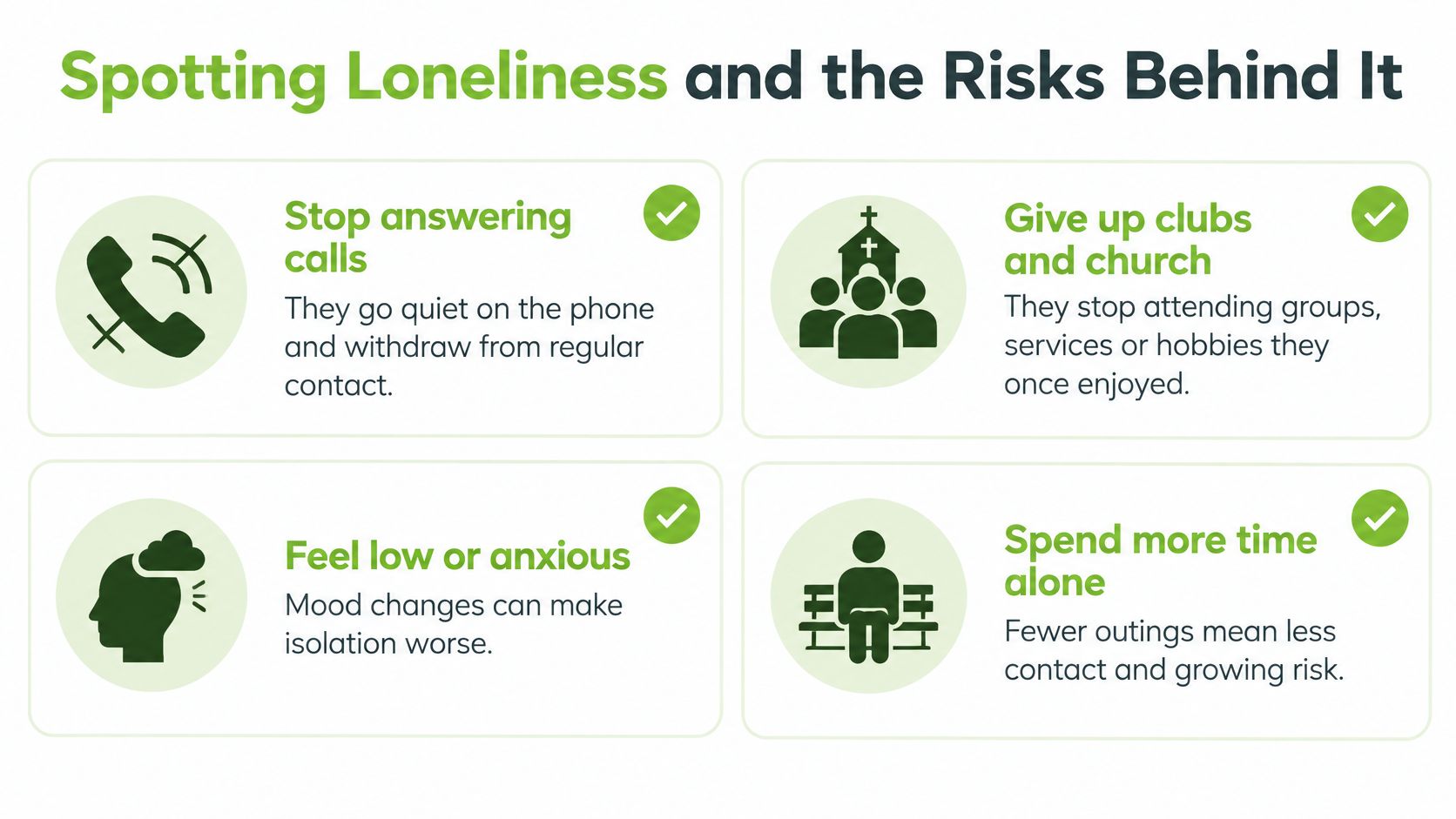
Withdrawal can be easier to notice than an admission of loneliness. Look for changes from the person's usual habits, not whether they match your idea of a sociable life.
- Calls become difficult: They stop answering or go unusually quiet during conversations.
- Familiar activities disappear: They give up clubs, church, hobbies or appointments they previously valued.
- They describe missing company: They say nobody visits or they've no one to talk to.
- Daily routines slip: Meals are skipped, post piles up or the home becomes less tidy.
- Sleep or appetite changes: They seem tired, eat differently or lose interest in preparing food.
- Going out feels frightening: They repeatedly cancel plans or need reassurance before leaving home.
Look for the barriers behind withdrawal
An isolated sign is weak evidence. A cluster of changes that persists is a reason to talk and arrange a health review, not a basis for diagnosing loneliness yourself.
Living alone deserves attention, particularly in later old age. Reduced mobility, sensory loss, bereavement, poor health, caring responsibilities, limited income and difficulty using transport or the internet can each restrict contact. Stoke-on-Trent's public mental health strategy recognises the importance of understanding why someone is lonely before reconnecting them with activities.
Consider an illustrative situation: an 84-year-old widow lives alone, has no car and can't hear the telephone properly. A missed call might reflect hearing difficulty, not rejection; recommending telephone befriending without addressing that problem won't help.
For a gentler way into conversations about emotional wellbeing, DeTalks offers a compassionate guide for families supporting seniors. Ask directly what feels difficult and which relationships the person misses.
This week's first step: have that conversation somewhere quiet, with hearing aids and glasses available. Listen before proposing a group.
How Companionship and Home Care Ease Isolation
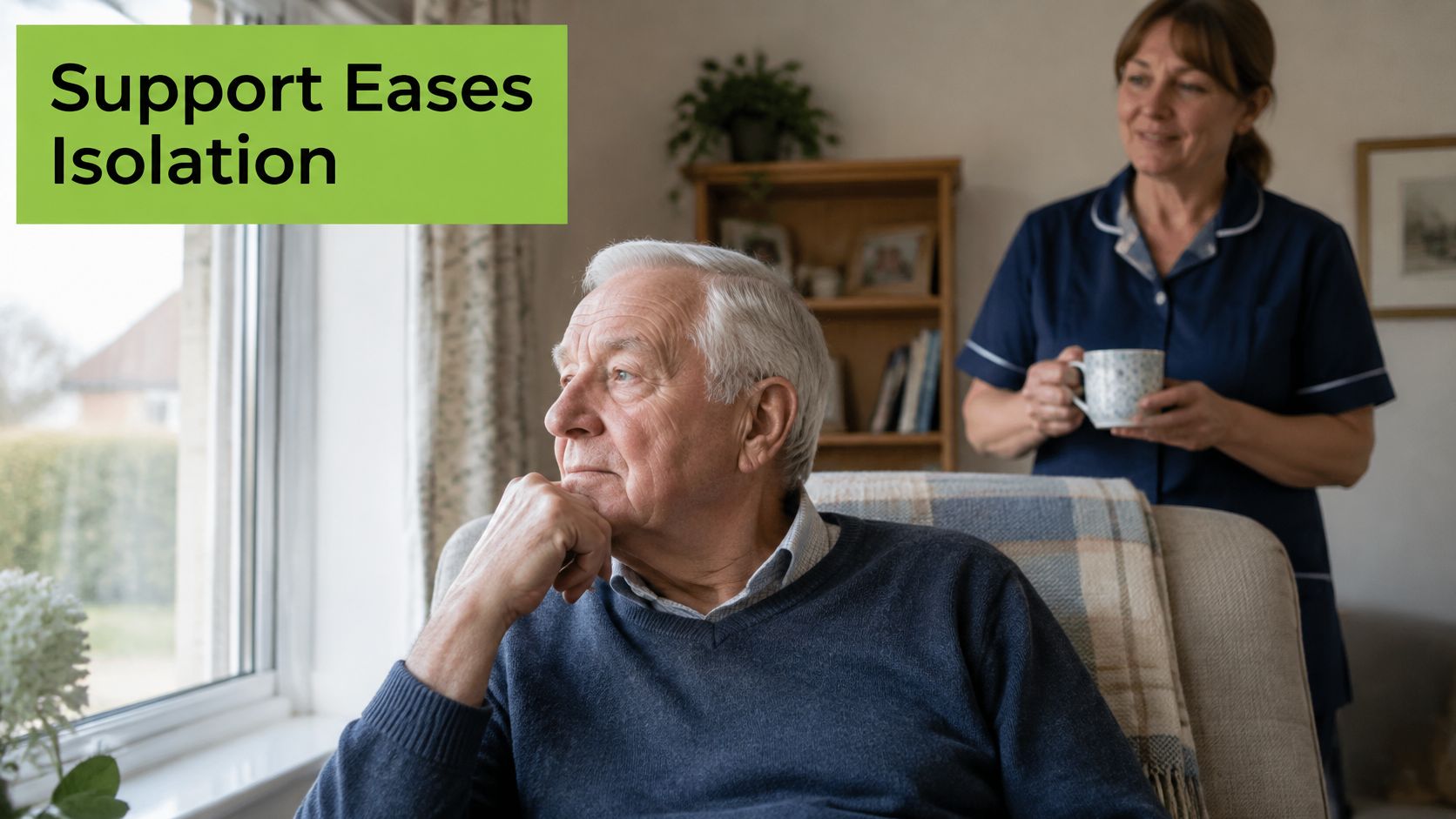
Someone who feels low may stop going out, then lose the conversations and routines that made going out worthwhile. The first useful intervention can be modest: a familiar person arriving reliably and doing something the older person enjoys.
The National Institute for Health and Care Research's review describes 39 studies across 29 countries, with loneliness reported by approximately one in four adults over 60, rising to 31% among those over 75. It also reports associations with 18% of depression cases after one year and 11% after 12 years, and identifies social prescribing, befriending and regular volunteer telephone contact as approaches that can help.
Make visits purposeful without making them demanding
Companionship centres on conversation, shared meals, walks, hobbies and outings. Domiciliary care adds practical assistance such as personal care, medication reminders and household tasks. They can run together, but a rushed task-focused visit shouldn't be mistaken for meaningful social time.
Aim for continuity of carers, a shared interest and an agreed goal. Record what the person currently enjoys, how they describe their mood and what contact they have, then review whether anything changes. Our suggestions for activities for elderly people at home can help turn a visit into something more engaging than another wellbeing check.
Practical rule: measure whether the person feels more connected, not simply whether someone attended.
An illustrative route back to a routine
Consider a retired engineer aged 81 who stops visiting his allotment after a fall. In this illustrative example, a weekly walk with a carer, followed by a supported introduction to a Community Lounge, helps him rebuild a routine over three months. That's a possible progression, not a promised result or a real client account.
Persistent low mood, self-neglect, cognitive change or suicidal thoughts need NHS or safeguarding attention. Companionship can accompany professional help, but mustn't replace it.
Matching Support to Your Situation
Choose the smallest workable step, not the busiest programme. A group only helps if someone can reach it, participate comfortably and wants to return. A home visit only helps if its purpose matches what the person misses.
Choosing a first step by situation
| Situation | Start With | Then Add |
|---|---|---|
| Can get out but feels anxious going alone | Community Lounge with a Connector | Group activity with a companion for the first few visits |
| Cannot walk far and has no transport | Home-based companionship | Befriending call, then a local group reached through a Connector |
| Recently home from hospital | GP review and short-term domiciliary care | Companionship plan with a review after four to six weeks |
| Bereaved and living alone | Connector referral and befriending | Regular companionship and a community activity |
| Struggles with phones or the internet | Scheduled in-person or telephone visits, using whichever is accessible | Assisted introduction to group activities |
| Family carer exhausted | Respite care for an agreed number of hours | Carers' support service and regular planned breaks |
The review interval above is a suggested planning point, not a clinical deadline. Any deterioration needs attention sooner.
When getting out is the difficulty
Before arranging attendance, check the entire journey: leaving the house, reaching transport, getting into the venue and returning home. Ask about steps, walking distance, accessible toilets, seating and whether somebody can greet the person at the door.
Don't assume a Connector provides transport or that a group can offer personal care. Establish who will help with coats, mobility aids and toileting if needed. Confirm the total cost, including travel, rather than discovering an unaffordable arrangement after the person has become interested.
For someone anxious about attending, agree a short introductory visit with permission to leave. For someone who prefers home, begin there. Independence includes choosing not to join a group.
When someone has just left hospital
Hospital discharge can leave families concentrating on medication, meals and safe movement while ordinary conversation disappears. The older person may feel frightened about another fall; the carer may feel unable to leave the house.
This week, work through a staged plan:
- Ask for agreement: Establish what help the person accepts and who they want involved.
- Check the discharge arrangements: Identify the named contact, outstanding follow-up and instructions about mobility or medication.
- Separate care from company: Make sure essential tasks are covered, then protect time for an enjoyable conversation or familiar activity.
- Schedule a carer's break: Name who takes over and what support they must provide.
- Agree a review: Check confidence, appetite, daily functioning and whether the arrangement feels helpful.
Don't independently change medication or interpret new confusion as loneliness. Contact the appropriate clinical team when recovery isn't following the advice given.
When the family carer is isolated too
About one-fifth of Stoke-on-Trent carers receiving support feel socially isolated, while 35.2% have a longstanding illness themselves, according to the city's Health and Wellbeing Strategy. Support should therefore consider both people, rather than treating the carer as an unlimited resource.
Short, regular in-home cover can give the older person another relationship while the carer reconnects with a friend, attends an appointment or rests. It doesn't remove independence when the person helps choose the timing, activity and boundaries.
A break isn't a break if the family carer still has to supervise everything from another room.
Start with a clear handover covering routines, mobility, communication and what to do if something goes wrong. The carer should know who is responsible during their absence, rather than remaining permanently on call.
We match clients with caregivers whose personalities and skills align with their needs. Our guide to how to choose a home care provider helps families prepare questions about the practical arrangement.
When grief or reluctance shapes the decision
Bereavement support shouldn't become an attempt to replace the person who died. Offer company without demanding cheerfulness, and ask whether the older person wants familiar conversation, quiet presence or help returning to an old interest.
If they refuse support, explore the objection. A stranger entering the home, worry about cost or fear of losing control each calls for a different response. Offer a manageable introduction rather than arranging visits without their knowledge.
Respect choices, but don't ignore danger. If someone cannot meet essential needs, is being neglected or exploited, or expresses suicidal thoughts, seek clinical or safeguarding help promptly. Social activities aren't a substitute for protection.
Call Cream Home Care to Arrange Support
Call our care team on 01782 444007, email info@creamhomecare.co.uk, or complete the simple contact form on our website and we'll get back to you. You can also visit our office at 2 Victoria Square, Hanley, Stoke-on-Trent, ST1 4JH.
Before speaking with us, prepare a short outline:
- Daily life: Routine, mobility, medication and who lives at home.
- Personal interests: What the person enjoys and whom they miss.
- Your priorities: What the older person wants and what the family hopes will change.
We'll discuss the client's requirements, develop a care plan, match a caregiver's personality and skills, and review the arrangement as needs change. If home care doesn't feel right yet, a GP appointment or Connector enquiry may be a better starting point; community and health support can also run alongside care.
Book a first conversation this week and agree a review date four to six weeks ahead. If anyone is in immediate danger, call 999.
Cream Home Care offers companionship, practical home support and respite that can help older people stay connected while family carers take a planned break. Visit Cream Home Care to start a conversation about a manageable first step for your household.