The search usually happens late at night. You've spent Sunday at your mum's, noticed the same unwashed pan on the hob, and found the calendar still turned to last month. So you type "home help for elderly near me" into your phone and get a screen full of companies describing themselves as compassionate, flexible and local. None of them tells you which kind of help you're looking for.
That confusion is worth clearing first, because home-based support is not the waiting room before a care home. On 30 June 2024, 662,320 people were receiving long-term adult social care arranged or provided by local authorities in England, and 481,150 of them were supported in community settings, equal to 1,053 people per 100,000 adults, according to Adult Social Care in England monthly statistics. The same release puts the rate among people aged 85 and over at 11,707 recipients per 100,000, so need climbs steeply with age while the setting usually stays the person's own home.
The useful question isn't "what services exist". It's "what does a Tuesday look like, and where exactly does it fall apart". Answer that, and the right row of the table below is easy to spot.
Home Help Options Near You at a Glance
| Support type | What it covers | Best suited when |
|---|---|---|
| Domiciliary care | Flexible home-based support with personal care, household tasks and general assistance | Regular visits are needed through the day or week |
| Personal care and daily activities | Washing, dressing, medication reminders and help with daily routines | Routine tasks have become difficult to manage alone |
| Companionship care | Social interaction, emotional support and company to reduce loneliness | Social contact has fallen away |
| Respite care | Short-term care that gives family carers a break while care continues | A carer needs planned or emergency cover |
| Elderly care | Help with mobility, medication and everyday tasks while promoting independence | Ongoing needs are growing |
| Medical appointment support | Accompaniment and practical help before, during and after appointments | Travel or appointments are hard to manage alone |
Six labels, six different jobs. Most families need one or two of them rather than all six, and the mix shifts as circumstances change.
Domiciliary care and personal care overlap in everyday understanding, and often the same carer delivers both. Domiciliary care is the arrangement itself, the scheduled visits that bundle personal care with household tasks and general assistance. Personal care is what happens inside some of those visits.
The rows separate cleanly once you describe the problem out loud. If your dad hasn't spoken to anyone but the postman in a fortnight, help with laundry won't touch it, so that's the companionship row. If you, the daughter, haven't had a night away in two years, that's respite. And if he manages washing and dressing perfectly well but can't face a hospital appointment alone, that's the final row.
A single provider often covers several rows at once. Cream Home Care, which works across Stoke-on-Trent, Newcastle-under-Lyme and North Staffordshire, offers home care, companionship, domiciliary care, respite care and elderly care, which matters when a plan has to grow without changing the faces delivering it.
Comfort around the home belongs in the same conversation. A relative who spends most of the day in the same armchair needs proper support beneath them, and this guide to chair comfort and support for retirees is a sensible companion to the care discussion.
Find the two problems that brought you here in the table above. What follows explains how each one is assessed, scheduled and paid for.
What a Carer Does on a Typical Visit
A visit is easier to picture with a real week attached to it.
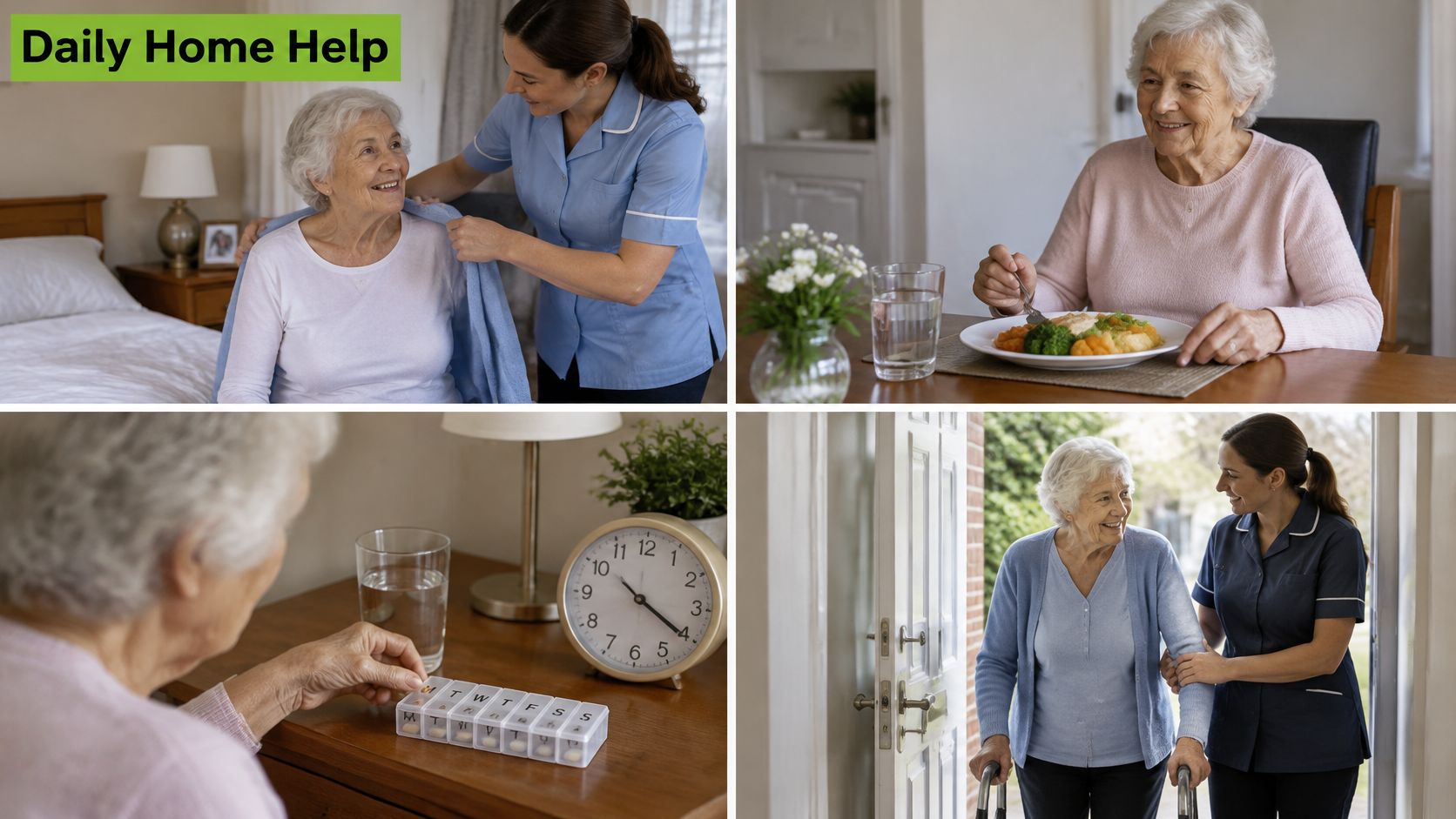
Say a 79-year-old woman lives alone and has come home from a hip operation. Mornings are the hard part, so she needs help getting washed and dressed. She wants a hot meal at lunchtime rather than toast, a reminder to take her tablets at teatime, and someone to walk with her to the shops twice a week so the trip stops being frightening.
Sorting the day into three groups
Personal care covers washing, dressing, toileting, moving safely and transfers from bed to chair. A transfer that needs two carers changes staffing, timing and cost, so ask directly whether a plan is single or double handed. Daily tasks cover meals, laundry, shopping and light housework, which are the jobs families usually absorb until something gives. Companionship covers conversation, a shared activity, a hobby, or the walk to the shops with company attached.
Keeping those groups separate matters because they fail at different speeds. Age UK's briefing on the state of health and care of older people estimated that 1.4 million people aged over 65 in England had unmet needs with at least one essential activity of daily living in 2018, that around 300,000 struggled with three or more, and that more than half received no help from paid carers, family or friends. Add shopping, hot meals and managing money, and the estimate passes 1.5 million.
Reminders and company are not clinical treatment. District nurses manage wound care, catheter care and medication reviews; a home carer prompts, records and reports. Blur that line and families end up arguing about what they've paid for.
Visit lengths are stretching, too. Average homecare provision rose from 13 hours 40 minutes per person per week in 2021/22 to 14 hours 23 minutes in 2024/25, while the share of over-65s accessing care fell from 6.0% to 5.2%, according to the ADASS Spring Survey of adult social care. Fewer people, longer visits, more complex need.
Ask three things before you book: how long each visit actually lasts, who will arrive, and whether the same carer comes back next week.
Then do the sorting exercise yourself. Write down three daily tasks the person cannot manage alone and label each one personal care, daily tasks or companionship. That list is what a provider should be quoting against.
Keeping Social Contact and Daily Routine
Search results for home help answer a question nobody asked. They list the tasks a carer can perform. They rarely answer what families lie awake worrying about: whether the person will still seem like themselves in six months.
England's 2024 to 2025 Adult Social Care Outcomes Framework shows where support most often falls short. The proportion reporting needs only partially met or unmet was 84.0% for how people spend their time, 78.4% for control over daily life and 69.9% for social contact. Practical tasks get done. Purpose, autonomy and company are where the gaps sit.
A checklist built from what people say is missing
Use those three areas as the spine of your conversation with any provider.
- How time is spent. Can a carer share a regular activity, a walk, a card game or a visit to a community group, rather than only completing tasks and leaving?
- Control over the day. Can visits stay at the same time of day so a routine survives, and who decides what happens inside a visit when the person changes their mind?
- Social contact. How does the carer record what the person enjoyed or refused, so the next visit builds on it instead of starting again?
Ask how a missed or late visit is handled, because the answer reveals how the provider thinks about routine. A good answer names who calls the family, when they call, and who arrives instead.
A late visit means a disrupted morning, and the person feels it for the rest of the day.
Social contact gets harder when conversation does. If your relative has stopped joining family meals because the noise is exhausting, age-related hearing loss may be part of the reason. This presbycusis prevalence data shows how common it becomes with age, so a hearing check is worth asking about.
Finally, list three things the person did every week before care began. Mark which can continue with support, which need a different arrangement such as a day centre or a friend who drives, and which have now gone. That marked-up list tells a provider more than any description of services.
How the Council Assessment Decides Support
Two routes lead into care and families mix them up constantly. One is a needs assessment through the local council, which decides whether the person qualifies for publicly funded support. The other is arranging and paying for help privately. The second isn't a fallback for people who fail the first, and choosing a provider doesn't depend on the council's answer at all.
The framework is the Care Act 2014. It sets a single legal route for establishing whether an adult has eligible care and support needs, requires the local authority to consider meeting those needs, and allows a financial assessment to decide whether the person should contribute, as explained in the government guidance on hospital discharge and community support. Age, a diagnosis or a difficult family situation on its own doesn't trigger support.
What the assessment looks at
An assessor should work through personal care, mobility, psychological well-being, social needs, and whether the person can stay safe and independent at home. The outcome might be council-arranged services, direct payments you spend yourself, information and advice, or a conclusion that privately arranged support suits the household better. A Carer's Assessment runs alongside it and looks at how caring affects the carer's own well-being.
Five steps from first call to written outcome
- Contact the council's adult social care team and ask for a needs assessment by name. Referrals get lost when the request is vague.
- Describe a typical week task by task, including the times things go wrong. "She manages" tells an assessor nothing useful.
- Ask for the outcome in writing, with each eligible need listed separately.
- Ask whether direct payments are available, because they widen your choice of provider.
- Keep every letter and decision in one folder, since funding is reviewed and circumstances change.
That written outcome is also the document you compare private quotes against, which saves repeating the same explanation to three different companies.
What Home Help Costs and Who Pays
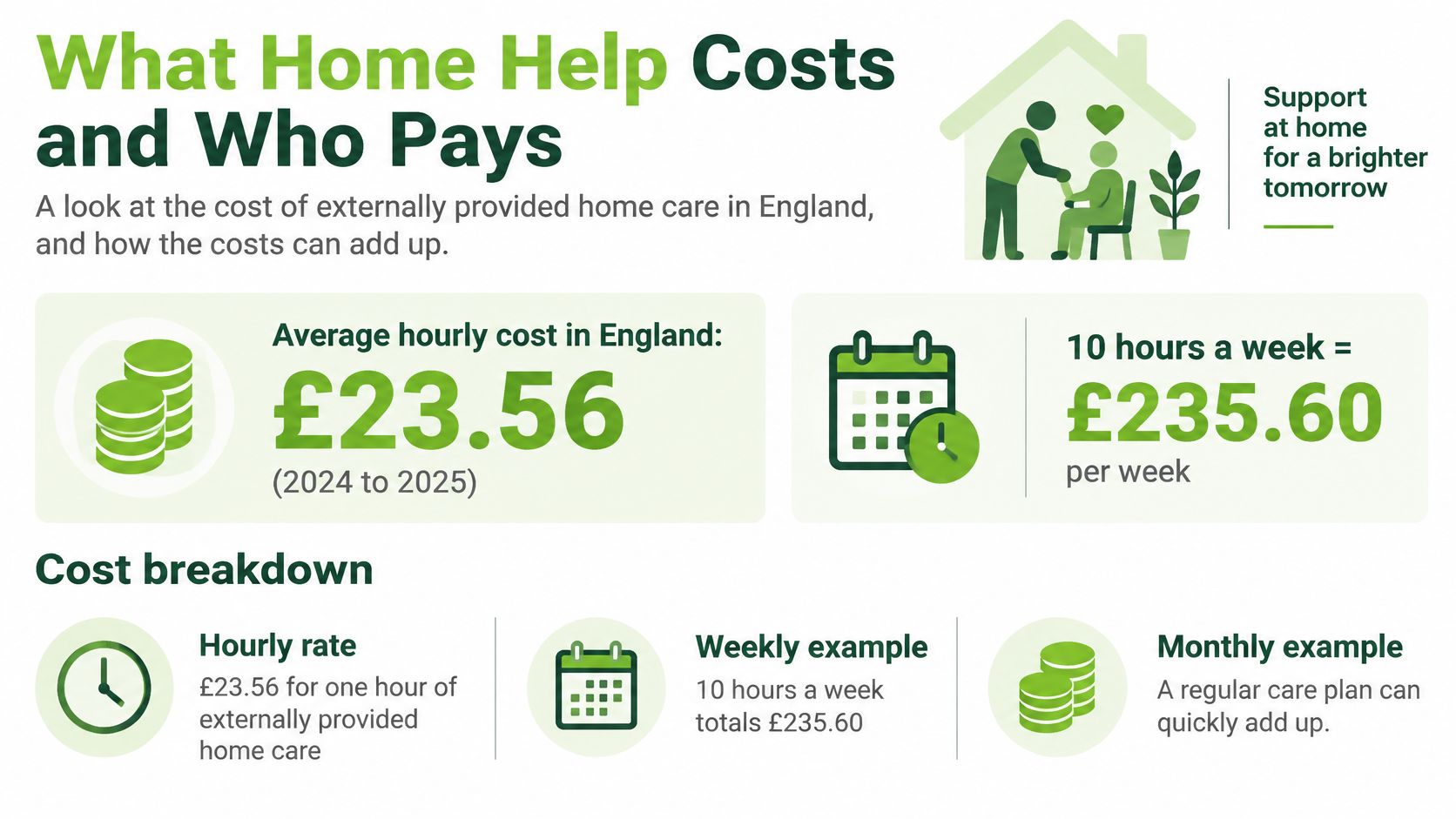
Start with the figure that anchors every budget. In the 2024 to 2025 financial year, the average cost of one hour of externally provided home care in England was £23.56, according to the Department of Health and Social Care adult social care finance report.
That rate scales quickly once you match it to a weekly routine. Covering the morning routine for five hours a week comes to £117.80. Add help with lunch and evening settling and ten hours reaches £235.60, while twenty hours, close to full daily coverage, reaches £471.20. All of that is before extra visits for illness, appointments or a bad week, and families tend to underestimate those extras rather than the hourly rate itself.
How savings change what you pay
A published local-authority explanation of the national approach, from Barnsley Council's guide to adult social care financial assessments, sets out the thresholds in this way.
| Savings and investments | Contribution towards care |
|---|---|
| Up to £14,250 | Not counted |
| £14,250 to £23,250 | £1 per week for every £250 above £14,250 |
| Above £23,250 | Usually the full cost of care and support |
Treat those as guide thresholds rather than a quotation. The final calculation also weighs income, allowable expenses, housing circumstances, and whether support is delivered at home or in a care home.
Two benefits are worth checking before any figure is agreed. Attendance Allowance and Personal Independence Payment follow their own eligibility rules, which differ from the council's financial assessment, so check entitlement for each separately rather than assuming one assessment covers everything.
A budgeting method that survives real life
Multiply the weekly hours you think you need by the hourly rate, then add a buffer for one or two extra visits a week, because the weeks when care doubles are exactly the weeks you can't plan for. Ask the council for a written financial assessment before committing to a regular schedule. When you want the figures worked through in more detail, our guide to how much in-home care costs is the place to look next.
How Respite Care Gives Families a Planned Break
Respite gets described as an emergency measure, and treating it that way guarantees it arrives too late, after the carer has already collapsed or cancelled something they can't get back.
The Survey of Adult Carers in England 2025 to 2026 shows how thin the support can be. Among the cared-for people represented, 38.7% had dementia and 49.5% had a physical disability, yet 25.6% of adult carers, 79,930 people, reported receiving no local-authority support or services in the previous 12 months.
Two forms, one purpose
In-home respite brings a carer into the house so the family carer can attend a hospital appointment, work a shift, sleep properly or take a booked holiday while routines stay where they are. Short stays move the person to a residential or day setting for a defined period. Both work best when arranged weeks ahead, because the person being cared for adjusts badly to sudden changes in who helps them and when.
In Staffordshire, a Carer's Assessment can examine how caring affects the carer's well-being and whether a break would help, and Staffordshire County Council states it can also consider what support the cared-for person needs while the carer is away. The cared-for person may be eligible if they live in Staffordshire and have eligible care and support needs under the Care Act 2014, and a financial contribution may apply, so a financial assessment may be needed (Staffordshire County Council on carers' breaks and respite).
Check the boundary first. Stoke-on-Trent is a separate council area from Staffordshire, so confirm which authority is responsible before relying on another area's eligibility conditions.
Four practical questions decide whether a respite arrangement holds up. How far ahead can visits be booked, and can they repeat weekly rather than once? How are routines, medication prompts and mobility risks handed over and recorded? Can you book a short trial visit before committing? And who do you ring if the carer is late?
Cream Home Care provides flexible, personalised respite care in Stoke-on-Trent and Newcastle-under-Lyme, treating it as reliable short-term care that keeps quality consistent while the family carer steps away. More detail sits in this guide to respite care for carers.
Enquiry Steps and Your First Call
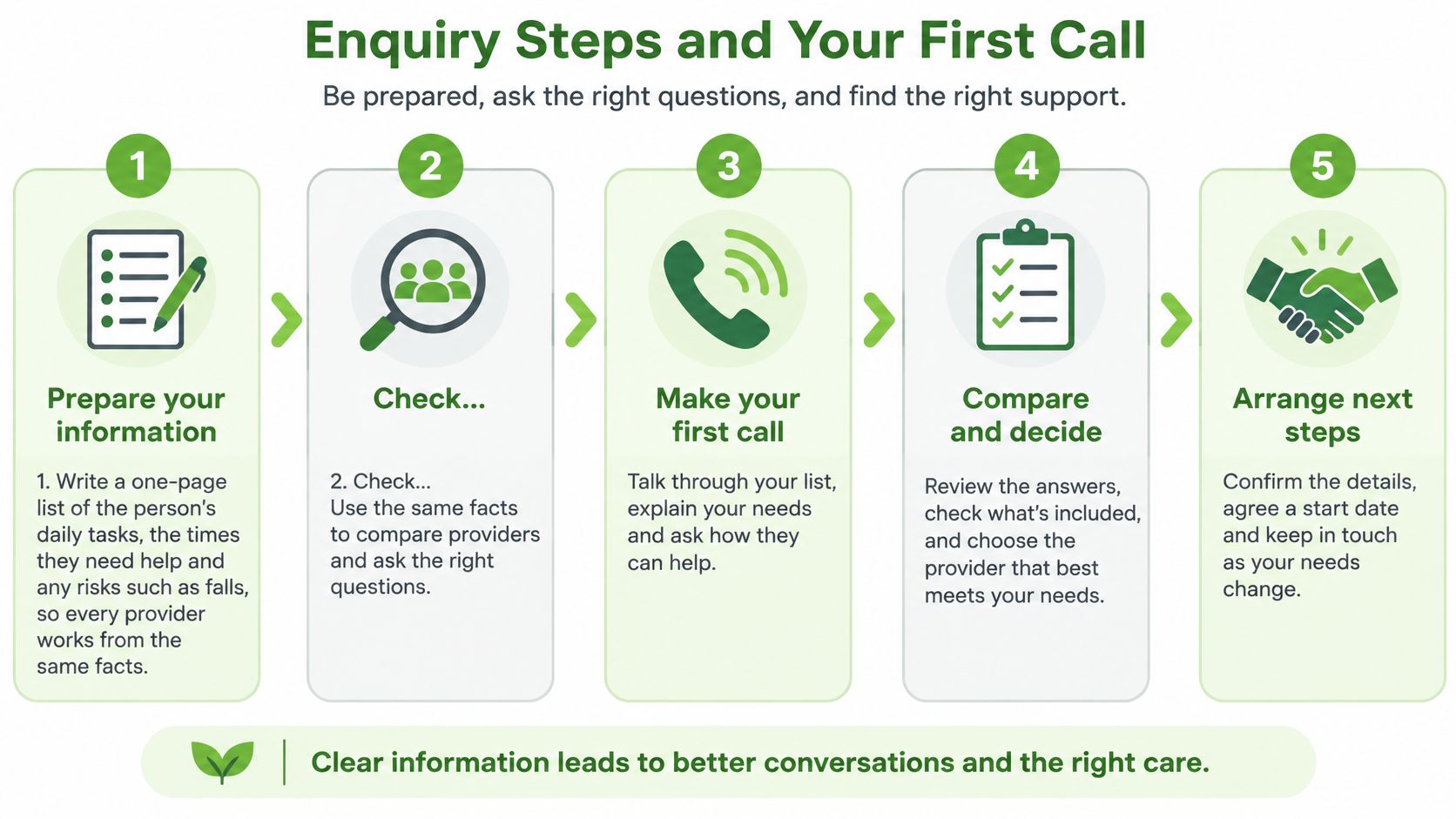
The first call goes better with a page of notes in front of you. Six steps, in order.
- Write a one-page list. Daily tasks, the times help is needed, and risks such as falls or a cooker left on. Every provider then works from the same facts instead of a different version of the story.
- Check the funding route. Has a council needs assessment been done or requested? The answer decides whether you're comparing private quotes or a care plan with a contribution attached.
- Shortlist two or three providers who cover your postcode. Boundaries matter around Stoke-on-Trent and Newcastle-under-Lyme, and a company fifteen miles away may not reach a rural village.
- Ask how carers are matched to the person. Temperament decides whether care settles, so mention whether your relative is quiet, chatty, tidy or particular about routine. We match clients with caregivers whose personalities and skills align with their needs.
- Request a written care plan listing each task, the length of each visit and a named contact. Families often agree hours without checking visit length, and personal care ends up rushed into thirty minutes that needed forty-five.
- Agree a trial period and a review date. A trial shows whether the match works before you commit to a monthly rhythm, and a review date forces the conversation while it's still easy.
When the shortlist feels impossible to rank, this guide to how to choose a home care provider sets out what to compare side by side, from visit length to how changes are recorded.
Some enquiries can't wait. After a hospital discharge, raise the need with the discharge team and the council the same day, because structured support at that point changes outcomes. NHS England's adult social care outcomes framework reported that 83.8% of older service users aged 65 and over were still at home 91 days after discharge into reablement or rehabilitation in 2023 to 2024, up from 82.3% the year before.
A planned need is different. It can wait for a written assessment and a written cost, and you should hold your decision until both are in your hand. A good first call ends with three things: a clear answer on availability, a named contact, and a date for an assessment visit.
Our care team is on 01782 444007 and can answer those questions directly, or you can start by filling in the simple contact form if writing suits you better. Before you ring, answer one last question. Which single daily task would you most like someone else to take on this month? Let that answer set the agenda.
Cream Home Care builds care plans around the routines that matter to you, from personal care and medication reminders to companionship and planned respite, across Stoke-on-Trent, Newcastle-under-Lyme and North Staffordshire. If the search that brought you here started with a difficult Sunday, the next step is a conversation about what a typical week looks like. Visit Cream Home Care to arrange an assessment and see what support could look like in your family's week.