Almost half of older unpaid carers in England and Wales provided more than 50 hours of care a week in 2021, according to the Office for National Statistics' profile of the older population. For couples, that raises a question families can miss: who's looking after the person doing the caring?
Home care for elderly couples works best when both partners are understood as people with needs, preferences and limits. The aim isn't to add help for the person who appears more frail. It's to keep their shared household working without asking either partner to sacrifice their own health.
Why Couples Need Support in Their Own Home
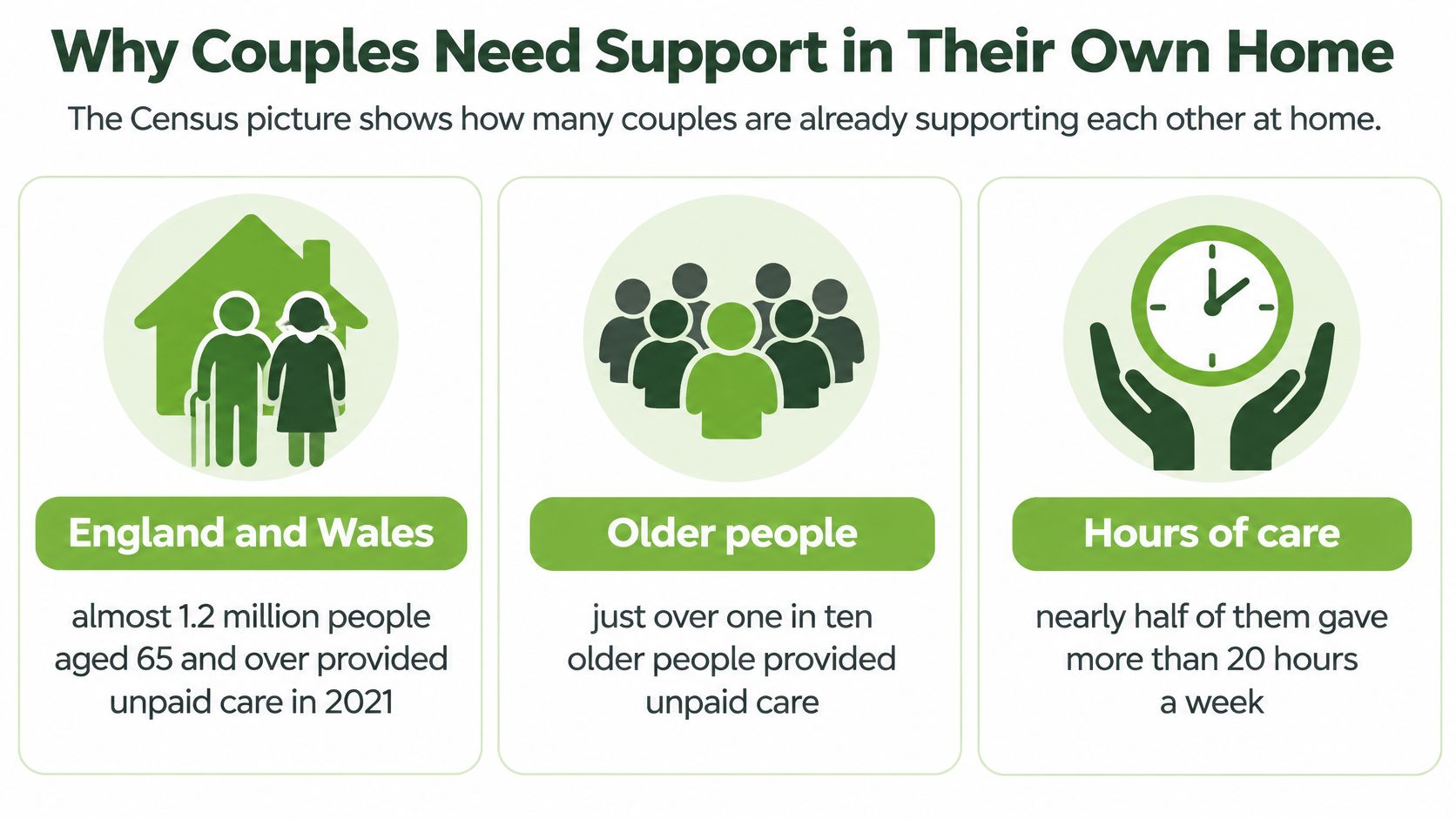
The Census picture includes almost 1.2 million people aged 65 and over providing unpaid care in England and Wales in 2021, just over one in ten older people. Unpaid care means help because of long-term physical or mental health conditions, illness, disability or needs associated with old age, rather than paid employment.
That count doesn't separate support for a spouse at home from care given elsewhere. Still, it challenges the assumption that an older person living with a partner already has all the help they need.
A household can lose its balance
Think of the couple's arrangement as a see-saw. Both carry some weight, but removing support from either end changes the balance.
Say a husband remembers his wife's tablets and prepares breakfast, while she helps him fasten buttons and keeps track of appointments. He struggles with walking; she has difficulty remembering instructions. Together, they manage, until an infection leaves him unable to get out of bed.
Calling him the carer and her the client would miss half the problem. She now needs breakfast and medicine prompts, while he needs personal care and rest.
Practical rule: Ask what each partner does for the other, not just what each person can do alone.
Timed help with washing, dressing, meals, medicines and housework can preserve the rhythm of their day. It also leaves room for being partners rather than spending every interaction giving or receiving care.
Support should fit the tasks that are becoming unsafe, not take over everything. Choosing suitable services, agreeing a joint plan, understanding funding in pounds and preparing for changes after hospital all start with that distinction.
Services That Keep Both Partners at Home
Home care services for a couple
| Service | What it covers for both partners | Usual pattern | Best fit |
|---|---|---|---|
| Joint care plan | Shared routines, risks and a written backup if one partner cannot cope | Reviewed after falls, illness, medicine changes or discharge | Needs are linked and change together |
| Companionship | Conversation, shared meals, outings and company against loneliness | Short regular visits | Isolation or low mood is the main gap |
| Personal care | Washing, dressing, continence and safe transfers for one or both | Morning and evening, matched to habits | Either partner cannot manage safely alone |
| Medication support | Prompts, administration records, side-effect notes and GP or pharmacist liaison | Aligned to dose times | Complex, confusing or sedating regimens |
| Respite | Planned or emergency cover so the partner-carer can rest | Hours, overnight or a short block | The caring partner is exhausted or unwell |
| Household and appointment support | Meals, laundry, shopping and transport to clinics | Alongside personal care or on its own | Daily logistics are slipping |
Couple-centred care means a coordinated household plan, with each person's needs and consent recorded individually. It shouldn't mean treating partners as interchangeable or assuming they want identical support.
In England, long-term local-authority-arranged or provided community support rose from 470,000 people on 30 April 2025 to 490,000 on 31 March 2026, approximately 4.3%, with community services driving overall growth, according to the Department of Health and Social Care's quarterly update. Community support includes more than domiciliary visits, and these figures don't count couples separately.
Match the service to the gap
A joint care plan connects routines and risks. Its backup arrangements should identify what happens if the partner who normally helps is admitted to hospital.
Companionship suits a household where conversation, confidence or getting outdoors has become difficult. A shared lunch or supported outing serves a different purpose from hands-on care, so explain which gap matters most.
Personal care needs enough time for each person's washing, dressing, continence support and safe movement. A morning visit shouldn't require someone to abandon their preferred routine just because their partner gets up earlier.
Medication support can include reminders or agreed administration by appropriately trained staff. Keep a separate, clearly identified list for each partner, record concerns and contact the GP or pharmacist about side effects. Carers must never independently stop a prescription.
Support beyond hands-on care
Respite gives the caring partner protected time to sleep, attend an appointment or recover. Household and appointment support addresses the practical backlog, such as laundry, shopping, preparing food and getting to clinics.
Equipment can complement those visits. Our guide to daily living aids for elderly people can help identify tasks worth discussing during assessment. For seating decisions, Willis Furniture & Mattress's guide to choosing a supportive lift recliner offers useful questions, although chair fit and safe transfers still need individual consideration.
Tick the table rows that match your household. A visit may cover several needs, but it must allow enough time and the right staffing for both people.
How to Build a Couple Centred Care Plan
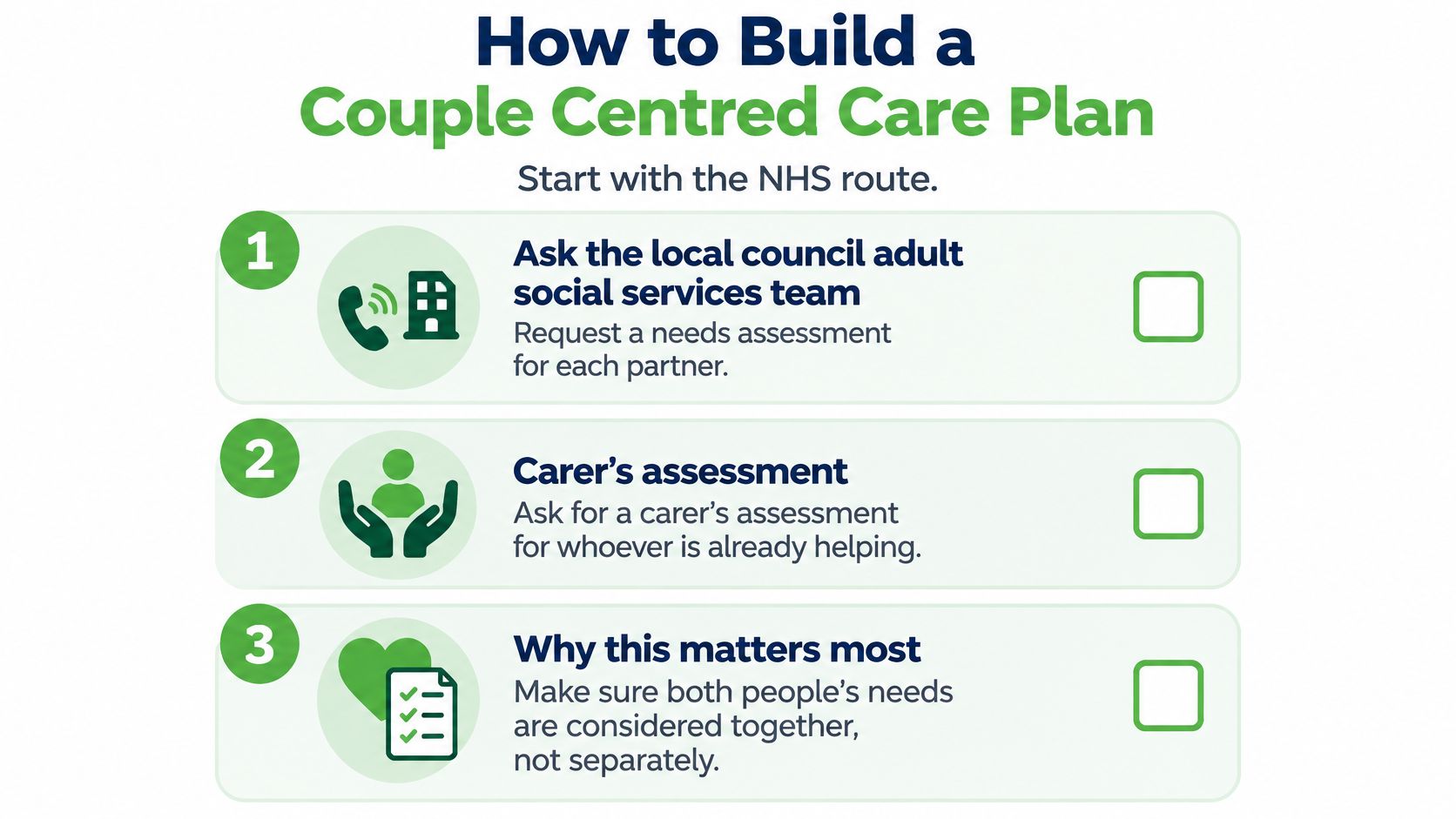
Start with the council, not an agency shortlist. In England, NHS guidance on support at home advises contacting the local council's adult social services department for a home assessment.
Request a needs assessment for each partner, and ask for a carer's assessment for whoever already provides unpaid help. Explain any new diagnosis, reduced mobility or recent hospital stay, rather than describing only the household's best days.
Record abilities as well as difficulties
Assessments consider personal care, mobility, everyday tasks and the effect of caring responsibilities. Prepare a household checklist so the quieter partner's needs aren't lost.
List what each person can still do safely. Include walking, stairs, remembering instructions, continence, cooking and night-time needs. Distinguish doing something independently from managing only because a spouse is supervising.
Identify tasks that need paid support. Be direct about lifting, transfers or confusing medicine routines. Being less visibly frail doesn't make someone able to provide safe physical assistance.
Write down medicines accurately. Record prescribed doses, times and who prompts or administers them. Use current prescription information and raise discrepancies with the pharmacist rather than guessing.
Build visits around the actual day. Note getting-up times, meals, rest and bedtime. If one person rises early and the other sleeps later, explain the trade-off between a shared visit and separate calls.
Protect privacy and prepare for change
Agree how personal care should happen. Ask each partner privately about preferences, including same-gender carers and whether they want assistance separately. Marriage doesn't remove anyone's right to dignity or consent.
Name the contingency arrangements. Write down who contacts the care team if the usual helper becomes unwell, who holds access information and which tasks cannot wait until morning.
Set review triggers. A fall, discharge, medicine change or reduction in the caring partner's stamina should prompt a fresh look at the arrangement. Don't leave an outdated plan in place because the next scheduled review feels far away.
Independence can mean choosing reliable help, not completing every task without it.
Ask for a copy of the plan that both partners can understand. It should distinguish shared preferences from individual instructions, especially where medicines, moving and handling, or personal care are concerned.
The council assessment helps clarify available support and any funding process. Couples paying privately can still use the same household approach, with separate needs recorded within a coordinated plan.
Funding Routes and Provider Checks
Ways to fund home care for a couple
| Route | Who it suits | How the money works | Means-tested |
|---|---|---|---|
| Self-funded private care | Couples wanting hours now or above what the council will fund | Hourly fees in £ paid to the provider; check premiums for evenings and short visits | No |
| Local authority care | Eligible needs after a Care Act assessment | Council arranges support; a financial assessment sets any contribution | Yes, for the contribution |
| Direct payment | Eligible people who want to choose their own provider | A cash personal budget used to contract care | Yes, same financial assessment |
| Attendance Allowance | People over State Pension age with personal-care or supervision needs | Non-means-tested DWP benefit at a lower or higher rate | No |
| NHS continuing healthcare | A primary health need, not ordinary frailty alone | NHS funds the agreed package | No |
| Carer's assessment and respite | The partner already giving unpaid care | Breaks or support arranged through the council | Ask whether the particular service carries an assessed charge |
Couples may combine funding routes, such as council-arranged support alongside privately purchased visits. Keep the distinction between eligibility for care, the contribution towards it and benefit entitlement clear when speaking to the council.
Attendance Allowance can be spent as the recipient chooses; it isn't a package of allocated care visits. NHS continuing healthcare involves a separate assessment of health needs, so don't assume that needing substantial everyday help automatically qualifies someone.
Compare the whole written quote
For private care, request the hourly rate in pounds (£), minimum visit length, travel charges and bank-holiday terms. Ask how evenings, weekends and short calls are priced, rather than assuming the headline rate applies throughout.
Compare several written quotes against the same tasks and schedule. A cheaper call isn't equivalent if it leaves insufficient time to help both partners without rushing.
Make the charging arrangement explicit: does the quote cover assistance for both people, and would a task requiring additional staff change the price? Don't assume that sharing an address guarantees either a discount or two full charges.
Check the people and the backup
Use these checks alongside our guide to how to choose a home care provider:
- Registration: Check the relevant Care Quality Commission registration and published inspection information.
- Training: Confirm staff can carry out the specific agreed tasks.
- Responsibility: Identify who builds the plan and receives concerns.
- Compatibility: Consider personality, communication and each partner's preferences.
- Sickness cover: Get a written explanation of how missed or disrupted calls are handled.
- Communication: Agree how changes reach the couple and, with consent, their family.
Our team includes trained carers, and we match people with carers whose skills and personalities align with their needs. Ask during assessment how continuity could work across both routines, without assuming that the same member of staff will always be available.
Coming Home After a Hospital Stay
Discharge can unsettle the whole household. The returning patient may need help dressing, while their spouse suddenly loses the person who usually cooks or remembers appointments.
A rapid review hosted by the University of Warwick examines spouses and mutual caring, an important reminder that the person waiting at home may also need support. Don't let their familiar presence stand in for an assessment of what they can safely do.
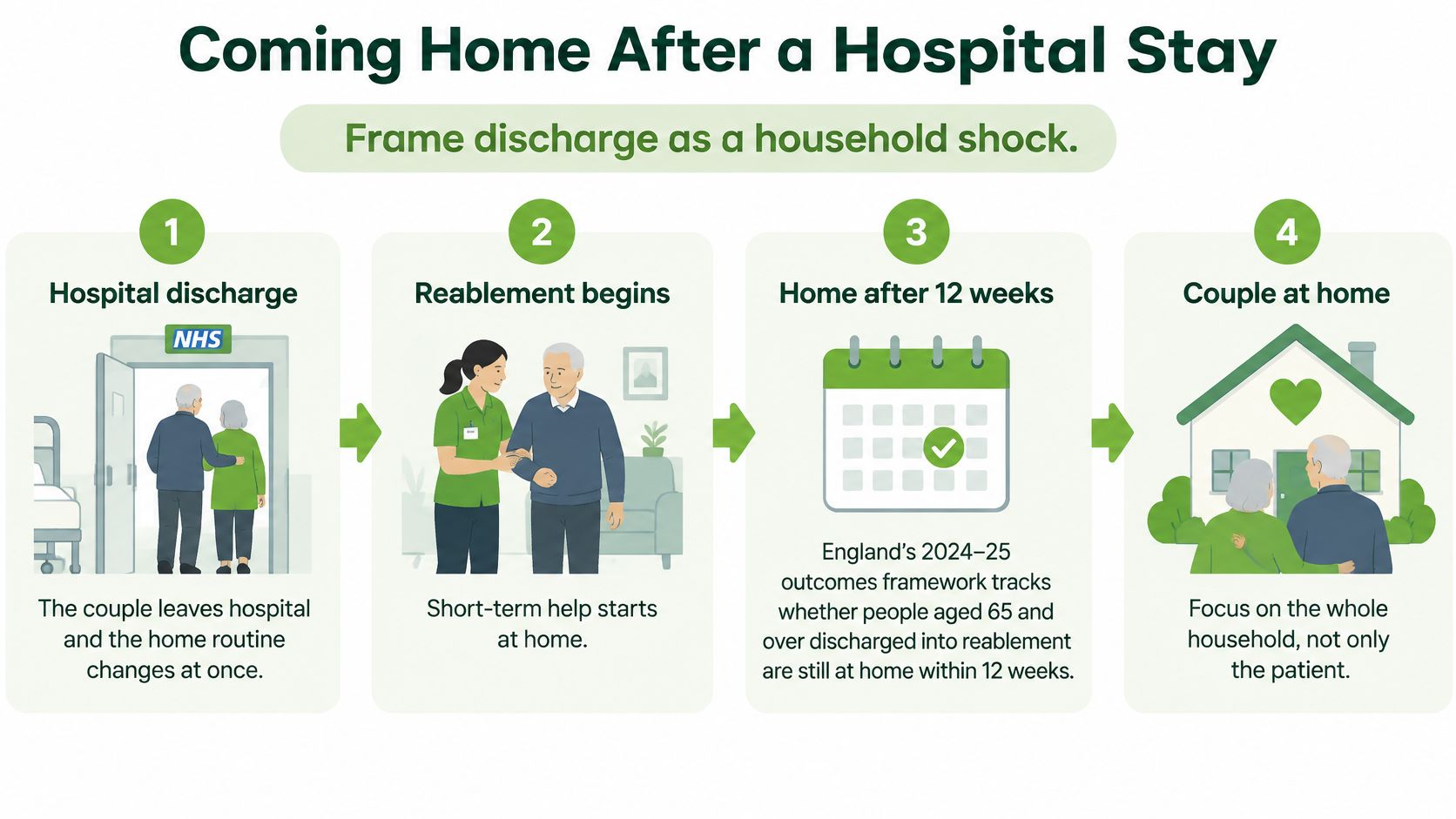
England's 2024–25 outcomes framework tracks whether people aged 65 and over discharged into reablement remain in the community within 12 weeks, as explained in the framework's data sources and uses. Recovery is a transition, not a completed decision at the hospital door.
Prepare the household before arrival
Ask staff to consider both partners. Tell the ward and council what the patient normally does for their spouse. That lost contribution belongs in discharge planning.
Confirm the first evening's arrangements. Name who will handle new medicines, food and overnight help. Check that instructions are understood, not merely handed over in a bag of paperwork.
Arrange interim support before leaving. Confirm visits or reablement, access to the property and required equipment before the journey home. Use our hospital discharge care plan guide to prepare questions while arrangements are being discussed.
Walk through falls and night-time risks. Check lighting, clear routes and suitable footwear. Don't assume a spouse can safely help with a toilet transfer because they managed before admission.
Protect the partner's rest. Arrange respite or additional help before the returning patient's needs consume every evening. Ask what the spouse can realistically sustain while managing their own health.
Set a recovery review. Adjust visits as strength, confidence and mobility change. Temporary help shouldn't become a rigid arrangement that no longer fits.
Keep the outcome in view
In England during 2024–25, 60.3% of people aged 65 and over receiving long-term support continued living at home or with family, according to the Department of Health and Social Care's outcomes commentary.
That isn't a guarantee for an individual couple. It does underline why a workable home arrangement matters: short, flexible support can give partners time to recover and make considered choices, rather than delaying help until everyone agrees a permanent plan.
Problems Couples Hit and How to Fix Them
Say Margaret prompts her husband's tablets and helps him dress, then cancels her own GP appointment because she can't leave him. The answer is to split the work, with scheduled personal care and protected respite, rather than waiting until she becomes ill.
The health burden is substantial: 48.6% of unpaid carers reported at least one adverse health effect, rising to 53.0% among women compared with 42.7% among men, with greater impact among those providing more hours, according to the Office for National Statistics' analysis of observations collected in 2015, 2017 and 2019.
When medicines and movement interact
Consider another household where both partners use walking aids and a new sleeping tablet leaves one drowsy on overnight toilet trips. Keep an identifiable medicines list for each person within the shared care record, log the unsteadiness and request a GP or pharmacist review.
In a UK study of 1,655 care-home residents with a mean age of 85, 31% fell within three months, and each additional regular medicine was associated with higher fall odds, according to the published multicentre study. These aren't private-home fall rates, but they support taking medicine-related unsteadiness seriously rather than treating it as inevitable ageing.
Carers mustn't alter prescriptions themselves. If dose times clash with visits, ask the pharmacist or prescriber whether they can safely be aligned.
When help feels like losing privacy
A couple might resist visits because they fear becoming patients in their own sitting room. Start with an agreed shared meal or companionship, and explain which practical task would give them more uninterrupted time together.
Consistency matters particularly for intimate care. Agree who enters the room, how privacy is protected and how either partner can raise discomfort.
Couple care problems and fixes
| Problem | Why it happens | What to change |
|---|---|---|
| The healthier partner is exhausted | They have absorbed medicines, meals and transfers | Move those tasks onto scheduled visits and add respite |
| A new fall or dizziness | Extra or sedating medicines plus a cluttered route | Log side effects, request a medication review and clear walking routes |
| Night-time panic | One partner cannot manage a toilet trip alone | Add an evening or night check and a written escalation plan |
| Care feels like an intrusion | Help was planned around illness, not the marriage | Start with companionship and seek consistent carers |
| The plan goes stale | Recovery, a fall or a hospital stay changed both people | Review after every fall, discharge or stamina drop |
Seating belongs in an environmental check too. Meliusly's discussion of firm cushions for easier standing offers considerations to discuss, but don't add a cushion without checking seat height, stability and foot placement.
A plan that describes only the more frail partner will keep overlooking the other person's limits.
Common Questions About Joint Home Care
Can both partners be supported at the same time?
Yes, when the visit is planned and staffed appropriately. Each person needs their own assessment, even where some activities can share a visit. Ask for a coordinated schedule that allows personal care to happen separately when privacy or safety requires it.
Do we pay twice?
Not automatically. Private charges reflect the agreed work, time and staffing, while council contributions follow individual assessment arrangements. Ask the council how each spouse's income and savings are treated, and request a written explanation before assuming that living together doubles the bill.
Can carers give medicines?
They can provide agreed medication support within their training and care plan. This may include prompts, administration, records and reporting side effects. They don't change prescriptions or stop medicines independently; ask during assessment exactly which level of support is needed and who has responsibility for it.
What if one partner later needs a care home?
Ask about options early, without assuming separation is unavoidable or that a joint placement is guaranteed. Discuss whether a suitable setting could accommodate both partners, including where their support needs differ. Update both assessments so decisions account for the person staying at home as well as the person who may move.
For each question, the useful starting point is the same: make the request about both people's assessed needs, not a service labelled for couples.
Arrange the First Joint Assessment
Book an assessment of both partners this week, rather than waiting for the next fall or cancelled appointment. Choose the service rows that describe the actual gaps in your household, including work that a spouse currently manages only through exhaustion.
You don't need a perfect account of everything before making contact. A clear description of an ordinary morning, a difficult evening and what happens overnight is more useful than saying that everyone is coping.
Prepare for the conversation
Have these details ready where possible:
- Daily routines: Note when each partner gets up, eats, rests and goes to bed.
- Current medicines: Gather clearly labelled lists for both people.
- Recent changes: Include discharge notes and changes in walking, memory or confidence.
- Tasks to hand over: Identify the jobs the family most wants taken off the caring partner.
- Individual wishes: Record what each person wants to keep doing and what help they would accept.
Families and social workers should ask how visits could cover both people without rushing, and how respite would be arranged if the partner-carer became unwell. With the couple's permission, agree who should join that first conversation.
For couples in Stoke-on-Trent, Newcastle-under-Lyme and North Staffordshire, Cream Home Care offers a local way to begin. You can call our care team on 01782 444007 and explain that you want both partners considered.
The aim isn't to replace the marriage with a timetable. It's to remove unsafe or exhausting responsibilities so both people have a better chance of remaining safely in the home they share.
Cream Home Care offers home care, companionship, domiciliary care, respite care and elderly care shaped around individual needs and routines. Visit Cream Home Care and use the contact form to request a joint assessment, describing what each partner needs and which caring tasks have become difficult.