The usual advice about preparing for home care starts with clearing clutter and booking visits. Those tasks matter, but they don't answer the most important question: can the person manage safely between visits, and who will act if the plan fails? Going home, or remaining at home, isn't the same as being ready for care.
A workable plan joins together the person's wishes, practical help, equipment, medicines and the unpaid carer's capacity. Its real test is what happens during the first 72 hours, including overnight and while promised support is still pending.
A Home Care Preparation Timeline You Can Use Today
Home is not automatically safe because support has been arranged. Use this timeline to check who is responsible for each task and whether the plan can work during the first 72 hours, including any time before promised support begins.
| When | What to complete | Who leads | Done when |
|---|---|---|---|
| As soon as need appears | Independence notes, preferred routines, emergency contacts, GP and pharmacy | Family with the person | A one-page summary is written |
| Hospital stay or likely council support | Goals, mobility, cognition, medicines, home layout and carer capacity; tell the local authority | Ward team and family | The council is notified before discharge |
| Week before the first visit | Consent, clear routes, equipment in place, medicines reconciled | Family and care provider | Aids are usable and medicines are in the home |
| Day support starts | Named carer, visit time, tasks in and out of scope | Care provider | The first visit is confirmed in writing |
| First 72 hours | Food, medicines, transfers, continence and overnight escalation | Family plus provider | Problems are logged and a named contact has been tried |
| Planned review | What changed after illness, discharge or a missed visit | Council or provider | A review date is in the diary |
Start with what the person can do
For each everyday activity, record independent, needs prompting or needs hands-on help. Cover washing, dressing, eating, using the toilet, moving around, shopping and household tasks. “Needs help with meals” is too broad if the difficulty is opening packaging or remembering to eat.
Keep established routines visible. Someone may dress independently when clothes are laid out, but struggle when rushed or offered too many choices. Note communication preferences, consent arrangements, falls concerns and the best person to contact. The same planning approach can support frailty, disability, illness or recovery, with details adapted to the individual.
Give each stage a clear finish
During a hospital stay, describe likely needs without assuming that someone's condition on the ward reflects their lasting abilities. Before visits start, ask the provider to confirm the tasks it has accepted and anything it cannot safely provide.
If memory difficulties affect the plan, families can compare home dementia care options before discussing the level of supervision and continuity needed.
Treat each completed row as evidence, not reassurance. Equipment ordered is not equipment available, and a telephone discussion is not a confirmed visit. Keep unresolved tasks visible so everyone knows what remains to be done.
How to Arrange the Needs Assessment and Paperwork
Start with the person's needs, not their bank balance. A needs assessment and a financial assessment serve different purposes, and confusing them can discourage families from asking for help.
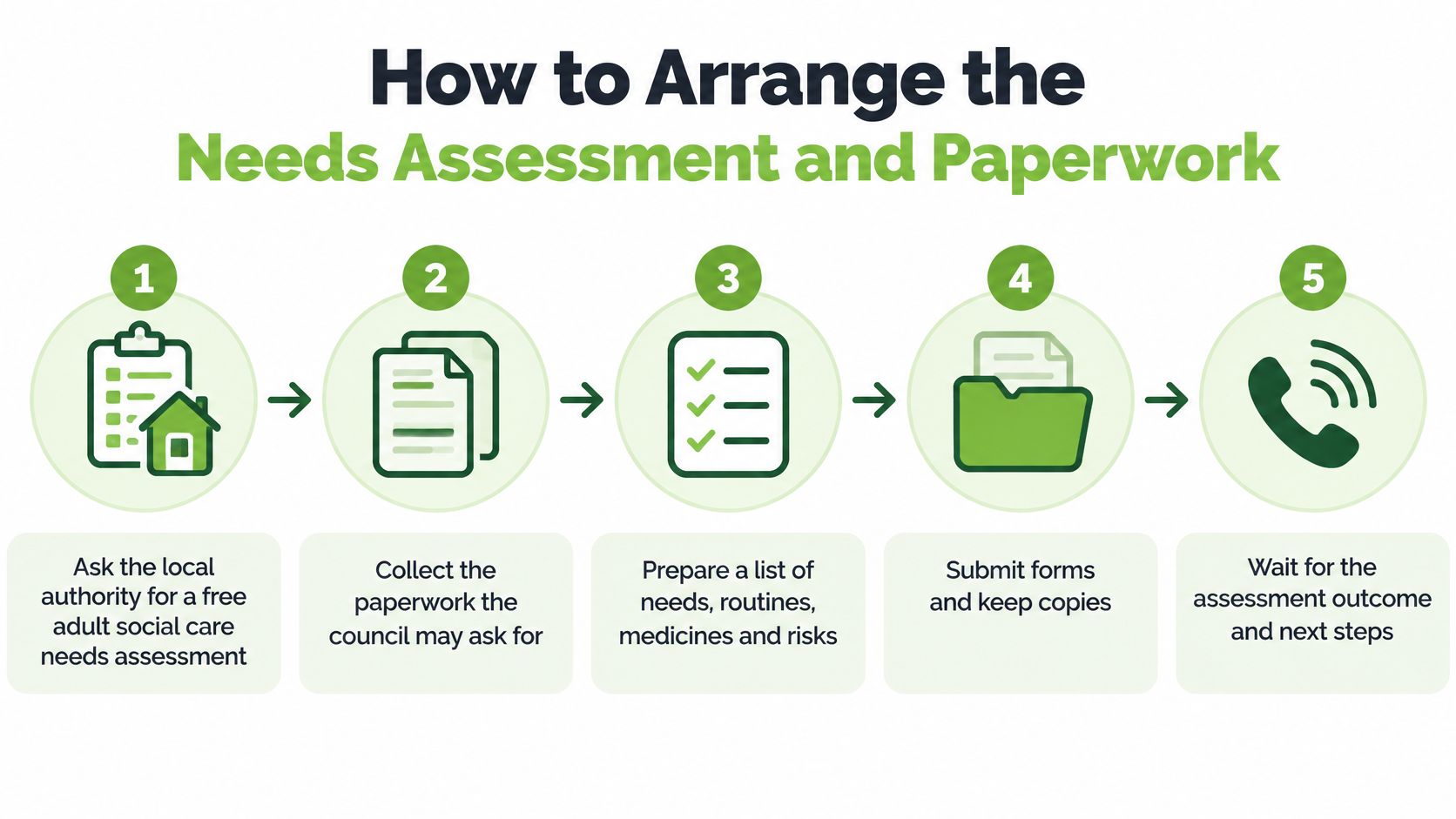
Build the paperwork in a useful order
Request the assessment and keep the acknowledgement. In England, anyone who appears to need care and support can request a free adult social care needs assessment, regardless of their finances or apparent level of need, as explained in Cornwall Council's needs assessment guidance. Contact the adult social care department where the person lives. Ask for confirmation that the request has been received and record the contact's name.
Prepare examples rather than a list of diagnoses. Write down difficulties with washing, dressing, eating safely, moving around the home and household tasks. Include keeping in touch with friends and family and getting to community activities. For example, “cannot stand long enough to prepare lunch” explains a support need more clearly than “has arthritis”. Note what relatives already do, including help the person might otherwise forget to mention.
Arrange someone to attend. Ask whether a family carer or independent advocate can join the assessment. Give that person a copy of the needs summary beforehand, with the individual's agreement. Their role is to help explain what happens on difficult days, not to answer every question on the person's behalf.
Check the written support plan. Look for the help being arranged, who will provide it, when it starts, visit frequency and a review date. Ask how essential tasks will fit into the proposed visits. If the plan says “personal care”, clarify whether that means washing at the basin, showering, dressing or help with continence.
Separate funding from permission
Prepare financial information when eligible needs have been identified. Gather income, savings, benefits, housing costs and details of existing support, recording amounts in pounds (£). Kent County Council's assessment guidance distinguishes the needs assessment from the financial assessment and explains that a GP, carer or social-services professional can request an assessment on someone's behalf. Ask which documents the council needs rather than sending sensitive records unnecessarily.
Record consent and keep copies. Agree who may receive medical information, visit notes and the care summary. Use the provider's or council's consent process and keep the completed record with the plan. If the person cannot make a particular decision, ask the professionals involved how it should be handled rather than assuming a relative can sign for them.
Keep forms, acknowledgements and decisions together in a folder, with a dated note of telephone conversations. A verbal promise on the ward isn't a start date: ask who has accepted the referral and when support will begin.
Get the Home Equipment and Medicines Ready
Walk through the home using the route the person and carer will take. A tidy sitting room doesn't compensate for a blocked toilet doorway or a bed that nobody can safely help someone get out of.
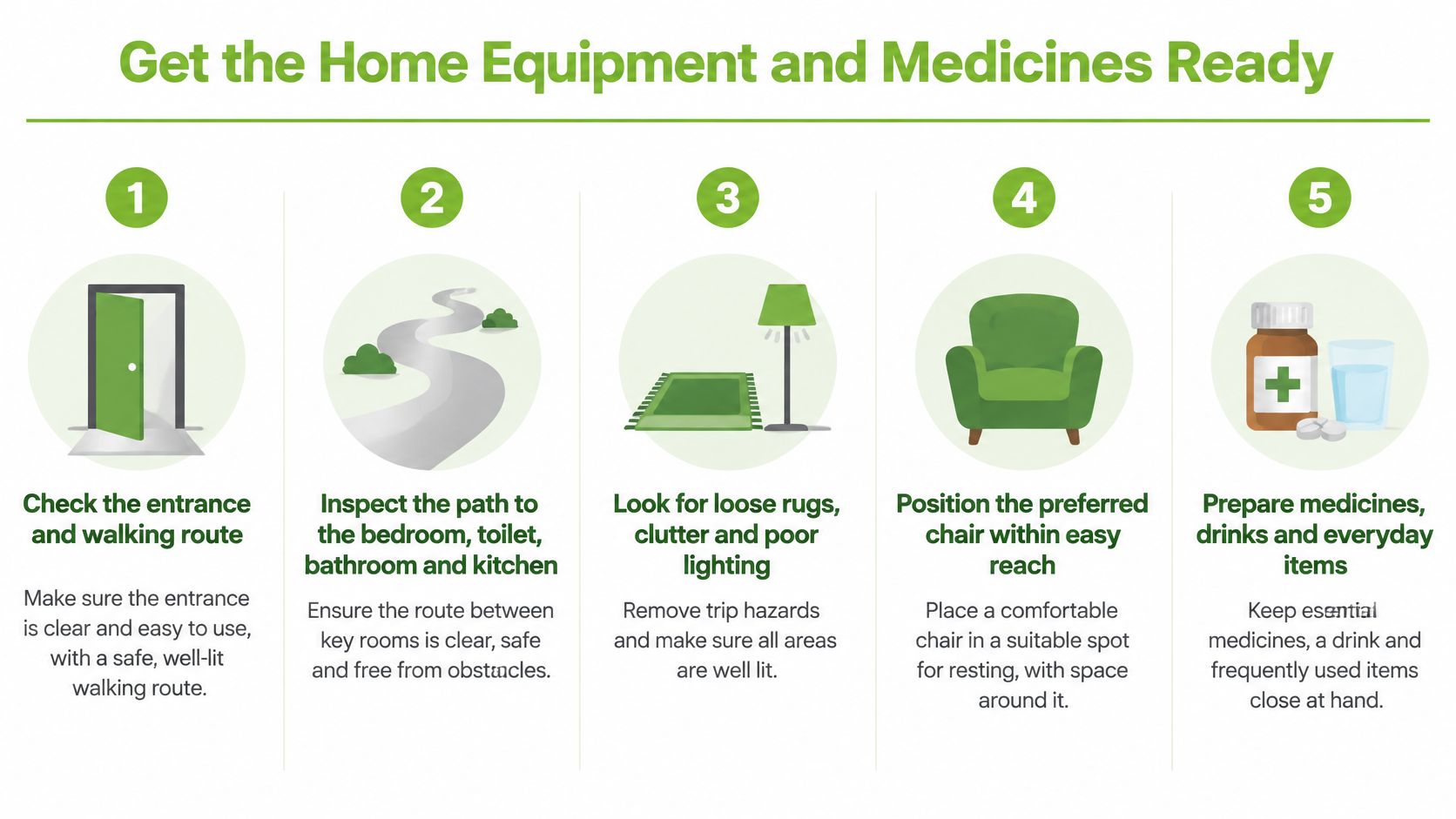
Follow the route from the front door
Check access and movement. Start at the entrance, then follow the route to the bedroom, toilet, bathroom, kitchen and preferred chair. Remove loose rugs and trailing cables, improve poor lighting and move furniture that narrows the route. Check that the person can reach a light switch and telephone without an unsafe stretch.
Request an occupational therapy assessment when mobility changes. Don't guess whether a different chair or toilet aid will solve the problem. Harrow Council's adult social care guidance describes assessments involving everyday activities such as making a drink, getting in and out of bed or a chair, dressing, using the toilet and washing. Watching these tasks helps identify what assistance or adaptations are needed.
Confirm prescribed equipment is usable. Check delivery and fitting of any grab rails, shower seat, raised toilet equipment, walking frame or hospital bed. Make sure the person and anyone helping them have been shown how to use it. The guide to daily living aids for elderly people can help you prepare questions, but equipment selection should follow the person's assessed needs.
A frame standing in the hallway doesn't prove that the person can manoeuvre it through the bathroom door. Ask the assessor or care team to check the whole task, including sitting down and standing up.
Match medicines to the current instructions
Reconcile the medicine list. Compare medicines in the home with the discharge or current GP list. Record each medicine's name, purpose, dose and timing, allergies, medicines that have stopped and who orders replacements. Ask a pharmacist or clinician to resolve discrepancies; don't decide yourself which instruction is correct.
Distinguish prompting from administration. A reminder to take a medicine isn't the same task as selecting and giving a dose. Confirm exactly what the provider is authorised and competent to do, how it will record support and who will notice a missed dose. Keep discontinued medicines separate pending advice about safe disposal.
Check that prescriptions are physically available, not merely requested. Lewisham Council's hospital discharge guidance describes a medicine supply normally covering at least two weeks, alongside follow-up information and the home-care plan; confirm the actual arrangement for the person concerned.
Avoid these common pitfalls:
- Booking care before equipment arrives. Tell the provider immediately if a missing aid prevents a planned task.
- Assuming relatives can fill every gap. Ask whether they can safely perform the task and whether they agree to do it.
- Treating reminders as administration. Get responsibilities recorded before anyone handles medicines.
Before the first unsupported period at home, complete a room-by-room tick: entrance, bedroom, toilet, bathroom, kitchen and sitting area. Check reach, lighting, equipment and the route between them.
Agree Daily Routines and How to Work with Carers
Home care is not ready just because the person is back in familiar surroundings. The day needs to work for the person receiving care and for anyone expected to help. Start with their usual getting-up time, how they prefer to wash and dress, what they eat and which activities they want to keep.
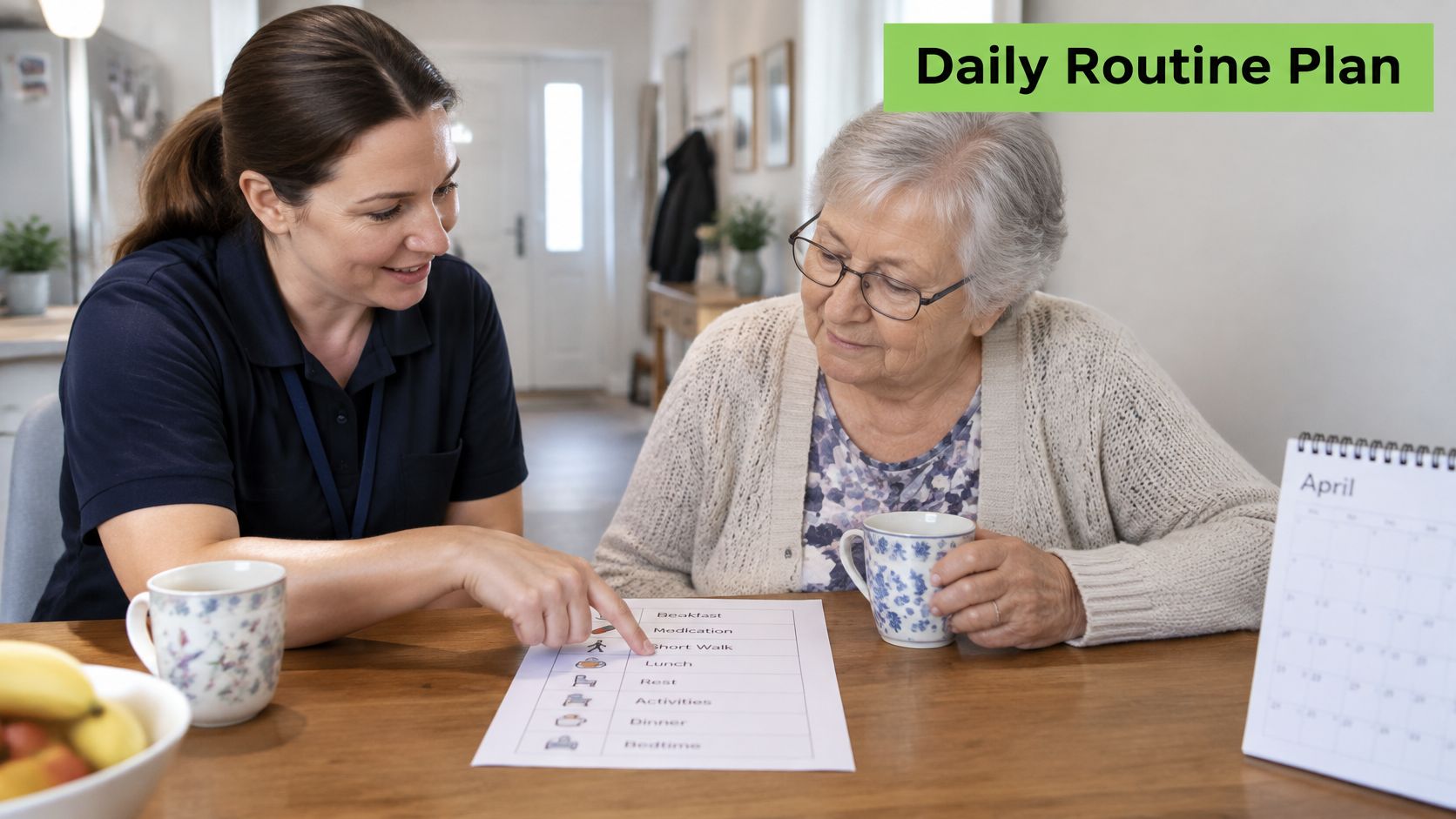
Make a routine sheet people can follow
Use a simple sheet with space for the task, the help required, who is responsible and what happens if that person is unavailable.
| Part of the day | What to record |
|---|---|
| Morning | Getting up, toilet needs, washing, dressing, breakfast and prescribed medicines |
| Midday | Lunch, drinks, movement, companionship and any shopping or household tasks |
| Evening | Meal preparation, favourite activities, changing clothes and bedtime preparation |
| Night | Toilet access, any planned support and who responds if help is needed |
For each task, mark independent, prompt or hands-on help. Include ordinary pleasures too, such as a favourite programme, a call with a grandchild or a supported walk to the front door.
Record preferred names and words, privacy arrangements and any preference about who provides intimate personal care. Arrange an introduction before the first visit, so the carer knows how the person wants support delivered. These person-centred care principles turn preferences into practical instructions.
Make family availability explicit
“Daughter helps” is not a workable rota. Check her working hours, health and willingness, then name who can cover if she is ill or away. Agree breaks before the family's capacity is stretched.
Surveys of unpaid carers in England suggest many feel included in decisions, while fewer find information easy to obtain or have as much social contact as they would like, according to the adult social care outcomes commentary. Being consulted does not by itself show that the care arrangements are clear or that the carer has enough support.
Practical rule: A relative's willingness to help today is not a commitment to provide unlimited care tomorrow.
Ask Cream Home Care to confirm how a personalised companionship, domiciliary, respite or elderly care plan will fit the person's routine, including visit times and a named route for raising concerns. Professional visits can supplement family involvement, but the routine should make clear who handles tasks between visits.
If unwanted calls unsettle the person, information about spam screening for home health patients may help when agreeing telephone arrangements. Keep a clear way for genuine carers and clinicians to make contact.
Leave a written summary in an agreed place. Include routines, communication preferences, relevant medical information, warning signs and whom to call. Make sure visiting carers know where to find it.
Handle the First 72 Hours and Plans That Slip
Coming home is not automatically safe. The first 72 hours depend on whether support is in place, what family carers can safely manage and what happens if an assessment or care package is delayed.
For hospital-to-home care, use discharge to assess: arrange safe immediate support, then assess longer-term needs as recovery becomes clearer. The hospital discharge and community support guidance recommends starting planning at admission for emergencies, or before a planned admission, and notifying the local authority as soon as social care appears likely.
Before transport is booked, confirm the first visit, medicines, usable equipment and a named contact. The written handover should say who does what, when and whom to contact. Use a hospital discharge care plan to organise any questions that remain unanswered.
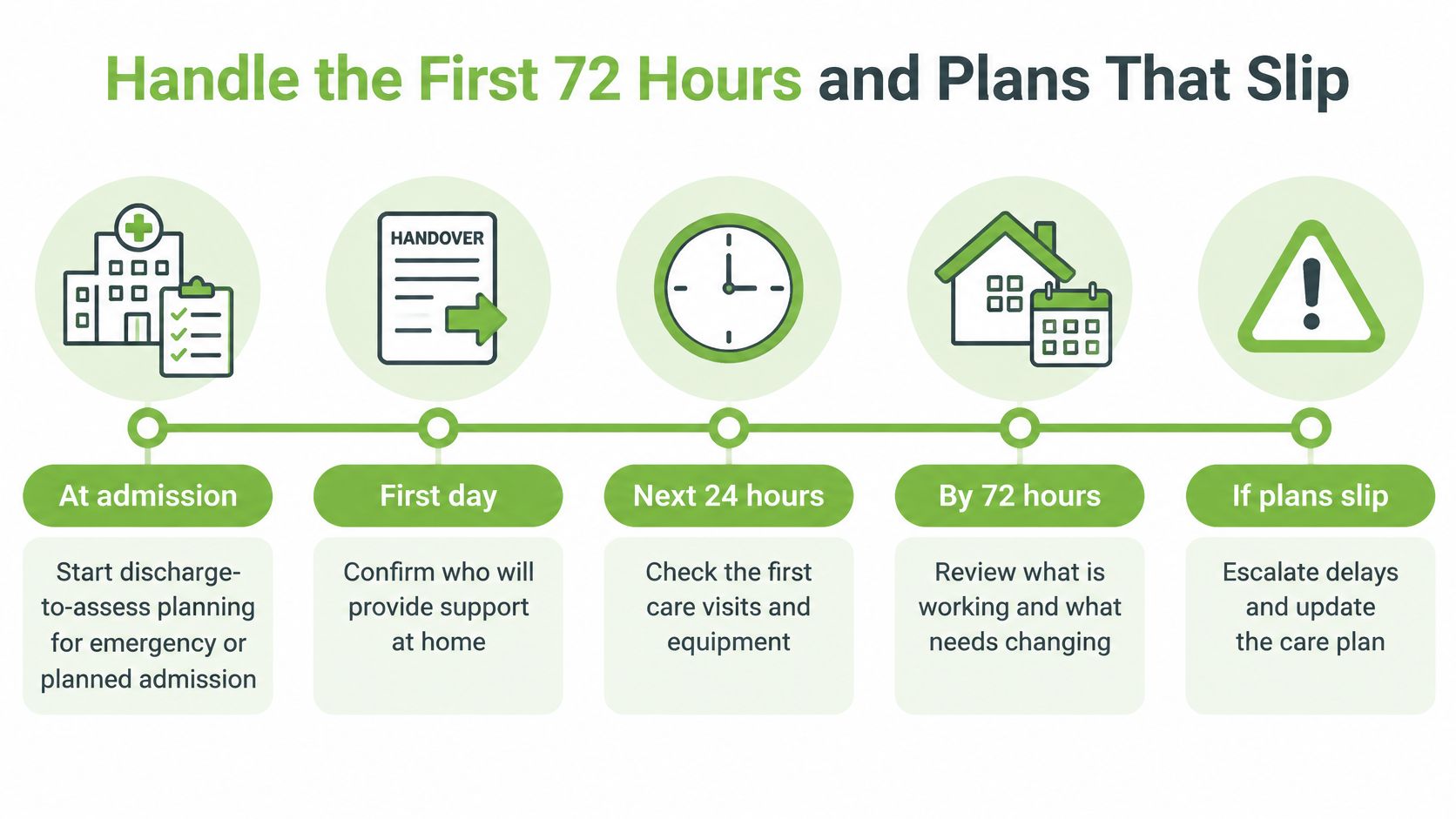
Know when to call whom
Keep this guide beside the contact sheet. Call 999 for a life-threatening emergency. Do not delay while collecting observations.
| Situation | What to check first | Who to contact | Do not wait if |
|---|---|---|---|
| Care visit does not arrive | Written time, backup carer and whether equipment is usable | Care provider, then council if the visit was commissioned | The person is unsafe to transfer or take medicines alone |
| Missed medicine | Name, dose and whether support was prompting or administration | GP, pharmacist or NHS 111 for advice | There's a severe reaction or collapse, requiring 999, or the dose was flagged as urgent |
| Fall | Pain, head injury, ability to get up and new confusion | NHS 111, or 999 for serious injury, unconsciousness or inability to move safely | The person cannot get up, or hit their head and is drowsy |
| New confusion or breathlessness | Change from usual, temperature if readily available and medicine changes | Urgent clinical advice through NHS 111; 999 for sudden confusion or severe breathing difficulty | Breathing worsens, lips turn blue or the person cannot be woken properly |
| Unable to eat or drink | Duration and any change in swallowing | Care provider and NHS 111; GP for a same-day review | There's no urine, repeated vomiting or dehydration with confusion |
| Main family carer becomes ill | Essential tasks needed today and respite backup | Provider or council urgent support; NHS 111 if the carer needs medical advice | Nobody can safely manage medicines or transfers tonight |
If a visit fails, contact the named backup. Do not attempt unsafe lifting or give an uncertain medicine dose to make up for missing support.
Test capacity and keep a temporary risk log
Before complex care begins, anyone expected to help should receive relevant training, have their competence checked and get a clear handover. Ask a professional to supervise a demonstration of the agreed task before discharge. A relative's agreement under pressure does not show that they can manage it safely.
While waiting for an assessment, care package, direct payment or review, keep a dated risk log. Record missed meals, washing difficulties, medicine concerns, unsafe transfers and the help provided.
- Set out minimum safe support. Name who will cover washing, meals, medicine prompts and transfers.
- Record the effect on the unpaid carer. Note cancelled work, broken sleep and unsafe lifting.
- Request an urgent review if safety changes. Tell the council what can no longer be managed safely.
Home first works only when the first 72 hours have a safe plan for both visits and the gaps between them.
Confirm the Care Plan Before the First Visit
The final decision isn't whether the house looks ready. It's whether the person has a workable arrangement for the time when a professional isn't there.
Use a go-or-delay check with the person and those providing support. Answer from what has been confirmed, not what somebody hopes will happen.
Ask for clear yes or no answers
- Written instructions and consent. Are the one-page summary and relevant permissions complete, accessible and understood?
- Practical readiness. Are the walking route, required equipment and current medicines ready for use?
- Cover between visits. Is a named person or service responsible for the first 72 hours, including any overnight needs?
If an answer is no, arrange additional cover or ask the discharge team to reconsider the immediate arrangements. Delay the first unsupported night rather than assuming a relative will cope. This doesn't necessarily mean delaying every care visit: a supported visit may help identify and resolve a gap.
Where council support is the intended route, chase the assessment or review using the examples and records already gathered. Explain the unmet task and its consequence, such as being unable to reach the toilet safely, rather than asking for more hours.
Private visits or respite can be an addition when help is needed sooner. They shouldn't be treated as a substitute for requesting a Care Act assessment or reporting a change in need.
Make the first conversation practical
For families in Stoke-on-Trent and Newcastle-under-Lyme, contact the Hanley team using the details on the provider's website. Bring the routine sheet, current medicine list, equipment still on order and preferred visit times.
Ask which companionship, domiciliary or respite tasks can be provided, what the carer won't do and how a missed visit will be escalated. Request written confirmation of the agreed arrangements before relying on them.
A plan is ready when someone unfamiliar with the household could follow it on a Sunday evening.
Put the review date in the diary now. After hospital or a new illness, the person's abilities and preferences should be checked once they've settled, rather than leaving a permanent package based on their most difficult day.
Cream Home Care offers companionship, domiciliary care and respite support shaped around daily routines and family circumstances. Visit Cream Home Care to contact the Hanley team, discuss your preparation checklist and clarify the visits, responsibilities and backup arrangements needed before care begins.