The kettle has just boiled, but your mum has forgotten why she went into the kitchen. You're trying to prepare dinner, prompt her medication and reassure her that she's safe, while wondering whether another short visit from a carer would help or whether the family is already reaching its limit. For many families, dementia care begins with these ordinary moments rather than a formal change in circumstances.
In Stoke-on-Trent, planning matters because more people are being identified and supported within the community. The right approach combines professional visits, practical changes at home, family respite and regular reassessment, rather than relying on a fixed list of tasks.
What Dementia Care at Home Looks Like in Stoke-on-Trent
At 6 pm, a carer may arrive as a daughter finishes work. The person living with dementia might need prompts to wash, choose clothes and eat a simple meal. The carer can prepare a drink, check that prescribed medication is taken as directed and listen without turning the visit into a checklist.
The pattern can change across the week. One visit may cover breakfast and personal care. Another may give a partner time to attend an appointment, shop or meet a friend. Help with meals, household tasks and companionship can maintain familiar routines while leaving the person involved in everyday choices.
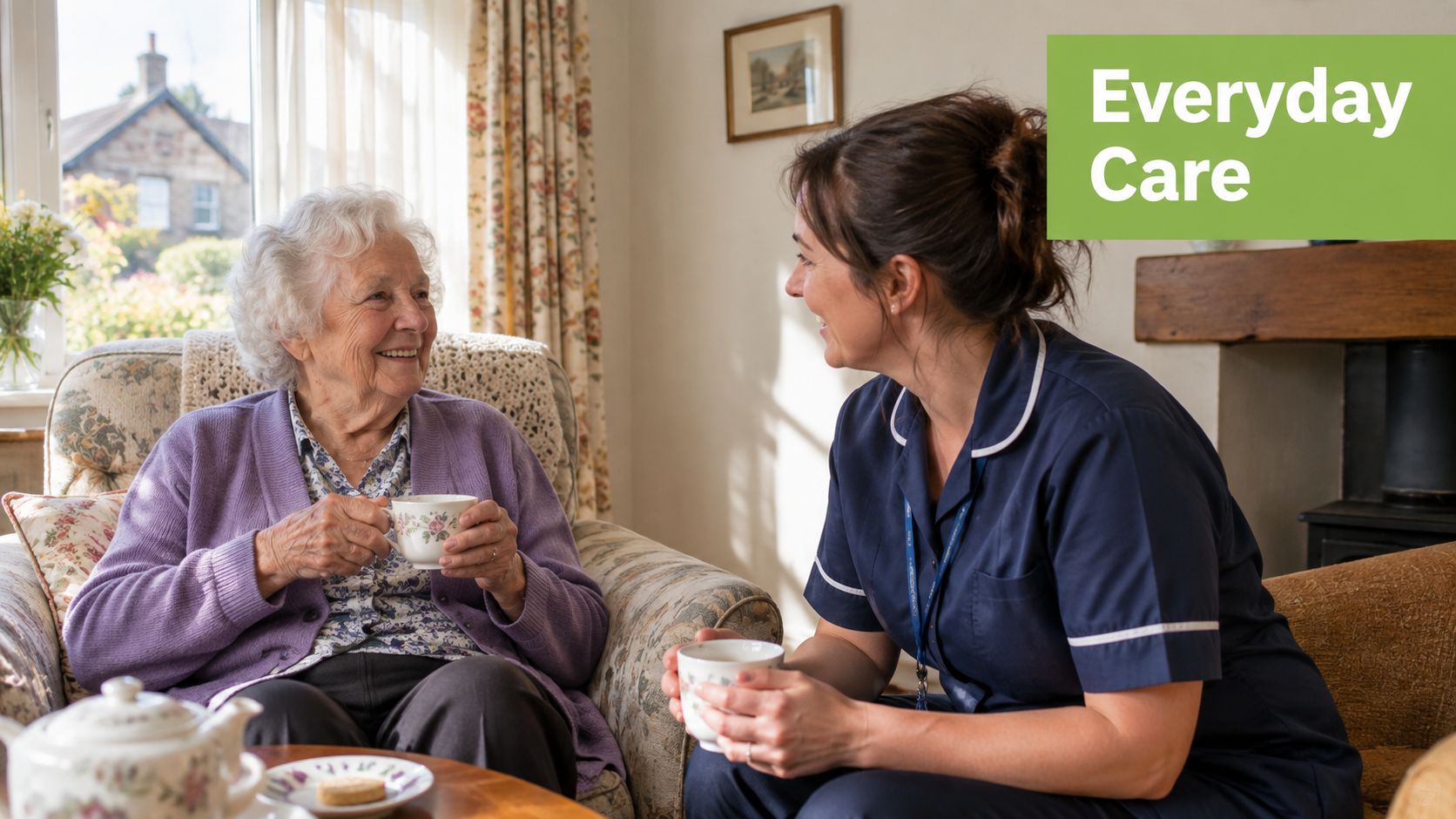
Support should preserve ability
Home care should build around abilities that remain. A carer might place clothing in order, offer a calm reminder and allow time for the person to dress independently. The support works like a handrail, providing stability without taking over the whole task.
Respite visits also give family carers planned time for shopping, rest or other responsibilities. The schedule may need to grow as memory, mobility or continence needs change, so reviews should adjust the plan rather than leave it fixed.
Stoke-on-Trent has a high level of formal dementia identification. The city's diagnosis rate was 93.8% in August 2024, with 3,047 registered cases against an expected 3,248, and it remained above 90% in January 2024, placing the city among the highest rates in England, according to the city's joint dementia strategy.
For families, high diagnosis rates can mean earlier entry into recognised assessment and support pathways. Local home-care hours and NHS funding thresholds then help determine whether a household needs occasional visits, several planned calls or a higher level of coordinated care. Understanding these stages early makes the expected intensity clearer before an evening crisis forces a decision.
Why Home-Based Dementia Support Is the Main Pathway Locally
A relative may start with one morning visit for washing, breakfast and medication prompts. Later, the same household may need several planned calls, two carers for some tasks or help that includes regular supervision. Home care remains workable when the schedule changes with the person's needs.
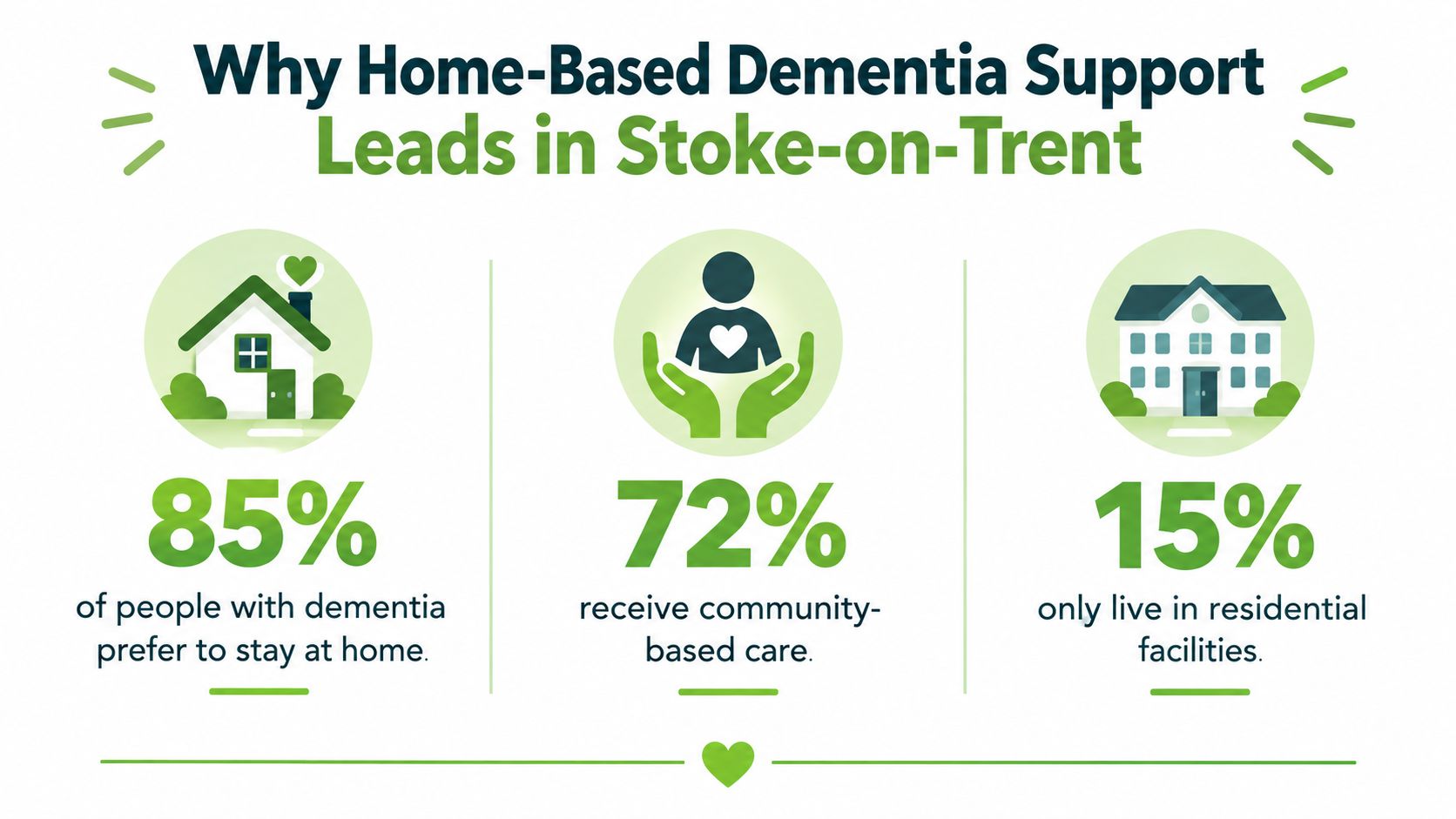
Home support is a central part of dementia care because many people continue living in familiar surroundings with practical assistance, safety measures and clinical input. NICE reports that roughly two thirds of people with dementia live in their own home. It also estimates £2 billion is spent on home care, while Alzheimer's Society findings cited in the Stoke-on-Trent draft dementia strategy indicate that 60% of people using home care have some form of dementia and 70% of people living in care homes live with dementia.
Stoke-on-Trent's commissioned hours show how this pathway operates locally. The city provided 764,094 hours of home care in 2022/23, averaging 14,694 hours each week, around 13 hours per service user per week, or 25 hours for dual calls, according to the Adult Social Care Local Account.
These figures describe planned care inputs, not continuous supervision. A few visits may cover personal care and meals, while more frequent calls may be needed when risks increase. Overnight wandering, repeated falls or complex clinical needs can exceed what scheduled domiciliary care safely provides.
Demand is moving in one direction
Per the city's dementia strategy projections cited earlier, residents aged 65 and over are expected to rise from 46,100 in 2023 to 51,300 in 2030 and 56,000 in 2040. The number of people aged 65 and over living with dementia is projected to increase from 3,034 in 2023 to 3,416 in 2030 and 4,083 in 2040.
For families, this points to a planning question: how much support can the household provide, and how many professional hours might be needed? Medication prompts, meals, personal care, supervision and breaks for unpaid carers may require different schedules at different stages. Guidance on home based dementia care with Velma can help relatives view support as part of daily life rather than an emergency response.
Home care is realistic when the plan matches changing needs and its limits are reviewed promptly. Families should ask for reassessment when safety risks or care demands grow.
Local Support Options Available for Dementia at Home
Stoke-on-Trent's local pathway combines several types of help. A professional carer's visit is only one element. Equipment, adaptations and reablement can address different risks and abilities, so families should ask how the pieces fit together.
Start with an assessment
The council can assess a person's needs and consider whether support is required with washing, dressing, eating, moving around, medication routines or staying safe. A formal dementia diagnosis can help explain the situation, but the council's information also refers to reablement for residents over 55 with a formal or suspected dementia diagnosis, as described in its guidance on support available for dementia at home.
An assessment should look beyond isolated tasks. Someone who can dress independently in the morning may struggle later because of fatigue, confusion or changes in routine. Families should describe what happens on difficult days, not only what the person manages during a calm visit.
Match the intervention to the problem
Professional care visits may support personal care, meals, medication prompting, companionship and household routines. Home equipment or modifications can reduce hazards, improve access and make essential activities easier. Reablement is different. It is short-term, goal-led support designed to help someone regain or maintain practical abilities rather than provide an indefinite schedule.
| Need at home | Possible response | What to clarify |
|---|---|---|
| Difficulty washing or dressing | Personal care visit | What can the person still do independently? |
| Unsafe movement around the home | Equipment or modification | Which risk is the change intended to reduce? |
| Loss of confidence after illness or a setback | Reablement | What progress will be reviewed? |
| Family exhaustion | Respite or sitting support | When does the unpaid carer need reliable time away? |
Families can also compare independent providers and council-arranged services. If you're exploring a private option, review the practical details of help at home from Cream Home Care alongside the assessment information, including visit purpose, continuity and communication.
Practical rule: A care plan should explain the reason for each visit or adaptation, not merely list the time someone arrives.
The NHS says many people with mild-to-moderate dementia can remain at home when adequate support is available. That support works best when it changes as the person's abilities and risks change.
Understanding Funding Routes and NHS Continuing Healthcare
Families often assume that a dementia diagnosis automatically determines who pays for care. It doesn't. Funding depends on assessed needs, finances and, for NHS continuing healthcare, the nature and complexity of health needs.
Council adult social care usually begins with a needs assessment. The council considers eligible care requirements and may carry out a financial assessment to establish whether the person contributes towards services. The resulting package can include care at home, equipment or other support, depending on the assessed situation.
NHS continuing healthcare follows a different route. NHS guidance says a person with dementia who develops complex health and care needs may qualify for NHS continuing healthcare, which can fund care at home through the local integrated care board. Someone who doesn't meet that threshold may still receive NHS-funded nursing care when nursing input is needed, according to NHS guidance on dementia and care homes.
Compare the routes by need
| Route | Main question | Possible outcome |
|---|---|---|
| Council adult social care | What help does the person need to live safely and manage daily life? | Assessed home-care and practical support, subject to the relevant process |
| NHS continuing healthcare | Are the person's needs primarily complex health needs? | NHS-funded care at home or in another setting if eligibility is confirmed |
| NHS-funded nursing care | Is registered nursing input required without eligibility for continuing healthcare? | Funding towards nursing care |
| Mixed support | Do health and social care needs sit across both systems? | A coordinated package involving more than one funding route |
The distinction matters because short visits may no longer be enough when medication management becomes complex, mobility risks increase, continence care requires clinical oversight or supervision becomes continuous. Those changes don't guarantee eligibility, but they should prompt a request for reassessment.
Government dementia profile commentary states that 169,500 people, or 34% of those with a formal dementia diagnosis, live in a care home, meaning the majority are supported elsewhere. This reinforces why families should understand community funding routes instead of treating residential care as the only answer.
Keep notes about falls, missed medication, night-time distress, hospital discharge and changes in personal care. Clear examples help professionals assess the pattern and decide whether the current package remains appropriate.
How Personalised Home Care Plans Protect Independence
A personalised plan begins with the person's daily life, not a diagnostic label. It records how they prefer to wash, which foods they recognise, what routines settle them and how they show discomfort. It also separates tasks needing a prompt from those needing hands-on help, while identifying situations likely to cause anxiety.
That detail helps carers provide the right level of assistance. Taking over a familiar task can weaken confidence; expecting too much can cause distress or refusal. A clear plan sets out useful prompts, preferred language, safety concerns and signs that support needs are changing.
Build the plan around real days
Home-care hours should reflect the pattern of the day, rather than fit an identical schedule for every person. Morning support might cover dressing and breakfast. An afternoon visit could provide company, an activity or help with household tasks. Evening support may need a quieter approach when confusion increases. Families can read about this pattern in guidance on dementia sundowning and evening changes.
Stoke-on-Trent's high diagnosis rates make this practical planning particularly important. A care plan helps families describe whether a few visits are enough, or whether changing needs require more local home-care hours. It also creates a clearer record if health needs become complex enough for professionals to reconsider whether NHS continuing healthcare thresholds may apply.
A useful plan answers questions that a generic timetable leaves open:
- Medication: Who prompts, records concerns and reports a missed dose?
- Meals and drinks: Which foods and drinks will the person accept reliably?
- Mobility: What help is needed, and what should happen after a near fall?
- Family respite: When does the main carer need protected time away?
- Communication: Who receives updates when the person's condition changes?
Cream Home Care serves Stoke-on-Trent and Newcastle-under-Lyme from its local office at 2 Victoria Square, Hanley. It describes customised support designed around individual routines, independence, comfort and well-being at home, as outlined on the Cream Home Care website.
Review before the crisis
Review the plan when the person stops completing a familiar task, wakes repeatedly, loses weight, has more accidents or needs closer supervision. Family members should report these changes instead of absorbing extra duties themselves. A written pattern gives the care team a basis for adjusting visit times, tasks or hours.
Familiar routines give carers a practical way to support choice when memory and confidence fluctuate.
Personalisation also supports relationships. A regular carer who knows the person's history can encourage conversation and meaningful activities, while respite visits give relatives time to recover. The aim is safer, calmer daily life that preserves choice wherever possible.
How to Choose a Local Dementia Home Care Provider
Start with the provider's ability to meet the actual risk, not with a general promise of compassionate care. Ask whether carers have dementia-specific training, how the service records medication prompts and what happens if a visit is delayed or a person's condition changes.
Use a focused checklist
- Confirm regulation and accountability. Check the provider's CQC information and ask who manages concerns, complaints and safeguarding issues.
- Ask about continuity. Find out whether the person will see a small regular team and how the service handles absence.
- Test the care plan. Ask for examples of how staff support washing, dressing, meals, mobility and communication without taking over unnecessarily.
- Discuss difficult periods. Ask how the provider responds to night-time concerns, wandering, missed medication, falls and rapid changes.
- Include the family. Clarify how updates are shared with relatives, social workers, GPs and other professionals, with the person's consent.
- Check respite arrangements. Make sure sitting or respite support can give the main carer a predictable break rather than only emergency cover.
A local office can make communication easier, but proximity alone doesn't prove suitability. Ask about availability in the person's area, visit windows, cancellation arrangements and the process for reviewing a package.
Providers should also explain charges, minimum visit requirements and what happens if needs exceed ordinary domiciliary support. The guidance on choosing a home care provider can help families prepare questions before an initial conversation.
Arrange a needs assessment and a provider discussion separately if necessary. The council assesses eligible needs and funding routes, while a provider explains how it could deliver the agreed support. Keeping those roles clear prevents families from assuming that one conversation has completed both processes.
Getting Started with Dementia Care at Home in Stoke-on-Trent
The first step is to describe what is happening at home in concrete terms. Write down the tasks that have become difficult, the times confusion is worst, any medication concerns, falls or near falls, and how much support family members are already providing.
Request an adult social care needs assessment through Stoke-on-Trent City Council. During the assessment, explain the person's usual abilities and the occasions when those abilities break down. Dementia can fluctuate, so a calm morning shouldn't conceal the problems that occur during evenings, illness or changes in routine.
Move from assessment to a workable package
Once needs are understood, discuss the available response. This may include professional visits, equipment, home modifications, reablement or a combination of services. Ask what each element is intended to achieve, who will review it and what signs should trigger a reassessment.
Speak with potential providers about a gradual start where appropriate. A first conversation can establish whether the service covers the area, whether staff understand dementia and whether the proposed visit pattern matches the person's routines. Families should also agree how carers will communicate concerns and who has authority to make decisions if risk increases.
Funding questions should be raised early. Council support, private arrangements, NHS-funded nursing care and NHS continuing healthcare have different criteria. If health needs become more complex, ask the relevant professional whether a reassessment is appropriate rather than assuming the original funding decision still applies.
A calm start is still decisive action. Early planning gives the person, family and professionals time to agree support before exhaustion or an emergency makes the choices narrower.
NHS guidance confirms that many people with mild-to-moderate dementia can stay in their own home and live well when adequate support is available, as explained in NHS advice on dementia help and support. Home care isn't a promise that needs will remain unchanged. It is a structured arrangement that should adapt as the person's abilities, risks and health needs develop.
Make the next call specific. Ask for an assessment, gather the relevant care information and involve the person living with dementia in decisions wherever possible. That approach turns dementia care at home in Stoke-on-Trent from an uncertain emergency measure into a plan that can be reviewed and strengthened over time.
Cream Home Care provides dementia, domiciliary, companionship and respite support for people living in Stoke-on-Trent and Newcastle-under-Lyme, with care delivered in familiar surroundings. Visit Cream Home Care to discuss your circumstances and arrange a practical conversation about support at home.