Among adults aged 80 and over living in private households, 52% needed help with at least one everyday personal or household activity, according to the 2021 Health Survey for England. For families searching for domiciliary care near me, the question isn't just which agency is closest. It's which service can provide the right help, at the right time, without assuming relatives will cover everything else.
What Domiciliary Care Near You Really Means
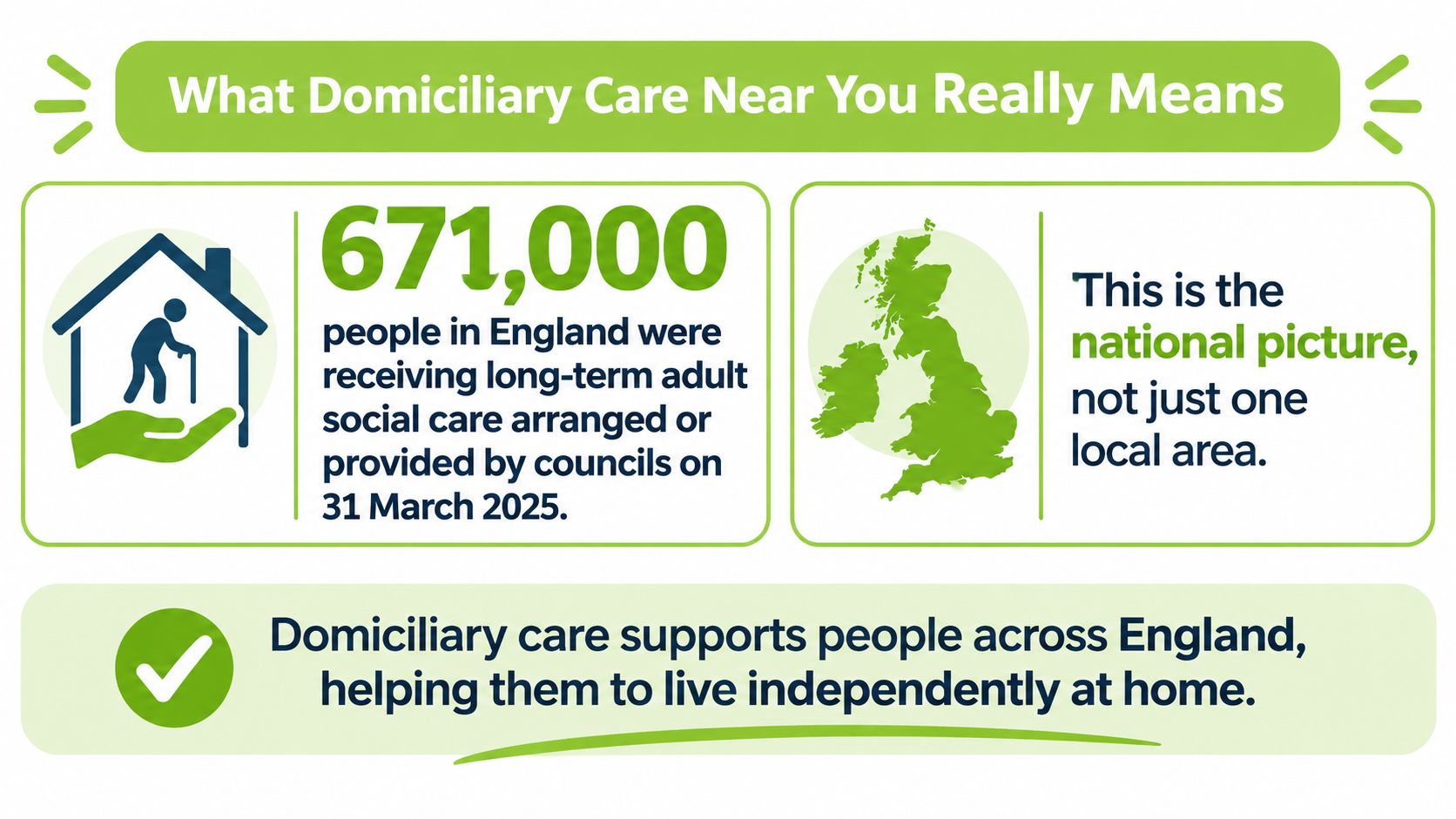
England's community-care system supports a substantial number of people outside residential settings. On 31 March 2025, 671,000 people were receiving long-term adult social care arranged or provided by councils in England, equivalent to 1,470 per 100,000 adults, and 489,000 were receiving support in the community, according to official adult social care statistics.
Those totals describe council-arranged or council-provided care, not every privately funded package. They also cover long-term social care more broadly, so the total mustn't be mistaken for the number receiving domiciliary care alone.
Help built around everyday life
Domiciliary care means flexible support delivered in someone's own home. It can help a person manage personal care, household tasks and daily routines while remaining in familiar surroundings.
The useful starting point isn't a service label. It's what the person finds difficult:
- Personal care: Washing, dressing, using the toilet and maintaining personal hygiene.
- Meals and household tasks: Preparing food, washing up and keeping essential living areas manageable.
- Medication prompts: Reminders and agreed assistance within the person's support plan.
- Daily routines: Help getting ready, moving safely and maintaining activities that matter to the person.
Regulated personal care isn't the same as companionship or domestic help. Someone who provides conversation, shopping or cleaning isn't automatically authorised or equipped to deliver hands-on personal care. A package can include both, but the responsibilities need to be clear.
Familiar surroundings still need a workable plan
Say someone in Hanley can prepare lunch but can't safely get into the shower. Their package should address that specific difficulty, rather than replace tasks they can still manage.
Home care also differs from having staff available within a residential setting. Our guide to domiciliary care versus residential care can help families consider which arrangement suits the person's needs and preferences.
At Cream Home Care, we provide home care across Stoke-on-Trent, Newcastle-under-Lyme and North Staffordshire. Our home-based support includes personal care, household tasks and general assistance.
Practical rule: A nearby office doesn't prove that a provider can deliver an early morning wash or safely roster a transfer requiring a pair of carers.
For a local family, suitability comes down to availability, staffing, a meaningful assessment, affordable arrangements and an honest account of what relatives can do.
Search Strategies for Stoke and Newcastle-under-Lyme
Start with the postcode, not the brand name. A provider may advertise across North Staffordshire while accepting new packages only within particular rounds.
Build a shortlist from the right places
Search the CQC register by location. For personal care, identify registered services and read their latest reports. Then confirm the service covers the address, because an office location doesn't establish its visiting boundaries.
Identify the responsible council. Stoke-on-Trent City Council handles adult social care for Stoke-on-Trent, while Staffordshire County Council covers Newcastle-under-Lyme. Similar-looking local searches can therefore lead to different assessment and funding teams.
Request the council's contracted-provider list. Ask which services can deliver council-funded packages in your area and what current charging information applies. Being on a list is a starting point, not a promise that an agency can accept your package.
Use the hospital discharge team when relevant. Ask which providers are being approached, whether they cover the postcode and who is confirming availability. The team arranging discharge should establish the live position rather than leave you to infer it from a directory.
Search the neighbourhood as well as the town. Combine domiciliary care with Hanley, Newcastle-under-Lyme or the relevant nearby village. Add suitable candidates to your shortlist, then test what they can offer.
Record answers rather than impressions
Keep a simple comparison sheet with the provider's name, postcode coverage, contact date, response and unresolved questions. Record the name of the person who gave each answer.
- Useful evidence: A clear explanation of the next assessment step and any limits on coverage.
- Unresolved evidence: A friendly response that doesn't establish whether the agency can meet the need.
- Reason to pause: Pressure to agree before anyone has assessed the person.
Don't rank providers by the polish of their brochures. Compare their answers to the same practical questions.
How to Test Real Availability Near You
A provider that covers Stoke-on-Trent on a map may still have no carer free at 7am on your street. Availability is a four-part match: address, timing, staffing and task complexity all have to line up at once. A provider can pass three parts and fail the fourth, so test each one separately.
Run an availability audit
Write down the requirements before you call. List the postcode, the visit windows that can't move, transfer needs and any evening, weekend or waking-night support. Mark which items are fixed requirements and which are preferences that could flex.
Ask whether the address sits on a current round. A care round works like a bus route: a carer already travels between nearby homes in a set order, so one more visit slots in easily. A postcode no round reaches means the provider has to build a new route around you, which takes longer and may never happen.
Match visit length to the work. Ask the shortest visit the provider accepts, then describe the actual tasks. Don't accept a slot that would force a carer to rush washing, toileting or a safe transfer.
Test absence and missed-call arrangements. Find out who organises same-day sickness cover, when someone tells the family about a delay and how an unanswered visit is escalated.
Check funding compatibility. Establish whether the service accepts privately funded, council-funded and NHS Continuing Healthcare packages. Acceptance of one route doesn't establish acceptance of the others.
Ask about the proposed regular team. Find out how many carers would normally share the package and whether that arrangement can support the person's communication and reassurance needs.
Ask what the package expects the family to do. Some schedules assume a relative covers mornings, weekends or the gaps between visits. Get a clear list of the tasks the provider delivers and the tasks it expects someone else to cover, so the plan never depends on unpaid care nobody agreed to give.
Availability audit for a local care package
| Question | Why it matters | A useful answer |
|---|---|---|
| Is this postcode on a current round? | Map distance is not travel time or an existing run | Named round and typical travel, not a future plan |
| Can you cover the required times? | Early washes, evenings and weekends are often full | Specific days and times offered, including limits |
| Can you supply two carers if needed? | Hoists and some transfers require assessed staffing | Yes, with how cover is rostered |
| What is the minimum visit length? | Rushed personal care creates risk | A length matched to the tasks, not a flat 15 minutes |
| What happens if a carer is off sick? | Continuity fails on the first absence | Same-day replacement and a named coordinator |
| Which funding routes do you accept? | Private, council and NHS packages are arranged differently | Clear yes or no for each route |
Why a bigger provider list isn't enough
The CQC's State of Care report records more than 13,500 home-care locations by April 2026 and a 5.8% increase in hours delivered between March 2024 and March 2026, but these totals describe provision, not an available slot at your address.
A long local list can still contain small services, restricted rounds or providers unable to roster complex visits. Willingness to provide daytime calls says nothing about night cover.
Take someone who needs help getting out of bed before a relative leaves for work. A later visit is acceptable if the person can safely stay comfortable until then, but not if it leaves them unable to reach the toilet. If no provider can offer the early slot, the honest options are a changed work arrangement, a family rota someone agreed to or a different package shape. A hopeful assumption that the gap will fill itself is not a plan.
Be flexible about preferences where you can, but don't negotiate away a safety requirement to fit an empty slot.
Drop any provider that can't give workable answers to the audit, however close its office is. A clear refusal is more useful than an uncertain promise.
Checks That Separate a Safe Provider
Once availability is established, look for evidence of safe delivery. A rating or testimonial can't tell you who will arrive tomorrow or whether they're competent to complete the assessed tasks.
Registration, checks and competence
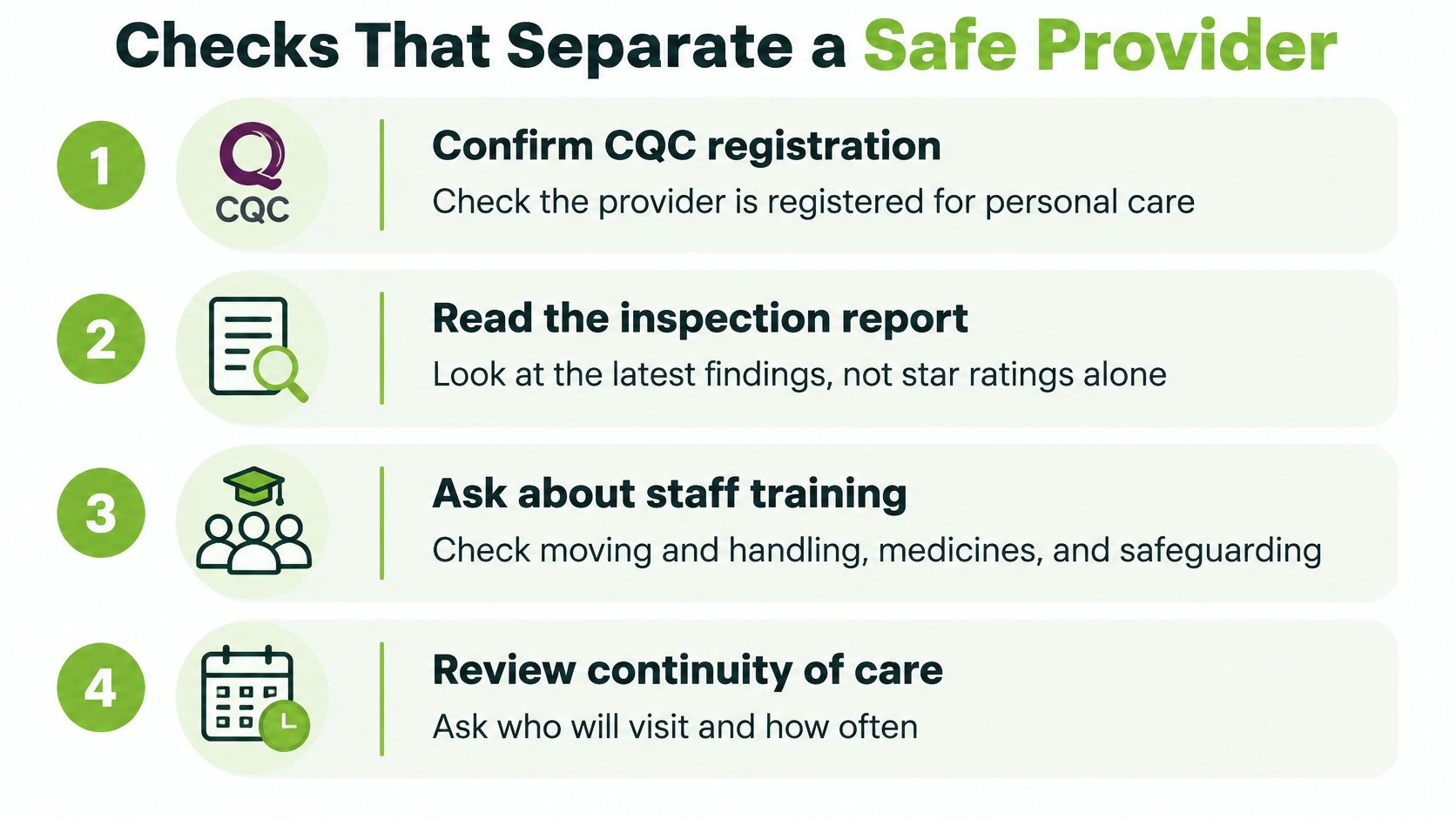
Confirm CQC registration for personal care, then read the inspection narrative. Look for findings about missed calls, medicines, safeguarding and staffing, not just the overall rating.
Ask who verifies enhanced DBS checks, when checks were completed and what renewal or update arrangements apply. DBS certificates don't have a universal expiry date, so an assurance that they're in date needs explaining rather than accepting at face value.
Provider checks before you agree a package
| Check | Where to look | Warning sign |
|---|---|---|
| CQC registration for personal care | CQC register and latest report | No registration, or unresolved findings about missed calls or medicines |
| Enhanced DBS for carers | Provider's written assurance of dates and update arrangements | Refusal to explain how checks are verified |
| Role-specific training | Training list for moving, medication prompts and dementia | Only a generic induction |
| Recent similar references | Families with a comparable need, subject to consent | Only marketing testimonials |
| Named regular team | Proposed rota and cover plan | A different carer every visit with no supervisor |
| Complaints and escalation | Named coordinator and out-of-hours number | No one accountable after the office closes |
Request recent references from families facing comparable needs, such as post-hospital frailty. Ask whether a conversation can be arranged with their consent, rather than relying only on selected quotations.
Continuity needs a staffing plan
Across England's adult social care sector, Skills for Care reported approximately 1.71 million posts in 2024/25, a 7% vacancy rate, equivalent to about 111,000 vacant posts, compared with a previous vacancy rate of 10.5%. Those figures don't judge any individual agency, but they make recruitment and cover arrangements sensible questions.
Ask for the proposed rota and supervision arrangements in writing. Low sickness figures alone don't prove that the person will see familiar carers.
At Cream Home Care, our team consists of trained caregivers, and we match clients with carers whose personalities and skills align with their needs. We have over 20 years of experience in social care; families can also use our guide to choosing a home care provider when comparing services.
Keep emotional support separate from agency quality checks. For a relative based in Gloucestershire who needs counselling alongside caring responsibilities, Therapy with Ben's resource can help them find a local Cheltenham therapist, rather than treating domiciliary care as a substitute for mental health support.
What a Good Introductory Visit Should Show
An introductory visit should produce a working understanding of the person's day, not just a quotation. Before the assessor arrives, write down what happens from waking through to bedtime, including anything that happens overnight.
Include tasks that have become difficult, and near misses and quiet help that family members provide without anyone noticing. A relative laying out clothes or checking that food is in the cupboard may be providing more support than anyone has recorded.
Watch how the assessment happens
The assessor should speak directly to the person receiving care, using their preferred communication style. They should discuss consent and decision-making, involve authorised representatives appropriately and avoid assuming that a relative answers every question.

Walk through the actual routine where safe. Discuss the route to the toilet, the chair the person uses, lighting, loose rugs and whether the bed allows an assessed transfer.
- Personal preferences: How the person likes to wash, dress, eat and communicate.
- Risk arrangements: What happens after a fall, a refusal of care or a concern about medicines.
- Task boundaries: What carers will do, what they won't do and which professional handles specialist needs.
- Desired outcomes: What the person wants to manage or regain, rather than only what others want completed.
Our flexible scheduling is designed around each client's lifestyle and preferences, and we develop care plans for their specific requirements. The assessment is where those requirements need to become clear.
Leave with a written support plan
Request the name of the person writing the plan, who agrees it and when the first review will happen. The plan should describe daily living support, medication prompts, mobility, communication, risks, emergency contacts and intended outcomes.
Record meaningful signs of progress, such as completing an assessed transfer safely, eating the agreed meals or feeling confident about washing. Attendance alone doesn't establish that the package is working; national assessment and reporting context is set out in the DHSC adult social care publication.
For hospital discharge, NHS guidance says the discharge plan should identify who provides care, how to contact them, when and how often support will happen, and any charges. Check that the home-care plan agrees with those arrangements.
Under discharge-to-assess, NHS England's model discharge pathway says assessment should happen promptly, ideally within two hours of arrival home. Ask the discharge team how the assessment is being arranged, rather than treating this as a guaranteed response time from a private agency.
Don't accept an unexplained tick list as a complete support plan. You need clear responsibilities, escalation arrangements and an agreed review point.
Funding Rules and the Family Capacity Check
Eligibility for care and liability to pay are separate questions. The needs assessment asks what support the person requires; the financial assessment asks what they can contribute towards eligible council-arranged care. Each answer can change without the other moving, so keep both processes running in parallel rather than waiting for one to finish.
Two capital thresholds set the starting position for means-tested care. Surrey County Council's charging policy explains how these nationally used bands apply, though it is not a guide to Stoke-on-Trent prices.
| Assessable capital | General position for means-tested care |
|---|---|
| More than £23,250 | The person generally pays the full cost of eligible care |
| Between £14,250 and £23,250 | Tariff income of £1 weekly for every £250, or part of £250, above the lower threshold, plus an assessed contribution from income |
| £14,250 or less | Savings are not counted as capital, though income may still be assessed |
For domiciliary care the occupied home is generally left out of the capital calculation. Income, household expenditure and disability-related costs still count, so two people with identical savings can face very different charges.
Obtain a local assessment and a usable quotation
Ask Stoke-on-Trent City Council or Staffordshire County Council, as appropriate, for a Care Act needs assessment and financial assessment. Don't copy another area's charge or assume that a private quotation predicts the council's decision.
Attendance Allowance or Personal Independence Payment may help with disability-related costs, but neither automatically purchases a suitable care package. Check benefit entitlement separately from how visits will be funded.
For private arrangements, request a written breakdown covering the agreed visits, staffing, additional charges and cancellation terms. Our explanation of how much in-home care costs can help you prepare budgeting questions without assuming a single national hourly price.
Record what the family can genuinely sustain
Many unpaid carers already give very intensive support each week, and families are often not asked about their capacity before a discharge plan is agreed. The result is a package that assumes relatives will cover every gap. Treat that assumption as something to test, not accept.
Build a family capacity check alongside the paid-care plan:
- Medicines: Who orders and collects them, and who handles any support outside visits?
- Washing and meals: Which tasks can relatives willingly undertake without risking their own health or employment?
- Nights: Who responds, and can that person realistically continue with interrupted sleep?
- Transport: Who manages appointments, shopping and unexpected journeys?
- Backup: Who takes responsibility if the main family carer becomes ill or unavailable?
- Respite triggers: What change means additional cover must start, such as exhaustion, illness or a planned break?
Write down limits without apology. A daughter who can bring shopping at the weekend hasn't agreed to provide every evening meal. A son working shifts cannot also be the reliable overnight responder.
Respite care is reliable short-term cover that gives family carers a break while care continues. We provide respite support across Stoke-on-Trent and Newcastle-under-Lyme, so rest can be scheduled before the arrangement becomes unmanageable.
Clinical needs require an explicitly agreed NHS or specialist arrangement. Don't assume an ordinary domiciliary visit includes clinical tasks, or that relatives should perform them without appropriate assessment, instruction and support.
Book the First Conversation This Week
Choose a practical next step rather than collecting more agency names. If discharge is imminent, speak to the ward or discharge team that day and establish who is arranging the first visits, whether the support is temporary and when it will be reviewed.
For ongoing care, contact a small shortlist of providers that have passed the availability audit. Arrange assessments close enough together that you can compare written proposals against the same description of need.
Have the essentials beside you
Prepare a short call sheet so you don't have to remember everything under pressure:
- Address and timing: The postcode and visit windows that matter.
- Daily tasks: Washing, meals, toileting, overnight needs and any transfer support.
- Assessed staffing: Whether the person needs a pair of carers for particular tasks.
- Current medicines: An up-to-date list and any known difficulties with taking them.
- Funding route: Private payment, council arrangements or NHS funding, including anything still awaiting confirmation.
- Family limits: What relatives can no longer manage after work, overnight or during illness.
Make the call count
Ask the person taking the enquiry to explain the next concrete step. A useful conversation establishes whether the service can consider the package, how assessment will happen and what information is still missing.
You can call our care team on 01782 444007, email info@creamhomecare.co.uk, or complete the simple contact form on our website and the team will get back to you. Check any other provider's contact details against its own website before sharing sensitive information.
Don't feel obliged to agree during the first conversation. If a provider won't explain its proposed arrangements or how concerns will be handled, keep looking.
Cream Home Care offers flexible domiciliary care, companionship and respite support across Stoke-on-Trent, Newcastle-under-Lyme and North Staffordshire. Visit Cream Home Care to start a conversation about your postcode, daily routines and the support your family can realistically sustain.