If a care worker reminds your parent to take a tablet, is that the same job as putting the tablet in their mouth? Most families treat those two things as one service. In practice, they're different levels of medication support at home, with different training, records and legal duties behind each one.
That difference matters. A reminder helps someone who can still manage their own medicines. Administration means the worker gives the medicine, and that step needs assessment, consent and a written record.
What Medication Support at Home Covers
Who's allowed to hand over a person's tablets at home, and does it matter? Yes, because medication support at home is any help that lets a person take their medicines safely in their own home, from a reminder to a full dose given by a trained worker.
NICE guidance on managing medicines for adults receiving social care in the community defines medicines support broadly as any assistance that enables a person to manage medicines, including prompting, practical help, self-administration support, or administration when the person cannot manage independently. It also says an individual assessment should record the person's medicines, prescribed instructions, ability, preferences, consent, and the precise tasks a care worker is authorised to perform.

Four levels of support
Think of support as a staircase. Each step adds more hands-on help, and more responsibility for the provider.
| Level | What the support involves | Typical need |
|---|---|---|
| Prompting | Reminds the person when a dose is due | Person can take medicines but may forget |
| Practical help | Opens packs, measures liquids or sets up medicines, while the person takes them | Person can take medicines but struggles with packaging or handling |
| Self-administration support | Oversees the person taking their own medicines | Person has capacity but needs supervision |
| Administration | Gives the medicine to the person | Person cannot take it themselves and a trained, authorised worker is needed |
The level is set by ability, not by family preference. Someone who forgets an evening dose isn't in the same position as someone who can't swallow, open a bottle, or understand which tablet is which.
Quick test: if the person can take the medicine safely once reminded, prompting may be enough. If they can't take it themselves, you need administration by a trained and authorised worker, with that task written into the plan.
Good support also means workers escalate problems quickly, including refusal, incorrect use, suspected side effects, stockpiling, errors and near misses. That early warning is part of the service, not an extra.
Services From Reminders to Pharmacy Liaison
Families usually arrange support in the order a dose is taken. First comes the reminder, then practical help, then administration and recording, then liaison with the GP and pharmacy.
Reminders and practical help
A reminder can be a timed visit, a phone call, or a clear chart on the fridge that matches the prescription times. The visit time matters, so a medicine due at 08:00 shouldn't rely on a call that arrives mid-morning. Families often compare therapy appointment durations when planning a weekly routine, and the same habit helps here, because medication visits need to fit around prescribed times, not the other way round.
Practical help keeps the person in control. A worker might open child-resistant packs, measure a liquid dose with an oral syringe, or watch inhaler technique while the person uses it. The person still takes the medicine themselves.
Administration and the MAR chart
Administration is different. The worker selects the medicine, checks the label against the record, gives the dose, and records what happened. The core document is the medication administration record, usually called a MAR chart. It's the written proof of what was given, when, and by whom.
| Column | What to record | Example entry |
|---|---|---|
| Medicine and strength | Name, strength and form exactly as on the label | Amlodipine 5 mg tablet |
| Dose and route | Number of units and how each is taken | 1 tablet by mouth |
| Scheduled time | Clock time the dose is due | 08:00 |
| Given by | Initials of the worker who gave it | JC |
| Outcome | Given, refused, omitted or held, with a code | R (refused) |
| Escalation | Who was told, when and by whom | GP surgery told at 09:15 |
Say a 78-year-old takes four regular medicines and refuses the 08:00 tablet because she feels nauseous. The worker doesn't persuade her to take it anyway, hide it in food, or leave the box blank. She records R for refused, notes the reason, and the GP surgery is told that same morning.
Pharmacy and GP liaison
Liaison keeps the system current. That includes:
- Keeping one medicines list: update it whenever a dose changes or a medicine stops.
- Ordering repeats in time: flag low stock before tablets run out.
- Reporting patterns: tell the GP or pharmacist about repeated refusals, missed doses or new symptoms.
Check any MAR chart this way. Every dose has an entry, no boxes are blank, and every refusal or omission has a reason and an escalation note.
Who Qualifies and How Needs Are Assessed
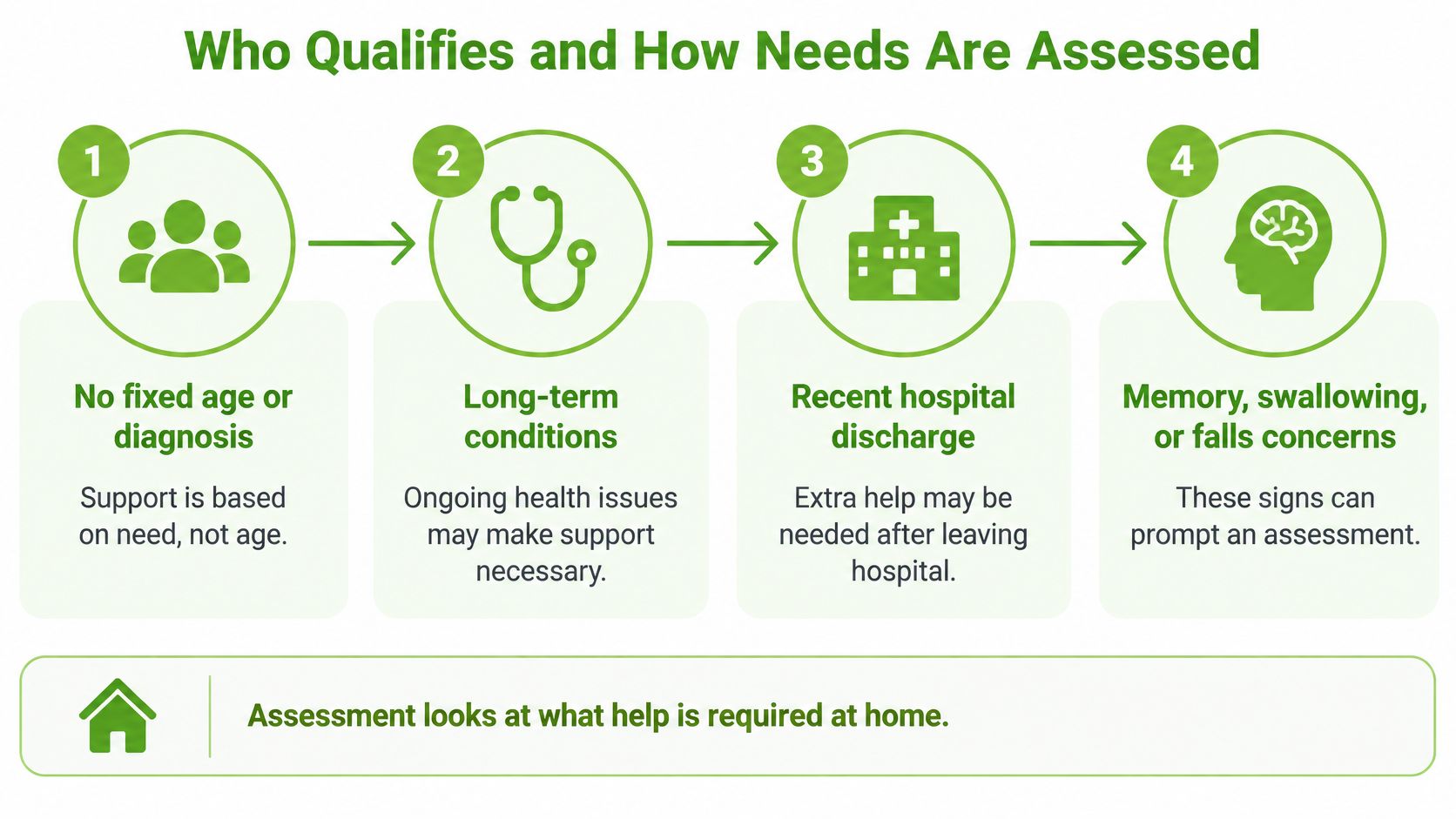
There's no fixed age or diagnosis that brings support. Need usually shows up through long-term conditions, a recent hospital discharge, memory problems, swallowing difficulties, falls, or a long list of medicines that's become hard to manage.
The scale helps explain why assessment matters. NICE medicines optimisation quality guidance notes that in 2013 almost all people aged 65 and over who required help with activities of daily living were taking at least one prescribed medicine, while professional supervision of medicine-taking in their own homes was limited. It also reports that approximately 470,000 people in England used local-authority-funded home-care support in 2013/14, with almost 80% aged 65 or over.
Four steps to a written plan
- Ask the GP practice for a current medicines list. This gives everyone the same starting point.
- Request a medicines review with a community pharmacist. The pharmacist can spot duplications, unclear instructions and medicines that may no longer be needed. Where eligibility rules are complex, families sometimes read condition-specific guidance first, such as Trim's guide to NHS Mounjaro access, before asking the GP what's available.
- Contact the local council for a care needs assessment. In England, this is the route to council-arranged support under the Care Act 2014.
- Agree a written medicines support plan. It should state which tasks the worker may perform, for which medicines, and what to do if a dose is missed or refused.
Private arrangements follow the same logic. You can arrange support directly as a family, but you still need the assessment and the written plan.
Bring evidence to the first conversation. The discharge letter, current prescriptions, the medicines physically in the home, and a note of missed or refused doses all help. After discharge, someone should compare the hospital list with what's in the cupboard, remove stopped medicines from use, and confirm any differences with the GP or pharmacist.
Council-funded support follows the assessment above. Privately arranged support is paid for by the family, so ask for the fee per visit in £ in writing before you agree a plan, and check whether record-keeping and pharmacy liaison are included.
Benefits and Risks Behind Safe Medication Support
The benefit families want most is simple. The right medicine, at the right dose, at the right time, without daily worry.
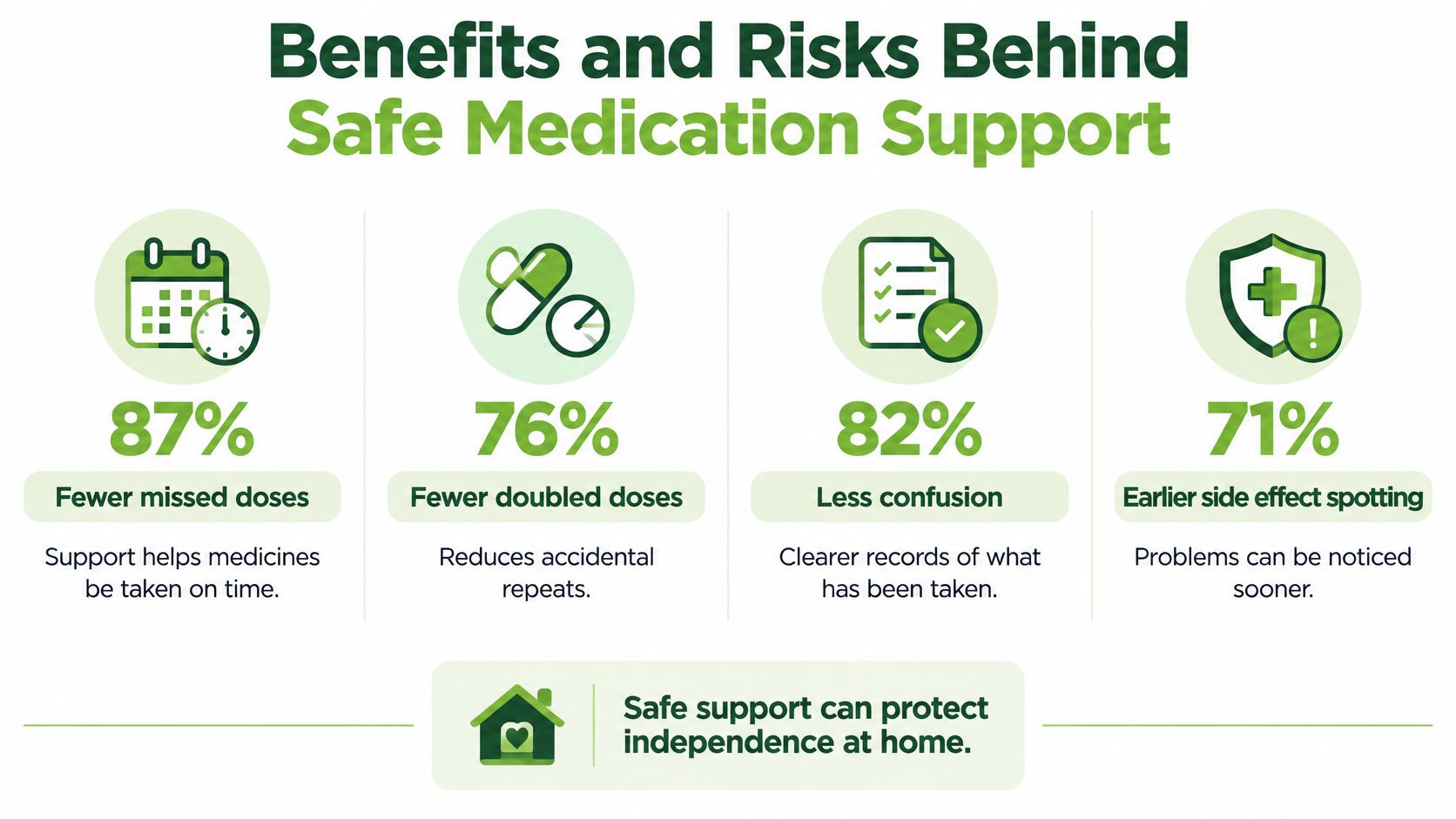
Good support reduces missed or doubled doses and removes the guessing game of whether a tablet was already taken. Workers who visit regularly can also spot drowsiness, dizziness, appetite changes or confusion early and report them. For many people, that structure protects independence, because they can stay at home with a routine they understand.
What can go wrong
The risks are measurable, which is why informal arrangements can struggle. A systematic review of medication administration in UK domiciliary settings found that administration-error rates ranged from 1.9% to 33% of medicines administered, while the proportion of carers making an error ranged from 12% to 92.7%. Reported errors included incorrect doses, omitted medicines, the wrong medicine, and administration at the wrong time or by the wrong route.
Those wide ranges don't mean every home is unsafe. They show that outcomes depend heavily on the system around the dose. The review identified contributing factors including the number of medicines prescribed, storage arrangements, clarity of prescription instructions, communication between carers, the recipient's age, and individual carer factors.
Tools can help, but only when they suit the person. Our guidance on using dosette boxes as part of a personalised medication routine explains how organised boxes fit into a wider plan, rather than replacing assessment.
The interventions shown to reduce errors were carer training and equipment designed to meet the person's needs. That's a practical test for any service. If a worker relies on memory, verbal handovers or an out-of-date list, risk rises.
Families can lower risk at home too. Keep one current medicines list, store medicines as the label directs, keep them in original packaging where advised, and ask for every new instruction in writing. If the label, the MAR chart and the GP list don't match, stop and ask before the next dose.
Safety and Legal Duties Families Should Know
A common assumption is that a blister pack or reminder chart settles safety. It doesn't. Packaging can't judge capacity, spot a side effect, or decide what to do after a refusal.
Capacity, consent and refusal
Capacity means a person can understand, retain and weigh information about a decision, and communicate their choice. A person with capacity can consent to support, and they can also refuse a medicine. That refusal must be recorded and reported. It must not be overridden because the dose is due.
If a person lacks capacity for a medicines decision, the Mental Capacity Act 2005 governs how decisions are made in England and Wales, including best-interest decisions involving those who know and care for the person. The Care Act 2014 sets the council's duty to assess needs in England, and the Care Quality Commission regulates providers in England. Your plan should make clear which framework applies to each key decision. You can read more about the wider duties in our overview of health and safety responsibilities in home care.
What the plan must state
A medicines support plan should name each permitted task, each medicine it covers, and the training behind that task. It should also align visits with prescribed times where possible. A UK review of people receiving home-care services found that polypharmacy was common, ranging from 41.1% to 89.5% across the studies included, and reported a UK prevalence of potentially inappropriate medicines of 14.2% in home-care settings. It highlighted two weaknesses: home visits may not occur at the time medicines are due, and workers may have insufficient expertise about administration and side effects.
Polypharmacy means taking several medicines at once. More medicines mean more chances for interactions, duplicated effects and confusion, so timing and competence aren't conveniences. They're safety requirements.
Monitored dosage systems, often called blister packs or compliance aids, shouldn't be used automatically. A pharmacist should assess whether one is clinically appropriate, because original packs may be safer when medicines change often or the person understands their regimen.
When to escalate
Workers and families should escalate promptly when they notice:
- Refusal or missed dose: record it and tell the provider the same day.
- Incorrect use: for example, a doubled dose or an inhaler used the wrong way.
- Suspected side effect: new dizziness, rash, swelling, confusion or unusual sleepiness.
- Stockpiling: unused medicines building up at home.
- Error or near miss: the wrong medicine almost given, or given.
Most concerns go to the provider first, then to the GP or pharmacist for advice. For urgent symptoms, a suspected serious reaction, or a missed critical dose, use NHS 111 or call 999 in an emergency.
Questions to Ask Before You Choose a Provider
Treat the first meeting as a working check, not a reassurance exercise. You should leave with written answers you can compare. There's practical help on choosing a home care provider and comparing answers fairly if you're meeting more than one company.
| Check | Good answer | Warning sign |
|---|---|---|
| Registration | Registered with the Care Quality Commission in England | Cannot say who regulates them or will not show registration |
| Medicines training | Staff trained and assessed on administration before visits | Training described only as learning on the job |
| Written plan | Medicines support plan agreed with the person and family | Promises made verbally with no written list |
| Records | MAR charts completed at each visit and checked regularly | Blank entries or missed doses not reported |
| Timing | Visits aligned to prescribed times where possible | Visits booked at random times regardless of doses |
| Escalation | Clear route to the GP, pharmacist and NHS 111 | No named contact for problems |
Six questions to ask in the room
- Are you registered with the Care Quality Commission in England, and can you show the registration?
- How are staff trained and assessed on medicines administration before their first visit?
- Who writes the medicines support plan, and how often is it reviewed?
- How are MAR charts checked, and who sees missed or refused doses?
- Can visits be timed to prescribed doses, and what happens when a visit is late?
- Who's the named contact when something goes wrong, and how quickly do they respond?
Ask to see a sample MAR chart and a blank medicines support plan before you sign anything. At Cream Home Care, our team consists of trained caregivers, and we have over 20 years of experience in social care. Any provider you consider should be able to explain its training and records just as plainly.
Write down each answer and compare providers against the same six questions. If a provider can't answer one of them in the room, treat that as the answer and look elsewhere.
Next Steps for Your Medication Plan
You don't need to solve everything this week. Start with three steps that make the next conversation safer and more specific.
Three steps to take first
- Gather the evidence. Find the current medicines list, the latest discharge letter if there is one, current prescriptions, and the medicines kept at home.
- Ask for a medicines review. Contact the GP practice or community pharmacist and ask them to check doses, timings, duplications and anything that no longer matches the list.
- Speak to a provider with the paperwork in hand. Ask how they would build a medicines support plan from the assessment, who would give or prompt each medicine, and how refusals would be recorded.
That first conversation should cover the same ground as a good assessment. What can the person do alone, where do they struggle, what times are critical, and who should be contacted when something changes? Confirm contact details, service area and fees directly before choosing, because published information can change.
For older adults, our Elderly Care is specialist care assisting with mobility, medication and everyday tasks while promoting independence. You can call our care team on 01782 444007, or start by filling in our simple contact form and we'll get back to you.
One safety rule stays the same whatever plan you choose. An urgent change in condition, a suspected serious side effect, or a missed critical dose should go straight to NHS 111 or 999. Don't wait for the next visit.
If you're arranging medication support at home for a parent or for yourself, we can help you turn a current medicines list and assessment into a clear, personalised plan with trained caregivers and written records. Visit Cream Home Care to discuss the right level of support, from prompting to administration, for your family.