On 31 March 2024, 483,255 people in England were receiving long-term care that their council provided or organised in the community, compared with 132,510 in care homes and 52,950 in nursing homes, according to the government's adult social care monthly statistics. Home care isn't the fallback for people who can't get a bed. It's the main way adult social care is delivered in this country.
For a family in Newcastle-under-Lyme, that changes the question worth asking. Not whether home care is a serious option, but which type of home care fits the situation in front of you, and which parts of it the council assesses and funds as opposed to what a provider can put in the diary. Those are two different conversations. Mixing them up is where most of the confusion starts, and it's the thing this guide keeps separate.
Why Local Demand for Home Care Is Growing
Home care in Newcastle-under-Lyme covers four broad things: companionship, domiciliary care (hands-on help with washing, dressing, medication and meals), respite care for family carers, and short-term support after a hospital discharge. They aren't interchangeable, and choosing between them starts with the person rather than the label.
The town's population is getting older, and the change is measurable rather than anecdotal. The Office for National Statistics' Census 2021 comparison for Newcastle-under-Lyme shows residents aged 65 to 74 rose by just under 2,100 between 2011 and 2021, a 17.4% increase, while the 35 to 49 group fell by roughly 4,100 people, or 16.1%. Fewer adults in the middle years living nearby, in other words, and more people in the years when mobility, medication, personal care and recovery after illness start to need a hand.
The Local Age Shift
The same census recorded a rise in the age-standardised proportion of residents identified as disabled and limited a little, from 11.1% in 2011 to 11.8% in 2021. Age-standardisation matters because it adjusts for a population that grew and aged. Without it, a larger number of disabled residents might just reflect a larger town. With it, the comparison is fair.
Demand for flexible support at home is tracking a real local change, not a national headline.
What the County Figures Add
Staffordshire County Council's market position statement for care in the home reports around 3,300 people receiving social-care support in their own homes, and recorded 382 adults leaving hospital with a care package in 2021. Discharge is often the moment a family first rings a provider, usually with a date already set and very little time.
Home care is also one option among several. Staffordshire's housing and care strategy notes that in 2024 Newcastle-under-Lyme had six extra-care housing schemes providing 355 flats, where support sits on site rather than in your own front room. Worth knowing before you assume the choice is home care or a care home.
Answer one question first: is the need immediate, with a discharge date already in the diary, or planned ahead of a change in health? That answer decides which option you look at first.
Home Care Types and Which to Start With
Five options account for most of the home care arranged in Newcastle-under-Lyme. They're often sold as separate products, which makes families think they have to pick a category and commit. In practice they're settings you adjust as circumstances change.
| Option | What it covers | Who it suits | How visits are arranged |
|---|---|---|---|
| Companionship care | Social contact, emotional support and company to reduce loneliness | Isolated older adults who manage most personal care themselves | Regular visits set in the care plan |
| Domiciliary care | Personal care, medication prompts, household tasks and general assistance | People who need daily hands-on help at home | Scheduled visits, from short calls to longer sessions |
| Respite care | Short-term cover so family carers can rest or attend to their own needs | Family carers who need a planned or emergency break | Arranged in advance or at short notice |
| Elderly care | Mobility, medication and everyday tasks while promoting independence | Older adults with age-related decline in mobility or health | Scheduled visits matched to assessed needs |
| Post-hospital domiciliary care | Support in the first days or weeks after returning home | People discharged from hospital who need short-term extra help | Higher visit frequency first, then reassessment |
Matching the Option to the Situation
Take a widow in her late seventies who is physically capable, manages her own tablets with a dosette box and gets to the shops on the bus, but whose week has narrowed to the television and one phone call. Companionship care fits her better than personal care does. The details worth agreeing are what the visits contain (a walk, a coffee, help writing a birthday card) and who she rings between visits if something goes wrong at 8pm.
Now take a man leaving hospital after a chest infection, mobile but unsteady and nervous of the stairs. Post-hospital domiciliary care is the right starting point, at a higher visit frequency than he'll need in a month. Get the visit times and an escalation contact written into the plan, and book the reassessment before the second week ends. Recovery moves fast in one direction or the other, and the plan should expect to change.
Third, a daughter who has done every morning and every bedtime for two years and is running on empty. Respite care gives her a break, but the questions that matter are different: how much notice the provider needs, how routines are handed over, and whether the same carer comes each time. A break that arrives with a stranger and a changed routine isn't much of a break.
A question worth asking: who do I contact at 7pm on a Sunday, and how quickly will someone answer?
The person matters as much as the task. Two clients with near-identical care plans can need completely different company, so we match clients with caregivers whose personalities and skills fit, then build the care plan around what that individual does in a day.
Choice isn't only between home care and a care home. Domiciliary care and residential care solve different problems, and plenty of people who shouldn't live alone still don't need to move. We provide respite care in Stoke-on-Trent and Newcastle-under-Lyme, so a first break can start with a conversation.
What Domiciliary Care Covers Day to Day
Most long-term adult social care in England supports people who remain at home or with family, according to the adult social care activity report for England. For a family in Newcastle-under-Lyme, the standard that follows is simple: a visit should leave the person safer in the house they know, with the same routine kept intact.
A domiciliary visit is a short, repeated sequence of ordinary tasks done in the same order each time. The repetition is the point. Predictability lowers anxiety, and small changes are easier to spot against a familiar baseline.
A Typical Visit, Task by Task
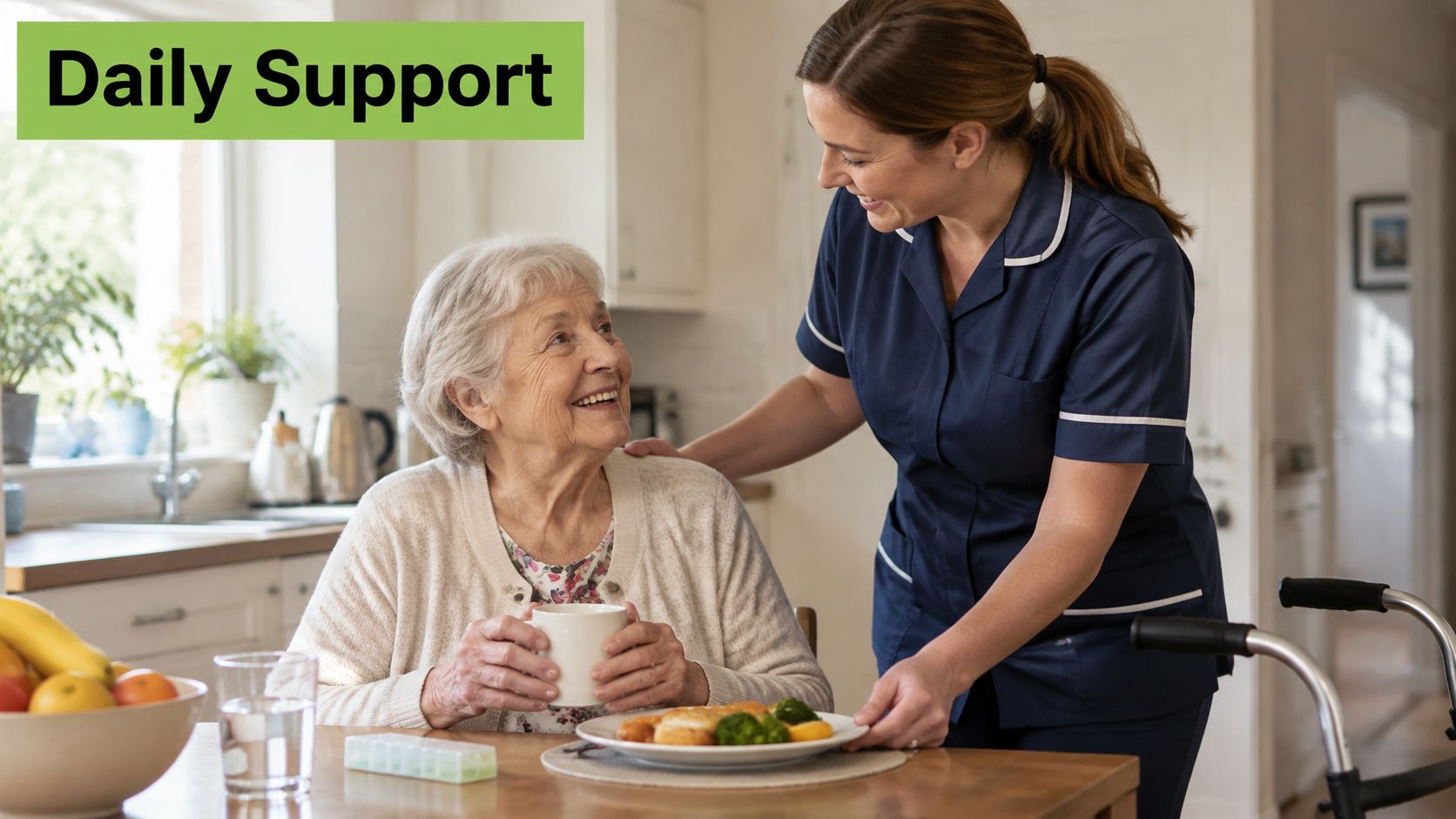
Domiciliary care is flexible home-based support: personal care, household tasks and general assistance. Personal care covers washing, dressing, hair, teeth and shaving, at the pace and in the order the person prefers, because dignity lives in the details. Nutrition means prompting breakfast, noting how much was eaten, and encouraging drinks through the day. Medication support is usually a reminder and a check against a dosette box or blister pack; giving medicines can require extra training and should be agreed in the care plan.
Moving around the home covers standing up from a chair, transfers to the bathroom or commode, and the stairs. Household routines such as laundry, changing bedding, washing up and emptying bins keep the home workable day after day.
Visit frequency follows assessed risk, so ask for the reasoning, not only the timetable. Someone home from hospital two days ago may need four calls a day for a fortnight; someone with stable needs may need three visits a week. The useful question is what would trigger an increase, a reduction, or an urgent review.
What Gets Recorded and Who Gets Told
Each visit should produce a record: falls, missed medication, how much was eaten or drunk, whether personal care was completed, and any unplanned hospital attendance. Those notes let a care coordinator spot a trend forming over several visits.
Agree escalation criteria in writing before the first visit. Repeated falls, acute confusion, reduced intake, or being unable to transfer safely should trigger a same-day call to a family member, GP or district nurse. If transfers are the sticking point, the right daily living aids for elderly people at home can solve more than an extra visit does.
Two questions sort a provider quickly: how are changes recorded, and who is told when they happen? A clear answer should name the record, the person responsible, and the timescale for action.
How Respite Care Gives Family Carers a Break
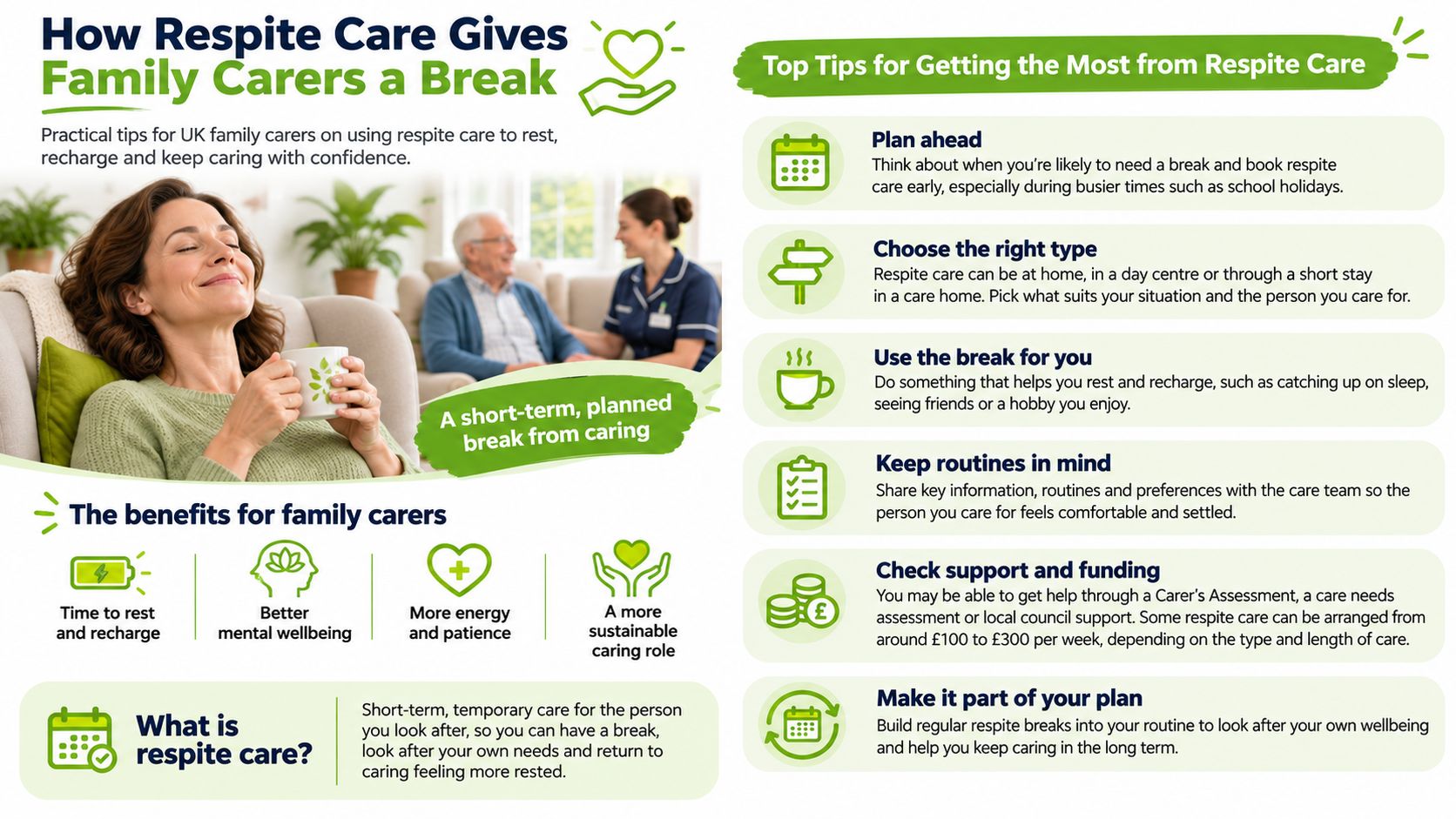
Respite care is short-term cover that lets an unpaid carer stop for a while. The person you care for still gets their meals, their medication prompts and their routine. You get a night's sleep, an appointment of your own, or a week away.
Planned respite is booked ahead for a holiday, a wedding, or surgery you've known about for months. Emergency respite is the version nobody schedules: you fall ill, or the person you care for changes suddenly, and cover is needed in hours rather than weeks. Ask any provider which of the two they can deliver, because the honest answer isn't always both.
There are two main formats. In-home respite brings a carer in at the usual times, which suits someone who finds travel hard, gets unsettled in unfamiliar places, or has dementia that flares in a strange environment. Facility-based respite, at a care home or day service, offers a change of scene and a fuller day of activity, and works well for people who enjoy company and can manage a night away from their own bed.
What Carers Say About the Support on Offer
The England-wide picture from the Adult Social Care Outcomes Framework survey for 2023 to 2024 is worth reading. 36.7% of unpaid carers reported overall satisfaction with social services, and only 30.0% said they had as much social contact as they would like, though that was up from 28.0% in 2021 to 2022. On being heard, 36.9% always felt involved or consulted about the person they cared for, rising to 66.4% once carers who usually felt involved are counted, while 8.4% said they never felt involved.
Those numbers aren't a verdict on you. They point at mechanics you can control when you set support up.
Four Things to Put in Place Before You Book
- Write the routine down. Preferred wake-up time, what breakfast looks like, which cup, which chair, when the tablets go down. A carer who arrives already knowing this is a different experience from one who asks.
- Name one contact. Decide in advance who the provider rings when something changes, and whether that's you, a sibling or a neighbour with a spare key. Ambiguity here is how small problems become phone calls at the worst moment.
- Protect your own social time in the schedule. Book the break around something you'll look forward to, whether that's a class, a visit or a lie-in, and treat it as fixed.
- Book at least one break before you're desperate. The first planned break teaches you how the handover works while you've still got the energy to manage it.
Planning a break is good practice. It isn't an admission that you can't cope.
Cost is usually the next worry, and the cost of respite care depends on whether you need an hour, a night or a week, and whether it happens in the person's own home or a residential setting. Ask for that breakdown in writing rather than a single figure.
How to Arrange Home Care Step by Step
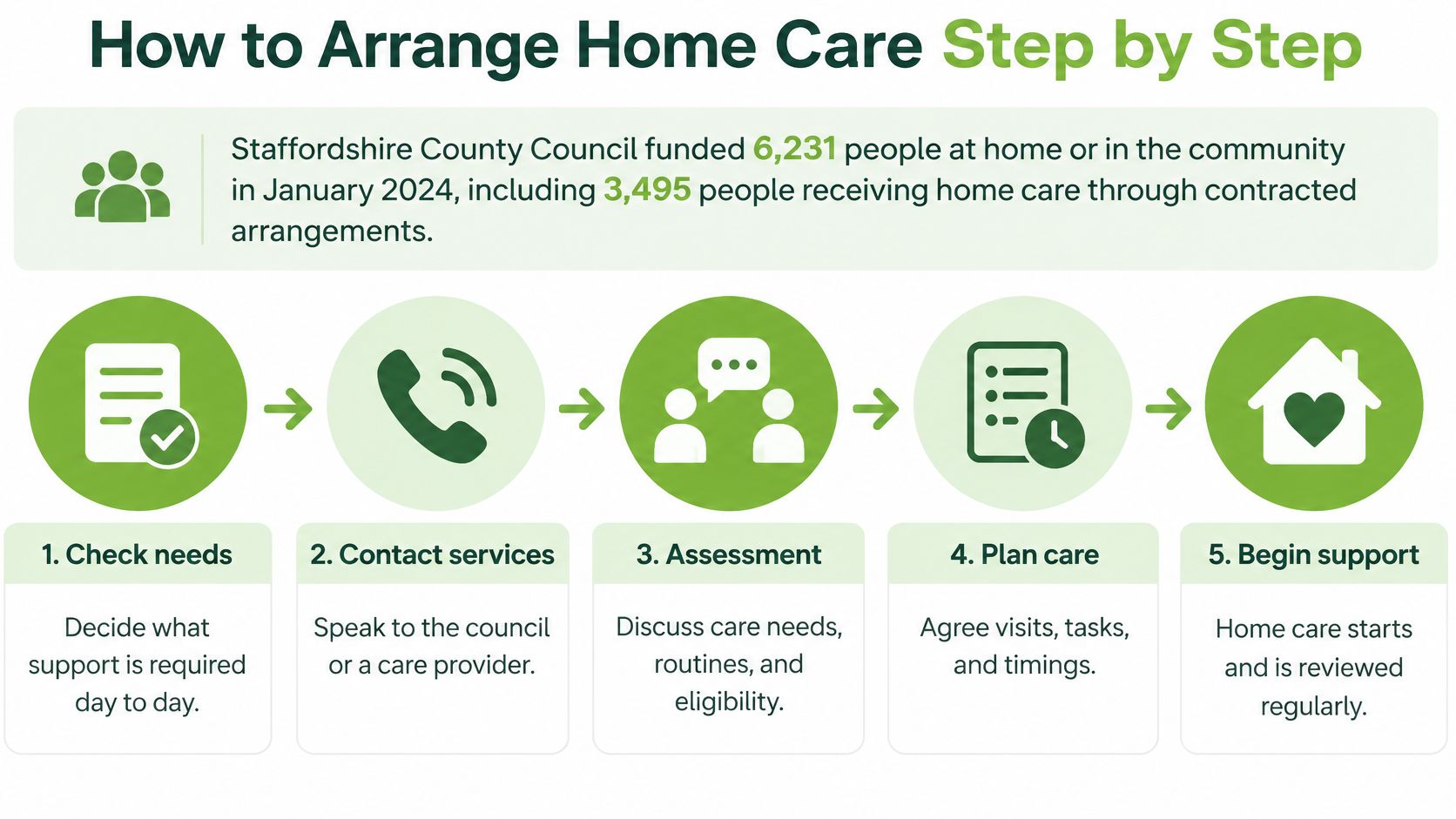
Staffordshire County Council funded care for 6,231 people at home or in the community in January 2024, including 3,495 people receiving home care through contracted arrangements or direct payments, and recorded a 7.13% uplift in relevant fees from 6 April 2025, according to the council's 2025/26 fee review decision report. That's the funding backdrop.
What it means for your household depends on an assessment and a means test, not on the fee percentage itself.
Means-tested support may cover part of the cost. With direct payments, the person chooses and manages their own carer; with council-arranged care, the authority sets it up. Keep the two roles separate in your mind: the council decides what need exists and what funding follows, while the provider decides what it can deliver on a given day. Staffordshire reports a generally sustainable market with no difficulty sourcing care, but market-wide availability isn't the same as your preferred provider holding your Tuesday 8am slot with the same carer each week. Check that directly, with the provider, before you assume it.
Six Steps From First Call to First Visit
- Request a needs assessment. Go through the council or your GP, because funding follows assessed need rather than diagnosis. If you're the carer, ask for a carer's assessment too: councils recorded £203 million of expenditure on support to carers in 2024 to 2025, up about 11% from £183 million the year before, according to the adult social care finance report for England.
- Ask how the money would work. Means testing, direct payments, and what happens if your preferred provider has no availability on the day you need. If you'd rather talk it through with a provider first, you can fill in our simple contact form and the team will get back to you.
- Describe the situation, not the service. Tell the assessor what has become hard and what risks you've noticed, rather than asking for "home care" as a label. The same assessed need can be met by companionship visits, personal care or short-term respite, and describing the situation keeps every option open.
- Compare providers on the awkward details. Visit length, travel charges, and the escalation arrangements if something changes at the weekend. These are the terms that cause trouble later, not the headline hourly figure.
- Ask for rates in writing. There's no published local rate card, so request each provider's hourly rate and minimum visit charge, and budget separately for temporary respite or a burst of post-discharge visits.
- Agree the plan and a review date. Get the written care plan, confirm who to ring, and book an early check-in for the first fortnight rather than waiting three months to find out how it's going.
Book a Local Care Assessment This Week
The decision reduces to three moves. Identify the situation (loneliness, hands-on personal care, a carer at breaking point, or a discharge date), choose the option that matches it, and confirm the funding route before you sign anything. Done in that order, you avoid paying privately for something an assessment would have covered, or waiting weeks for a council assessment when you need cover now.
Ours is a local service. Cream Home Care has an office at 2 Victoria Square, Hanley, Stoke-on-Trent, ST1 4JH, and provides home care across Stoke-on-Trent, Newcastle-under-Lyme and North Staffordshire. Call the care team on 01782 444007, or email info@creamhomecare.co.uk.
Before the call, have four things to hand:
- The tasks that have become hard. Washing, dressing, cooking, stairs, medication, getting out of a chair.
- Health concerns and medication. What's prescribed, what's prompted, and anything that's changed recently.
- Preferred visit times. When the person is at their best, and when they need someone there.
- The outcome of the needs assessment from step one, if it's already happened.
Ask about continuity and cancellation rules rather than working through the whole checklist again. One call this week, before a crisis makes the decision for you, gives you more choice over which carers visit and at what times.
Cream Home Care provides home care, companionship, domiciliary care, respite care and elderly care across Stoke-on-Trent, Newcastle-under-Lyme and North Staffordshire, with care plans built around each client's routines rather than a standard package. If you're weighing companionship visits against personal care, or planning a first respite break, the team can talk through which option fits your family and what the next step looks like. Visit Cream Home Care to see the full range of support and get in touch.