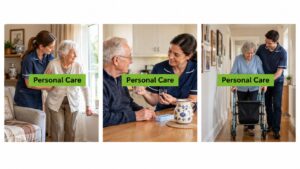
The care worker at the door asks where the medicines are, how your mum likes her tea and what a normal morning looks like. Yesterday's worker knew all of that. You answer again, while wondering whether anyone has passed on that she's been struggling to stand.
A visit has been arranged, but something important is missing. Continuity of care means your relative's relationships, information and support remain connected, even when the person at the door changes.
What Continuity of Care Means at Home
A completed rota tells you someone attended. It doesn't tell you whether that worker understood the person, read the latest notes or knew whom to contact about a concern.
Think of a house key. Several authorised people might hold one, but that doesn't mean they know the household. A small named team needs to understand how the person lives, while anyone covering a visit needs enough information to provide safe, respectful support.
Three dimensions of continuity at home
The 2026 Oxford scoping review of 180 UK primary-care studies describes relational, informational and managerial continuity, finding that relationships were measured much more often than information transfer or coordination.
These terms sound technical, but families can recognise them in everyday care.
| Dimension | Meaning at home | What good looks like | Simple audit |
|---|---|---|---|
| Relational | An ongoing relationship with a small named team | Workers know routines, preferences and warning signs | Share of visits delivered by the agreed core team |
| Informational | Records and preferences follow the person | Baseline, daily notes and medicine changes are written and shared | Next worker can act without phoning the family for yesterday's change |
| Managerial | Care is coordinated across family, GP, nursing and discharge teams | A named contact owns each escalation and the next step is clear | Missed referral, missed visit or contradictory instruction is resolved |
Repeat visits alone don't prove continuity. The same worker can attend regularly but still lack an updated medicine list. Equally, a detailed care folder won't help if nobody takes responsibility for contacting the district nurse.
Familiarity needs a usable record
A familiar worker gradually learns the person's baseline, meaning what is usual for them. That includes how they walk, communicate, eat and manage everyday tasks, rather than their diagnoses alone.
Say your dad normally walks to the kitchen with his frame and enjoys choosing breakfast. If he stays seated and leaves his toast untouched, a worker who knows him can describe a meaningful change rather than recording that he seemed tired.
That knowledge must travel beyond the individual worker. Cura Academy's guidance on better handovers for care workers is a useful resource when discussing how colleagues should pass on changes, preferences and unfinished actions.
Practical rule: A care package should preserve what staff know about the person, not depend on a particular worker remembering everything.
Ask the person receiving care what they want workers to remember, too. Their preferred name, communication needs and wishes about personal care belong alongside practical instructions.
Score any current or proposed package against every row in the table: working well, needs attention or missing. A strong relationship shouldn't hide a weak handover or an unresolved referral.
Why a Familiar Carer Protects Health and Dignity
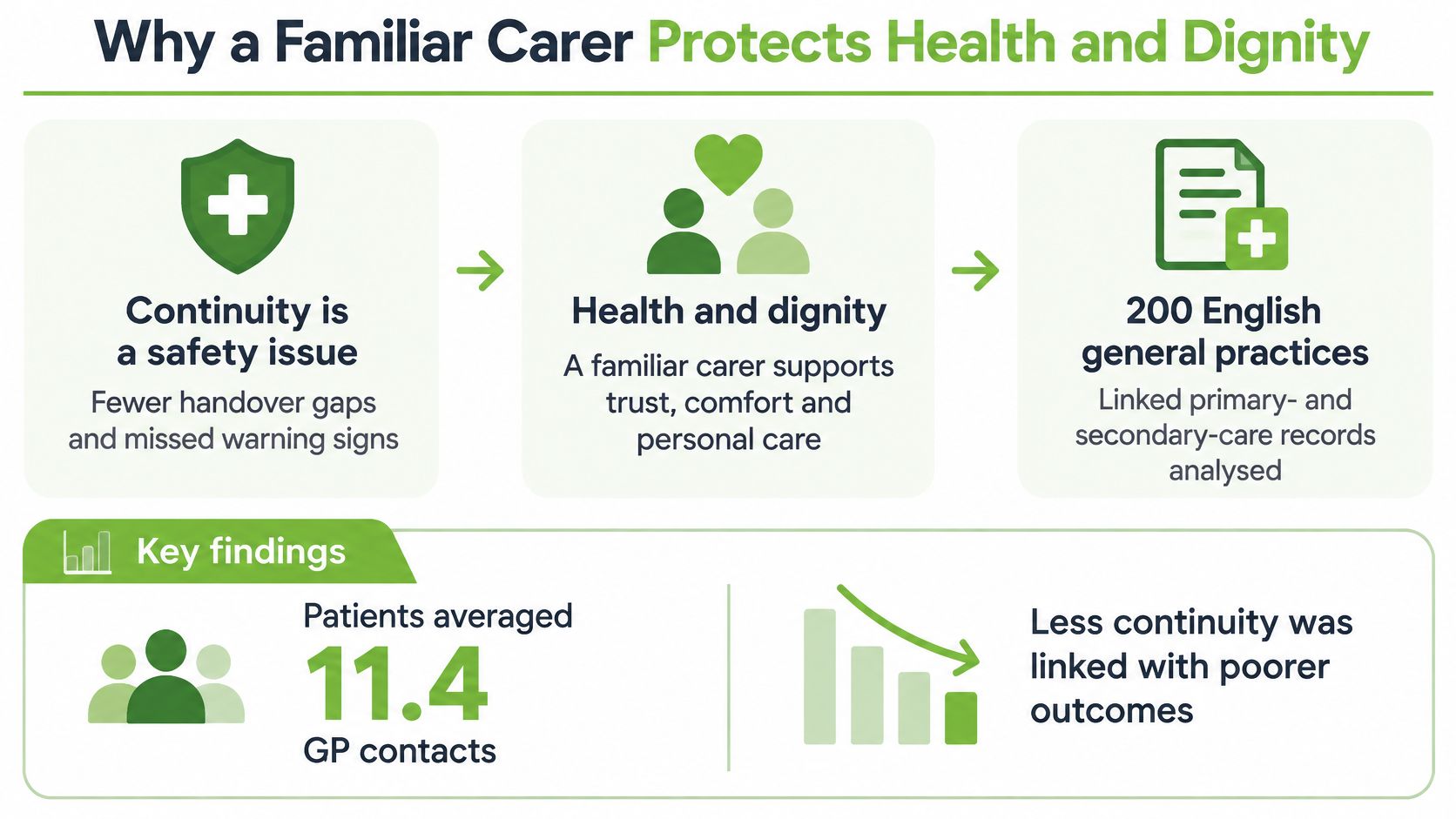
Continuity is a safety issue, not just a preference for a friendly face. In an analysis of linked primary- and secondary-care records from 200 English general practices, the Health Foundation report on GP continuity estimated that seeing the most frequently consulted GP two additional times in every 10 consultations was associated with 6% fewer hospital admissions for the conditions examined, after accounting for patient characteristics.
That is an association, not proof that continuity alone prevents admission. People's health, circumstances and access to services also affect hospital use.
Understanding the GP measure
The Usual Provider of Care index describes how much of someone's contact is with the GP they see most often. It measures repeated contact, not whether every consultation was good.
The linked-record analysis reported the following measures.
Continuity and hospital admissions in English general practice
| Measure | Figure |
|---|---|
| GP contacts over two years | 11.4 on average |
| Usual Provider of Care index | 0.61, so 61% of contacts were with the GP seen most often |
| Extra contacts with that GP | 2 more in every 10 consultations |
| Hospital admissions | 6% fewer for the conditions examined, after accounting for patient characteristics; an association, not proof |
The same counting idea can help families examine a home-care rota, without pretending home visits are GP consultations. As a hypothetical example, eight of ten visits from an agreed core team provides more repeated contact than three of ten, with the remainder spread across unfamiliar workers. It doesn't establish a clinical benefit or a universal staffing target.
Knowing what has changed
At home, the useful question is what familiarity allows a worker to notice. Someone who knows the person's usual walking, appetite, pain and level of confusion can give a clearer account when seeking clinical advice.
They might explain that your mum normally dresses with verbal encouragement but now cannot follow the sequence. That description is more useful than saying she wasn't herself, and it helps the clinician decide what assessment is needed.
Dignity matters just as much during washing, dressing and continence care. Having to explain an intimate preference to each unfamiliar worker can feel exhausting or embarrassing.
- Personal care: A known worker understands how the person wants to be covered and which tasks they prefer to do themselves.
- Communication: They know whether to allow extra processing time, use a hearing aid or offer choices separately.
- Trust: The person may feel more comfortable reporting pain, a continence problem or fear of falling.
Kindness during a pleasant one-off visit is valuable. But kindness without knowledge of the person can still leave a change unnoticed.
Ask prospective providers: who will know this person well enough to notice that they're not themselves?
How to Keep a Small Named Care Team
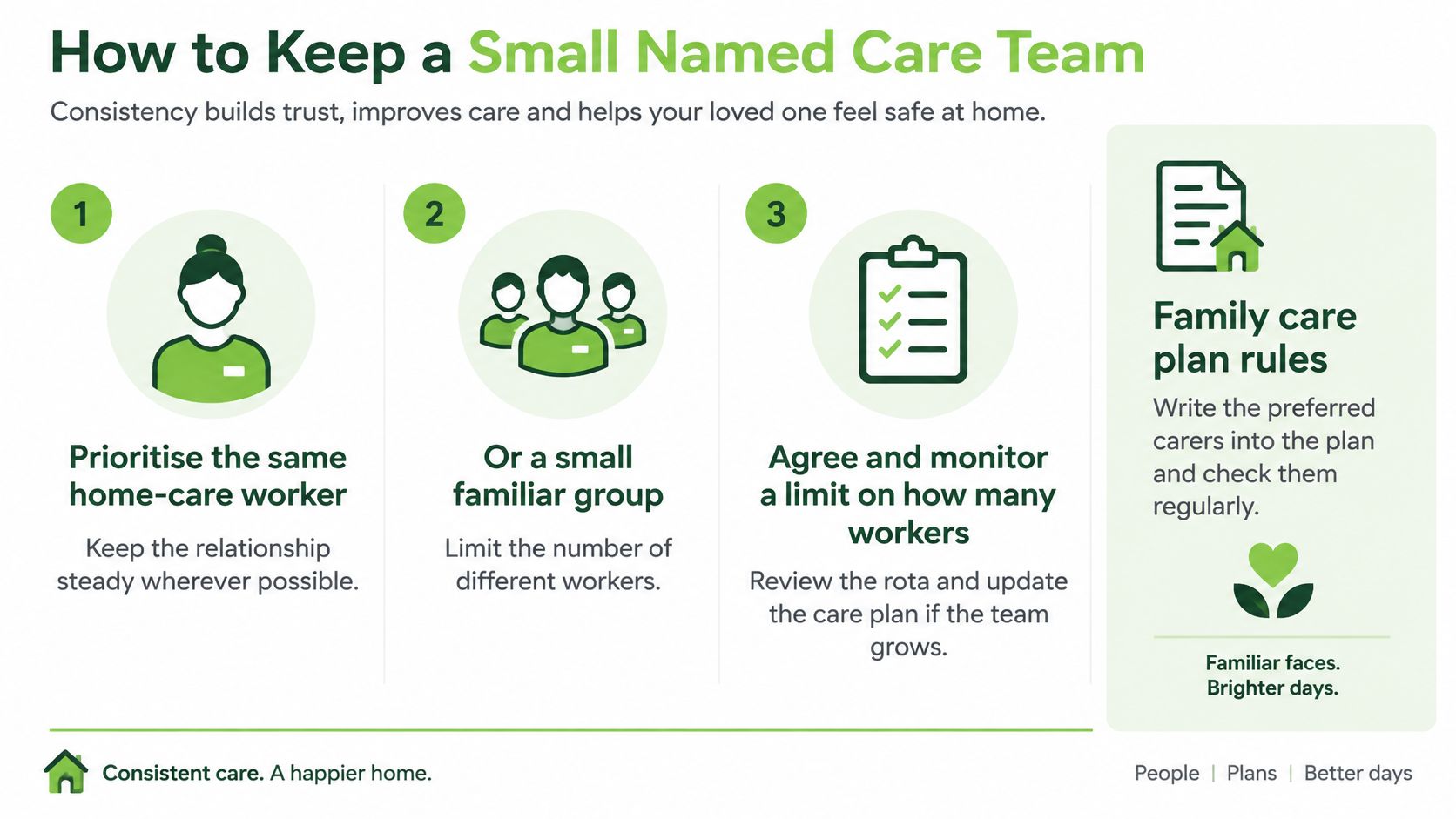
Ask for names and arrangements, not just a promise of consistent staff. The care plan should explain who normally attends, how replacements are introduced and what happens when someone is off sick.
The Healthwatch home-care report recommends prioritising the same worker or a small familiar group, agreeing and monitoring a worker limit suited to visits and needs, and introducing workers before their first visit. Where meeting isn't possible, it recommends attempting a suitable introductory telephone conversation.
Put the staffing agreement in writing
Name the core team. As a starting proposal, ask whether two or three regular workers and one already-known backup could cover the package. This is an example to negotiate, not a universal safe staffing limit.
Write down the weekly pattern and maximum number of workers. Include weekends and evening calls. A promise about weekday mornings isn't enough if the person meets unfamiliar workers throughout the rest of the week.
Arrange introductions before care begins. Let the person meet the worker and explain how they prefer to receive support. A telephone introduction should suit their hearing, memory and communication needs.
Fit call times around the person's routine. Washing, meals and medication support need sensible timing. Ask what arrival window the provider can deliver, rather than accepting a time that only fills a gap in the rota.
Plan sickness cover. The known backup should be the first option where available. Write down who contacts the household, who checks the replacement attended and what happens if no worker can arrive.
Review the limit when needs change. After illness or hospital admission, the person may need additional visits or workers with different skills. Explain the change and agree a revised arrangement rather than allowing the team to grow unnoticed.
A growing market doesn't guarantee familiar staff
The Care Quality Commission's assessment of home care identifies a consistent care worker as part of good provision and records an 11% increase in newly registered English home-care services in 2024/25, compared with 3% growth in the North East, which had the lowest provision at 69 services per 100,000 people aged 65 and over.
Those figures describe service availability, not whether a particular household receives a stable team. The written worker limit still needs to be agreed locally.
For example, Cream Home Care, based at 2 Victoria Square, Hanley, builds personalised plans covering companionship, personal care, medication reminders and household tasks in Stoke-on-Trent and Newcastle-under-Lyme. When comparing it with other options, use these questions for choosing a home-care provider to discuss the actual staffing arrangements.
A practical sentence to add to the plan is: new workers are introduced first, and visits stay inside the agreed team unless the person, or their authorised representative where appropriate, agrees otherwise.
Daily Records and Handovers That Travel
Use this handover test: can the next worker act safely without phoning the family to discover yesterday's change? A record that merely says all tasks completed won't pass it.
The daily note should be brief enough to scan quickly but specific enough to guide action. Workers need to distinguish what they observed, what the person said and what they did about it.
Make the usual picture easy to find
Keep a concise baseline page at the front of the paper record or clearly accessible in the care-record system. It should describe usual waking times, walking aids, communication needs, faith or cultural preferences, authorised recipients of updates and what a difficult day normally looks like.
Daily entries then need to capture:
- Attendance and support: Arrival and departure times, tasks completed and anything left unfinished.
- Food and fluids: What was offered and taken, including a meaningful change in appetite or drinking.
- Everyday health: Mood, mobility, skin concerns and continence, described respectfully.
- Medicines: Prompts or assistance provided within the agreed role, including declined medicines.
- Changes and action: What differed from baseline, who was contacted and what should happen next.
A significant update should reach the appropriate family contact, GP, district nurse or discharge team the same day, with the person's consent where applicable. Urgent deterioration needs urgent help, not a note left for the next visit.
A handover is complete when the next person knows what happened, what was done and what remains unresolved.
Check medicines without guessing
After hospital discharge or a change made by the GP, compare the home medicine list with the latest authorised instructions before prompting the next dose. Medication reconciliation means checking the lists agree and getting discrepancies resolved by an appropriate clinician or pharmacist.
If a dose, medicine name or stopping instruction conflicts, seek advice promptly and the same day. Don't choose between competing lists, change the dose independently or delay a time-sensitive query until a routine review.
Privacy also belongs in the handover. Record when the person declines information sharing, explain any safety concerns to the responsible manager and avoid sending intimate details in a family message without agreement.
A declined wash still needs a respectful entry, including the person's reason if they wish to give one and any alternative offered. A missed visit needs a recorded contingency and follow-up, not a blank line.
Families can request a weekly record review focused on gaps, contradictions and unreported changes. They don't need to inspect every personal detail to check that the handover works.
The First 72 Hours After Hospital
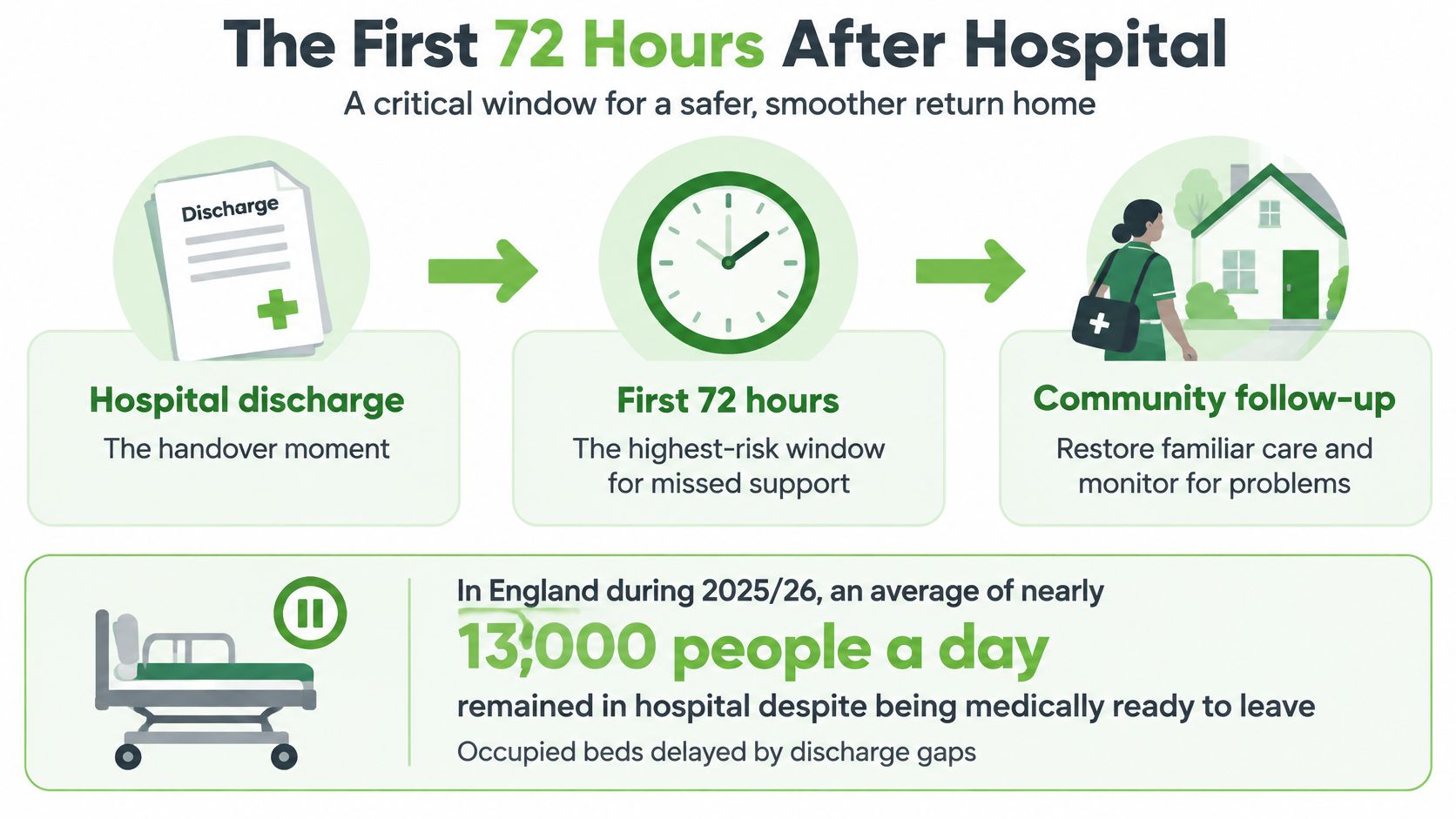
A hospital may decide someone is medically ready to leave when they no longer need an inpatient bed. That does not mean their home support is ready. In England during 2025/26, nearly 13,000 people a day remained in hospital despite being medically ready, occupying 13.8% of adult general and acute beds, according to the CQC's hospital discharge assessment.
Among discharge-ready patients who had stayed at least a fortnight, 12% of delays were attributed to insufficient social-care capacity, nearly 1,000 people daily. Another 12%, almost 1,100 people daily, were attributed to transfer negotiations.
A care package on paper is only a starting point. If your dad is coming home after surgery, continuity means a named relationship, a record that travels with him, and people coordinating what happens next. The plan must work in his kitchen, bathroom and bedroom, and support both him and the family member helping him.
Before leaving hospital
Before your relative leaves, ask what happens next, who is responsible and whether the practical arrangements are ready. Check that the discharge summary, medicines, equipment, transport and visit times are in place, and find out who to contact if something is missing.
The NHS discharge team arranges the clinical handover and referrals within the discharge pathway. Home-care workers provide the agreed practical support and report concerns. They do not replace the discharge team or make clinical decisions.
A home visit may be needed to check that the person can manage safely with the planned equipment and support. Hospital staff or an occupational therapist can advise on the home setup. Families can also use this guidance to create a safer post-surgery recovery space.
At home, check delivery rather than promises
- On the first day: Ask the named provider coordinator to confirm that the first visit took place and update the nominated family contact. Check that the person's mobility, memory, eating and falls risks match the hospital plan.
- Over the following days: Follow up on medicine queries and whether the person is eating and drinking. Report new confusion promptly. If a referral is missing, contact the named discharge contact the same day.
- If the plan doesn't fit: Contact the provider and discharge team to request a reassessment. A worker should not attempt an unsafe transfer because the written plan assumes the person can manage it.
For a medicine discrepancy, contact the discharging ward, GP or pharmacist promptly, following the discharge instructions and the urgency of the issue. A hospital discharge care plan can help the family organise contacts and follow-up.
Cream Home Care provides home care and respite in Stoke-on-Trent and Newcastle-under-Lyme, subject to assessment and availability. If support is needed while checks are completed, ask whether bridging visits are available. After the first fortnight, review whether the person remains safely at home because the support fits their needs, not just because visits were booked.
Agree who arranges cover if a visit is missed. That contingency is part of the care plan, and helps the person and their unpaid carer know what to expect.
Monthly Signals That Continuity Is Holding
Monthly continuity signals at home
| Signal | What good looks like | Review the plan when |
|---|---|---|
| Core-team visits | Most visits come from the agreed small team | Strangers attend without prior agreement |
| Introductions | Every new worker is introduced in person or by a suitable call | A first visit happens with no introduction |
| Missed or late visits | Cover is a known backup and the gap is recorded | A visit is blank with no contingency |
| Medicines | Home list matches the latest instructions before the next dose | A discrepancy waits beyond the same day |
| Escalation | A named contact receives significant changes the same day | Family, GP or nurse learn of a change late |
| Carer's week | Respite and updates protect work, sleep and one social commitment | The carer is losing time, control or contact |
Use the rota, visit record and unresolved-action list together. Count visits delivered by the agreed team against all completed visits, then look at why unfamiliar workers attended rather than treating the result as a pass-or-fail score.
A stable-looking rota can conceal other problems. Repeatedly late visits might disrupt meals, while a family member who spends every evening chasing updates may be doing coordination work the package was meant to reduce.
Include the unpaid carer's life
For England in 2024 to 2025, the Department of Health and Social Care's outcomes commentary reports that 84.0% of unpaid carers had partially met or unmet needs concerning how they spend their time, 78.4% around control over daily life and 69.9% around social contact.
These national figures are a prompt for discussion, not a score for your household. Ask whether the family carer can keep their job, attend appointments, sleep properly and maintain a social commitment without repeatedly cancelling.
Predictable respite means a break the carer can use. If they remain on standby because visits are unreliable, being out of the house doesn't necessarily mean they're relieved of responsibility.
A useful warning sign: If the person receiving care seems settled but their family carer is steadily losing sleep and freedom, the arrangement needs attention.
Keep the review short and practical
Try a 20-minute monthly conversation as a practical starting point, not a required standard. Invite the person receiving care to lead wherever possible, and ask:
- What changed from baseline? Identify the change and check whether anyone acted on it.
- Did the agreed team deliver the visits? Examine exceptions and their effect on the person.
- Could the family carer keep their own week? Adjust respite or communication around specific commitments.
The Adult Social Care Outcomes Framework also tracks people supported at home and formal-care staff leaving their roles. Those measures describe wider service conditions; they don't replace household checks.
A falling core-team share or a carer skipping sleep is a reason to revise the plan before a crisis.
Agree Who Pays and What Continues
Before agreeing the package, turn the discussion into a written agreement. Confirm the essentials without leaving the family to fill gaps informally.
- People: Record the named core team and agreed size limit.
- Information: Confirm the baseline page, daily record and escalation contacts for medicine concerns, falls and missed visits.
- Respite: Protect the family carer's work, sleep and a regular social commitment.
- Reviews: Agree a check after the first fortnight, followed by monthly household reviews.
Funding shouldn't determine whether care stays connected
The UK Government consultation on adult social-care market oversight gives approximate home-care contact-hour purchasing shares of 60% for local authorities, 21% for individual consumers, 10% through direct payments and 7% for the NHS, and cites an estimate that small providers account for 60% of the market.
These are consultation figures, not a current local funding breakdown. Whatever the funding route, ask who authorises changes, who receives invoices and what support continues during a dispute or reassessment.
Use the guide to how much in-home care costs to prepare questions about the package, including cover and changes in need. If a provider withdraws or fails, ask the local authority how essential visits will continue; service exit is a continuity issue, not just a private inconvenience.
For households in Stoke-on-Trent and Newcastle-under-Lyme, Cream Home Care can shape companionship, personal care or respite around existing routines. Home care provides agreed support and reports what's happening; it doesn't replace the GP, district nurse or hospital discharge team.
The person shouldn't have to reintroduce their life at every visit.
Cream Home Care offers personalised companionship, domiciliary care and respite for families in Stoke-on-Trent and Newcastle-under-Lyme. Visit Cream Home Care to discuss a named care team, reliable handovers and support that protects both your relative's routine and your own time.