Privately arranged elderly home care in the UK commonly costs around £25 to £38 per hour, while a compliant minimum is around £32 to £34 per hour. Even 2 hours of care each day can reach about £350 per week, before additional charges for evenings, weekends, travel or specialist support.
You may be looking at care because a parent has returned from hospital, a partner is finding personal tasks difficult, or a family carer can no longer manage without regular breaks. The emotional decision is hard enough without trying to understand why one hourly quote differs so sharply from another.
The phrase elderly home care cost can sound as though there should be one simple answer. In practice, the final price depends on the number and length of visits, the type of help required, whether care is arranged privately or through a council, and whether support is needed overnight or continuously.
For a family in Stoke-on-Trent or Newcastle-under-Lyme, the useful question isn't just, “What is the hourly rate?” It's, “What will this care plan cost over a normal week, what does the fee include, and will it remain suitable as needs change?” This guide explains those questions in plain language, so you can compare care with greater confidence and protect your loved one's independence without overlooking financial sustainability.
Introduction to Elderly Home Care Cost in the UK
When Margaret's daughter first searched for care, she expected to find a price list. Her mother needed help with washing, breakfast, medication reminders and a little company after returning home from hospital. The family quickly discovered that an hourly figure didn't answer the questions that mattered most. How many visits would be needed? Would the same carer attend? Were evenings included? What happened if her needs increased?
That experience is common. Families often begin with a short-term concern, but care can continue for months or longer. A rate that looks manageable for one visit may become a substantial commitment when repeated every day. Age UK cites private home care in an older person's own home at around £25 per hour, while the average hourly rate paid by local authorities for externally commissioned home care was £22.03 in 2023/24. These are different figures for different parts of the market, as explained by Age UK's guide to care costs.
Why the headline rate isn't the whole bill
At £25 per hour, two hours each day works out at about £350 per week, or approximately £18,200 a year, before extra charges. Those extras may include evening or weekend care, travel time, specialist support, or changes to the schedule. A provider charging more may include stronger staffing cover, training, care planning and coordination that a lower quote leaves unclear.
The wider market has also faced sustained cost pressure. The King's Fund reports that, in real terms, the average hourly rate for home care rose 18% since 2015/16, while the average weekly fee for older people's care home places rose 33% over the same period. Its Social Care 360 expenditure analysis helps explain why families and councils are both scrutinising fees more closely.
For local families, Cream Home Care's home care services may include companionship, domiciliary support, respite and help with daily routines. The right starting point is an honest assessment of what your loved one needs now, followed by a conversation about how the plan could adapt later.
How Elderly Home Care Pricing Models Work
Home care pricing makes more sense when you treat it like choosing between pay-as-you-go support and a planned package. An hourly visit is similar to paying for each journey separately. A regular package is closer to arranging a dependable travel pass, where the pattern of support is agreed in advance.
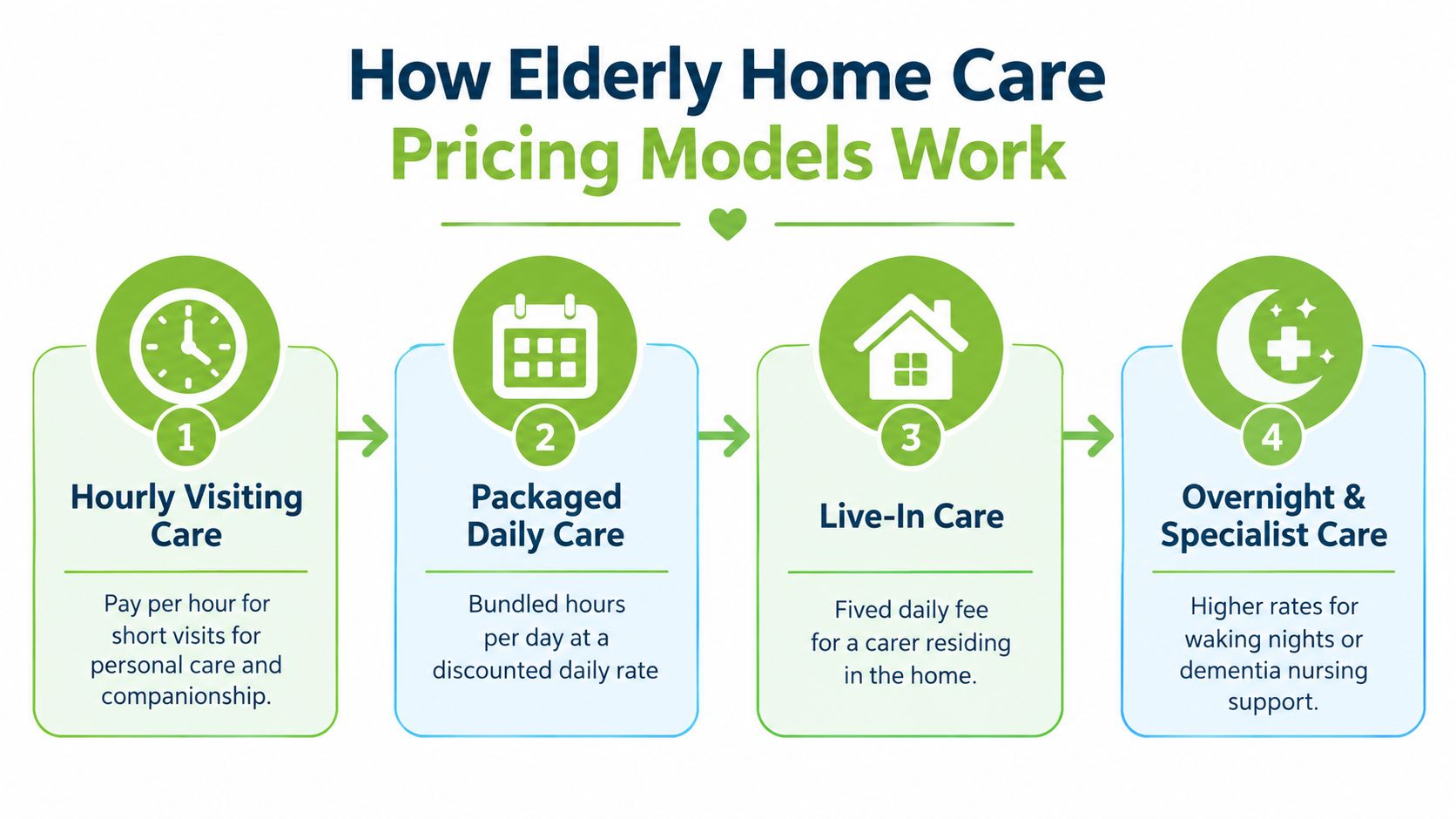
Hourly visiting care
Hourly care suits people who need assistance at particular points in the day. A carer might help with getting up, washing and dressing, preparing food, prompting medication or settling someone for bed. The weekly cost is calculated by multiplying the agreed hourly rate by the hours delivered, then checking whether separate charges apply.
A short visit can be useful, but the schedule matters. Several brief calls may cost more across a week than a smaller number of longer visits, even when both arrangements provide similar total support. Ask whether the quoted time includes arrival, handover and recording care notes, or whether those activities are handled separately.
Packaged daily care
Some families agree a regular daily pattern, such as morning and evening visits with additional support at lunchtime. A provider may describe this as a package rather than listing each appointment. The benefit is clarity: everyone understands when support is expected and which tasks belong in each visit.
A package isn't automatically cheaper. Its value depends on the rate, the guaranteed hours, the flexibility of the arrangement and what happens when a visit is cancelled. Request an itemised weekly figure rather than relying on the word “package”.
Live-in, overnight and specialist arrangements
Live-in care uses a different pricing model because a carer stays in the home rather than visiting for isolated periods. UK-facing guidance commonly places live-in care around £220 per day, or roughly £1,540 per week, while care intensity and the arrangement itself can alter the final amount. The comparison should include practical requirements in the home, rest arrangements and what support is expected during the night. Families considering this model can review the cost of a live-in carer as part of their research.
Overnight care also needs careful definition. A sleeping night, where the carer can rest, isn't the same as a waking night involving repeated assistance. Dementia support, nurse-led care and complex moving and handling may require additional expertise and staffing.
Practical rule: Ask a provider to separate the care rate, the hours, the supplements and the conditions of service. A clear quote is easier to compare than a low headline number.
What Drives Your Elderly Home Care Quote Higher or Lower
Two families may request “two hours of care” yet receive different quotes because the work inside those hours isn't the same. Helping someone prepare breakfast and reminding them about medication involves different planning and risk management from supporting complex mobility needs or responding to distress linked to dementia.
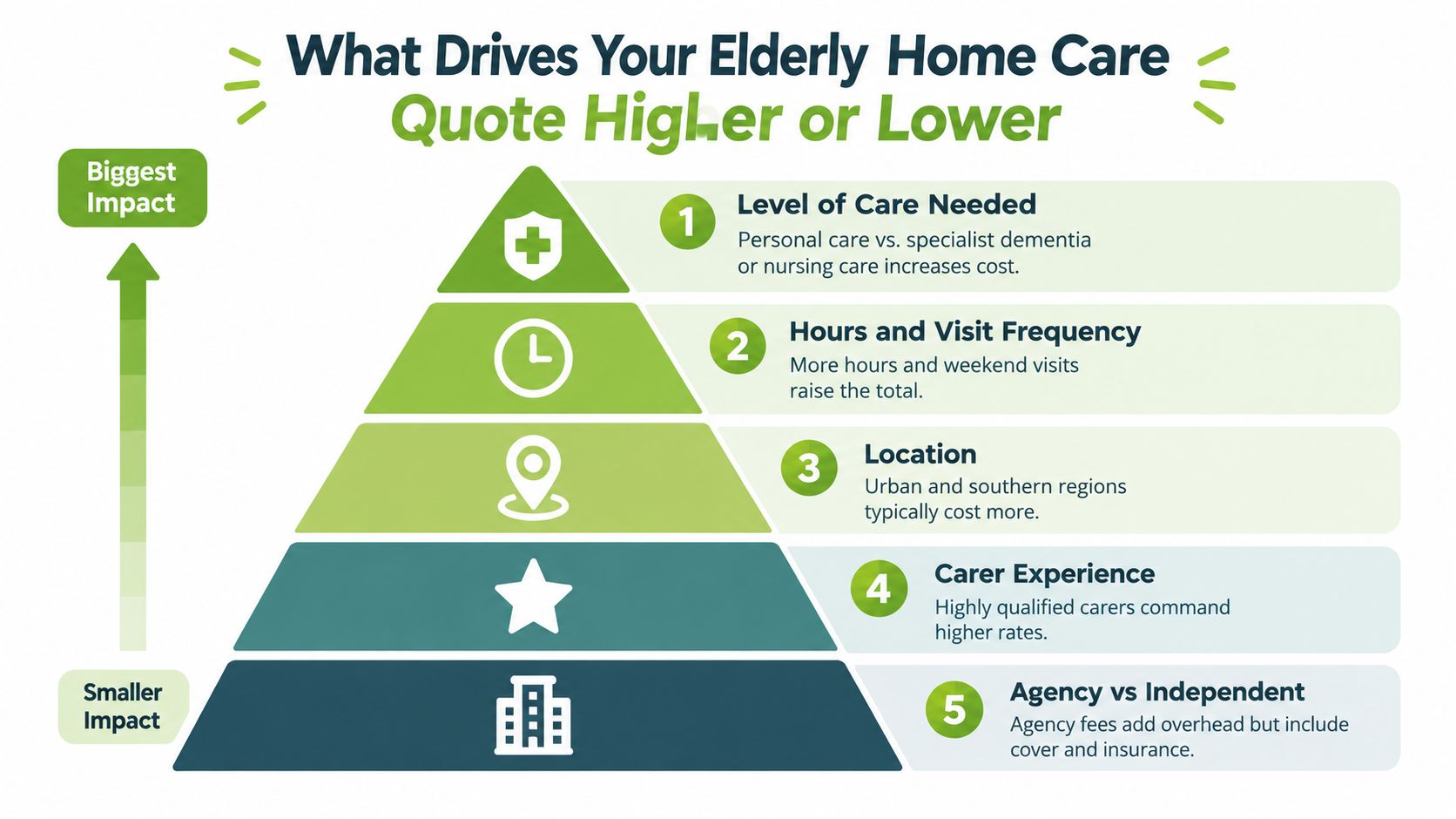
The care task matters most
Personal care, companionship and household assistance may be suitable for standard domiciliary support. Specialist dementia care, complex moving and handling or nurse-led care can require more experienced staff, additional planning and closer communication with health professionals. UK guidance cited in the market places specialist dementia support from £32 per hour and nurse-led care at £45 to £65 or more per hour, depending on the service and needs. These figures are discussed in guidance on home care costs for 2026 and 2027.
The provider needs enough information to assess risk properly. Be open about falls, continence, medication, behaviour, equipment and night-time routines. An incomplete description may produce a quote that later changes when the actual work becomes clear.
Frequency, timing and travel affect the total
More visits usually increase the weekly bill, even if each visit is short. Evening, weekend and bank holiday arrangements may attract different rates. Travel time and the distance between calls also affect what an agency must pay for non-billable staff time.
Continuity has a price too. A provider that invests in recruitment, supervision, training and backup cover carries costs that may not appear in an informal arrangement. That doesn't mean every expensive quote offers good value, but it does mean a very low quote deserves careful questions.
Why 2026 pricing sits above older advice
For 2025/26, councils paid external home care providers an average of £25.05 per contact hour, a figure reported in the government's Market Sustainability and Improvement Fund provider fee report. The Homecare Association's minimum price for sustainable home care in 2026/27 is £34.42 per hour, as stated in its response to sector funding findings.
That gap reflects wages, travel, training, holiday pay, pensions, National Insurance, administration and time that cannot always be billed to a client. The Homecare Association's 2025/26 minimum price was £32.14 per hour, according to the published sector pricing guidance. A fee below the sustainable benchmark isn't automatically unsafe, but you should ask how the provider funds continuity, supervision and emergency cover.
Regional Variations and When Home Care Costs More Than a Care Home
Location changes the price base, but care intensity often changes the decision more dramatically. A small number of visits can preserve familiar routines at home without approaching residential fees. Multiple daily calls, waking nights or continuous support can create a very different calculation.
UK-facing guidance commonly places hourly home care around £25 to £38 per hour, with sustainable England benchmarks around £32.14 to £34.42 per hour. The same guidance places live-in care around £1,540 per week, residential care around £1,298 to £1,300 per week, and nursing care around £1,512 to £1,535 per week, as set out in this comparison of care-at-home costs. These are broad market figures, not a quote for Stoke-on-Trent or Newcastle-under-Lyme.
Weekly Cost Comparison by Care Intensity
| Care Level | Typical Weekly Cost | Best Suited For |
|---|---|---|
| Two hours daily at £25 per hour | About £350 | Personal care, meals, medication reminders or companionship |
| Live-in care | Around £1,540 | People needing substantial support at home, with suitable accommodation |
| Residential care | Around £1,298 to £1,300 | People needing accommodation, meals and structured care |
| Nursing care | Around £1,512 to £1,535 | People whose health needs require nursing support |
The first row uses the example described by Age UK, while the other figures come from the care-at-home comparison above. They shouldn't be treated as like-for-like packages. Residential fees generally combine accommodation and care, whereas home care may leave the household responsible for rent, food, utilities, equipment and adaptations.
Finding the break-even point
At £34.42 per hour, one hour of care each day would cost about £241 per week, before supplements, using the Homecare Association's 2026/27 benchmark. Four hours each day would cost about £964 per week, and six hours each day would cost about £1,446 per week. Those calculations show why intensive home care can approach or exceed residential fees, but they don't include every possible charge and aren't a substitute for an individual quote.
The comparison becomes especially important when someone needs support throughout the night. A care home may become financially simpler when the person needs continuous supervision, meals and accommodation, while home care may remain preferable when needs are concentrated into specific parts of the day. Discuss safety, dignity, choice and family capacity alongside the arithmetic.
Funding Support and Financial Help for Home Care
Start with the council, not with assumptions about savings. An adult social care needs assessment looks at how a person manages daily life and whether eligible needs exist. A financial assessment then considers income and capital to determine how much the council may contribute.
The 2026 to 2027 capital rules
In England, the upper capital limit remains £23,250 and the lower capital limit remains £14,250 for 2026 to 2027, according to the Department of Health and Social Care charging circular. Between those limits, a person pays £1 per week for every £250 of capital above the lower limit. The personal expenses allowance rises to £31.80 per week.
These figures relate to England's charging framework and don't mean that every person above the upper limit pays the full private cost. The council still needs to assess eligible needs, calculate income and explain the proposed contribution. Ask for the assessment in writing and check how the council has treated pensions, benefits, property and jointly held assets.
Other routes worth checking
NHS Continuing Healthcare can fund care for people with significant health needs, subject to assessment. It isn't awarded just because someone is elderly or has a particular diagnosis. Ask the clinical team or NHS body involved in discharge and ongoing care whether an assessment is appropriate.
Attendance Allowance is a non-means-tested benefit for people over State Pension age who need help with personal care. Personal Independence Payment may apply to eligible people below State Pension age, subject to its own rules. Direct payments can allow an eligible person to arrange approved support more flexibly, but they also bring responsibilities for managing the budget and care arrangements.
Family carers should also check whether they qualify for Carer's Allowance where they provide 35 or more hours of care each week, as described in the relevant benefit guidance. Alongside care planning, some families review wider financial protection through resources about seniors life insurance, although insurance doesn't replace a social care assessment or pay every care bill.
If a relative provides most of the support, respite care options can help the family plan breaks before exhaustion becomes a crisis. Prepare bank statements, benefit details, pension information and a written record of daily care needs before speaking to the council.
Practical Tips for Budgeting and Comparing Home Care Quotes
A quote becomes useful only when it describes the same service you're comparing elsewhere. Begin with the routine, not the price. Write down what happens on an ordinary morning, afternoon, evening and night, including tasks that family members currently perform without recording them.
Build the real weekly figure
Multiply the hourly rate by the planned hours, then add any supplements or separate charges. For example, the Age UK illustration of two hours daily at £25 per hour reaches about £350 each week, before extras. If the plan includes different rates at weekends or for waking nights, calculate those periods separately instead of averaging them away.
Ask whether the invoice includes travel, care planning, supervision, holiday cover, bank holidays, cancellation periods and equipment-related tasks. Also check whether the provider bills by the full hour or uses shorter visit units.
Compare service quality as well as price
Request written answers to these questions:
- Continuity: Will the same small group of carers normally attend?
- Cover: What happens if a carer is ill or cannot travel?
- Training: Are staff trained for dementia, mobility support, medication prompting and safeguarding where relevant?
- Assessment: Who reviews the plan when needs change?
- Communication: How will the family receive updates and raise concerns?
- Terms: Are notice periods, cancellation fees and payment dates clearly stated?
A low rate may look attractive until missed visits, unfamiliar carers or unclear charges create additional stress. A higher rate may provide more dependable cover, but you should still ask for evidence of what it includes.
Plan for change without inventing a budget
The infographic suggests allowing for annual rate rises of 5 to 8 per cent, but that planning figure must be treated as a budgeting assumption rather than a guaranteed market outcome. Providers should explain how and when they review fees, so ask for the policy before agreeing long-term care.
Obtain three written quotes where possible, but don't choose by number alone. Compare the care tasks, visit times, staffing arrangements and total weekly cost in a simple table. For short-term respite, ask whether the minimum booking, assessment fee or cancellation terms differ from ongoing care.
Making Confident Decisions About Elderly Home Care
The right elderly home care cost is the one your family can sustain while meeting the person's actual needs. A lower hourly figure isn't good value if it excludes essential tasks, creates unreliable visits or leaves relatives filling dangerous gaps. Equally, a more thorough arrangement may cost more but reduce pressure on family carers and keep a loved one safely connected to home life.
Use a clear sequence. Record the daily tasks, request an assessment, obtain itemised quotes, check funding routes and compare home care with residential or nursing care if support is becoming continuous. Review the plan whenever mobility, cognition, medication or night-time needs change.
Home care can support dignity through familiar routines, personal choices and relationships with trusted carers. A local provider such as Cream Home Care can discuss domiciliary care, companionship, respite and individualized daily support for families in Stoke-on-Trent and Newcastle-under-Lyme, while helping clarify what a proposed plan involves.
The next step doesn't need to be a final lifelong decision. Ask for an initial conversation, describe an ordinary week and consider whether a planned trial of support could help your family judge practical fit, communication and continuity.
If you're comparing elderly home care costs in Stoke-on-Trent or Newcastle-under-Lyme, visit Cream Home Care to discuss domiciliary, companionship or respite support designed for your loved one. Share your loved one's routine and care concerns with the team, then request a clear plan that sets out visits, tasks and expected costs.