You're sitting beside a hospital bed at Royal Stoke, listening as someone says your relative is ready to go home. The bags are packed, but important questions remain unanswered. Who is arranging the first care visit? Has anyone checked whether the bathroom is safe? What happens if the medication instructions are unclear or the promised support doesn't arrive?
That gap between clinical readiness and practical readiness at home is where discharge can become unsafe. Hospital discharge care in Stoke-on-Trent works best when the patient, family, hospital team and community services share the same plan, particularly during the first 48 hours at home.
Understanding Your Discharge Journey from Royal Stoke
At Royal Stoke, a discharge decision can arrive before home feels ready. A doctor may confirm that hospital treatment is complete, while the patient still needs help washing, preparing food, walking safely or remembering medicines. The practical test begins after the ward, particularly during the first 48 hours at home, when unclear instructions or missing support can quickly create problems.
Age UK's hospital discharge guidance explains that discharge follows clinical readiness. The decision does not depend only on whether the patient or family feels ready. The patient and their representatives should still take part in planning the support that follows.
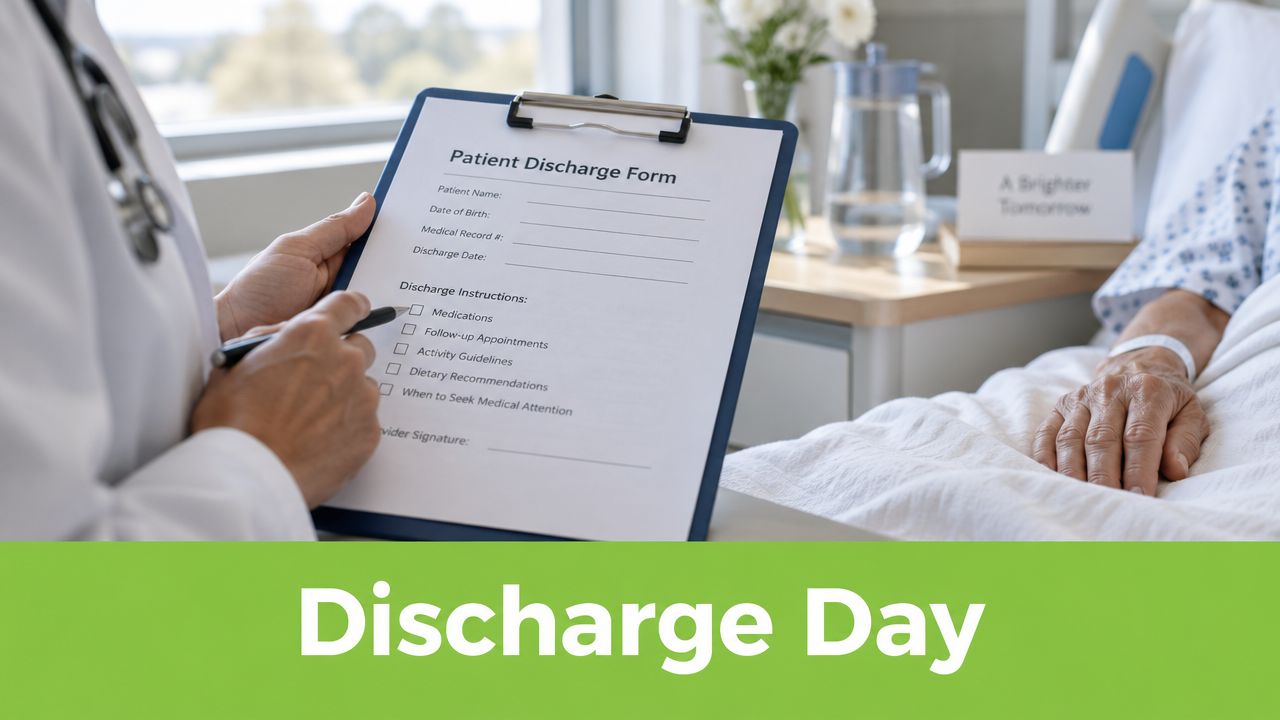
What happens before the journey home
The ward team usually begins discharge planning by referring the patient for review. Nurses, doctors, therapists, social care professionals and other practitioners consider what the person can manage and what assistance must be arranged outside hospital.
A multidisciplinary discussion may examine:
- Mobility: Can the patient stand, walk, transfer and use the toilet safely?
- Daily activities: Can they wash, dress, eat and prepare drinks?
- Medication: Which medicines have changed, and who will explain the new routine?
- Home circumstances: Are there stairs, access problems, caring responsibilities or safeguarding concerns?
- Community support: Is reablement, rehabilitation, domiciliary care or another service required?
The discharge conversation should convert these findings into actions. Ask who is coordinating the plan, where the patient is going, when equipment will arrive, when the first visit is expected and whom to contact if support is late.
Royal Stoke's Integrated Discharge Hub completed 11,263 complex discharges in the 2024-25 financial year, according to the Care Quality Commission's local system review. The figure highlights the scale of local discharge work, but an efficient process still depends on families receiving instructions they can use at home. The discharge paperwork is a handover, much like passing a route plan between teams. Every name, time and phone number needs to be clear.
Practical rule: Leave with names, timings, instructions and a backup contact, not only a discharge date.
Families seeking a clearer explanation of the social work role can consult this Cura Academy social work guide. Social workers may clarify care needs, safeguarding concerns, family involvement and the practical effects of returning home.
Communication remains a weak point. National patient experience data found that 22% of inpatients said staff did not discuss potential health or social care needs after discharge, while 24% said post-discharge support was lacking when needed, as reported by the Care Quality Commission. Those findings explain why the first evening can feel harder than the ward conversation suggested. Use the first day at home to check that the agreed plan matches reality, and report gaps promptly.
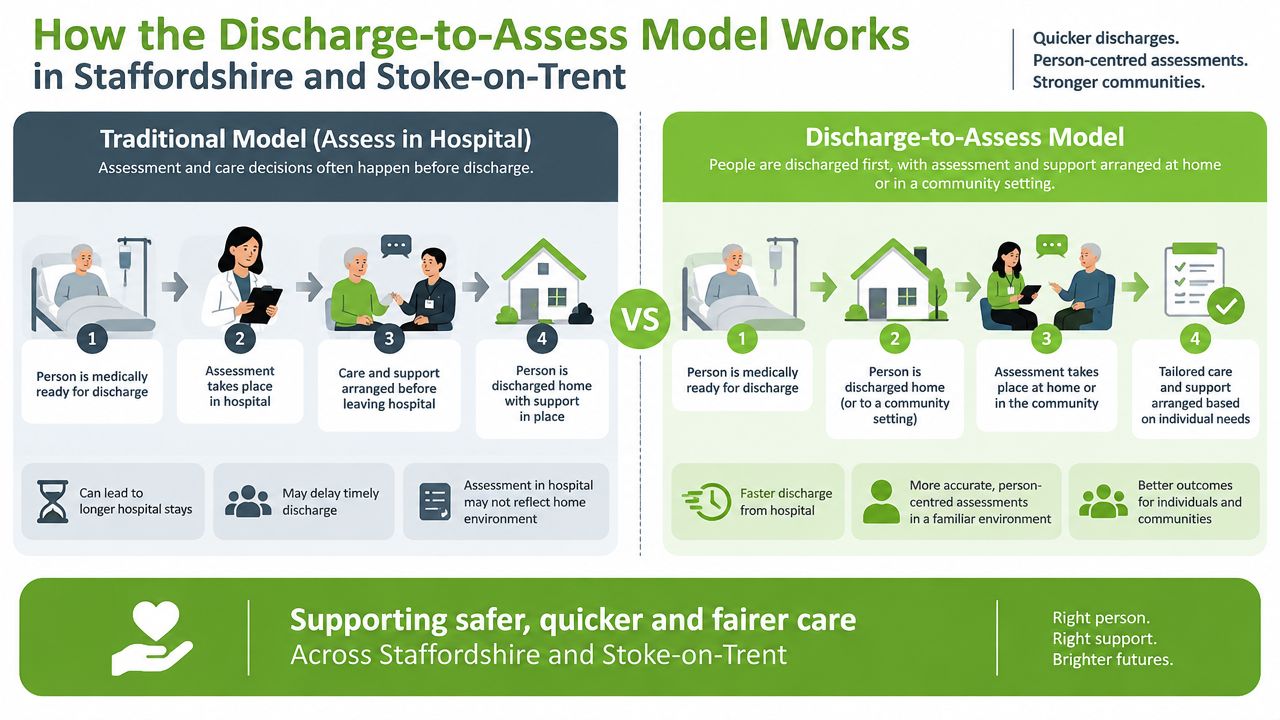
How the Discharge-to-Assess Model Works in Staffordshire and Stoke-on-Trent
A patient may leave Royal Stoke with short-term help arranged, even though their longer-term care needs have not been settled. That is the central idea behind discharge to assess. People often move more safely, regain strength and show greater independence at home than they could while acutely unwell on a ward. Professionals therefore assess ongoing needs after recovery has begun, using evidence from everyday life rather than a single hospital snapshot.
The Government discharge-to-assess guidance describes this approach as best practice introduced in 2016. The assessment should happen after discharge, once appropriate short-term support is in place. For families, the important question is not only whether the person is medically ready to leave, but what practical help will cover the first hours and days at home.
Staffordshire and Stoke-on-Trent fully implemented the model for University Hospitals North Midlands NHS Trust, including Royal Stoke and County Hospital. The county council reported that it helped reduce delayed transfers of care by around 40% since March 2018. The model was also partly implemented across neighbouring acute trusts and pathways, according to the Staffordshire council reablement report.
The four discharge pathways
The pathway reflects the setting and amount of short-term support required.
| Pathway | Who It Applies To | Support Provided |
|---|---|---|
| Pathway 0 | People needing minimal help after discharge | Usual community, family or self-directed support, with no substantial short-term package |
| Pathway 1 | People who can return home with temporary assistance | Short-term care, rehabilitation or reablement at home before longer-term needs are assessed |
| Pathway 2 | People who can't safely manage at home immediately | Short-term support in a residential setting, followed by assessment as recovery progresses |
| Pathway 3 | People unlikely to benefit from short-term rehabilitation | Ongoing nursing care, usually in a nursing home, based on continuing needs |
For example, someone on Pathway 1 might return home with help to wash, dress, prepare food and practise transfers. Staff can then see what the person manages during the first 48 hours, when small gaps in mobility, medication routines or supervision can become clear. Longer-term decisions should follow that observation, rather than being made solely during an acute admission.
Families should also check whether the proposed support has been arranged. Only 3.9% of patients aged 65 and over in Staffordshire and Stoke-on-Trent were offered rehabilitation or reablement on discharge, according to the local CQC system review. A discharge-to-assess framework does not, by itself, confirm that a reablement referral or home visit exists.
Before leaving, ask which pathway applies, what help starts immediately, who will provide it and when the review will occur. The pathway label matters only when it becomes a working plan for the person's first days at home.
Creating a Personalised Care Plan Before You Leave Hospital
A discharge plan should answer one practical question first: who will arrange the care? The answer might involve hospital staff, adult social care, community health services, a family member or a private care provider. If nobody can name the responsible person, the plan is incomplete.
Because discharge-to-assess assessments happen after the patient leaves hospital, temporary arrangements often need to be in place before the final assessment. The patient may need help for a short period while strength, balance and confidence improve. Longer-term decisions can then be based on what the person can do at home, rather than what they managed while unwell on a ward.
Ask for a plan you can use
At the discharge meeting, ask these questions and write down the answers:
- Who is the named care coordinator? Record their name, role and contact route.
- What support has been authorised? Clarify whether it is reablement, rehabilitation, domiciliary care or another service.
- When is the first visit? Ask for a date or time window, not just “soon”.
- What will happen during the first visit? Find out whether staff will help with personal care, meals, mobility, medicines or safety checks.
- Which medicines have changed? Ask someone to explain each new medicine, dose and timing in plain language.
- What should the family do if support doesn't arrive? Keep the escalation contact beside the telephone.
- When will the plan be reviewed? A temporary package should have a clear review point.
Around 20% of people discharged from hospital can be defined as having complex needs, according to the Healthwatch Stoke-on-Trent discharge consultation. Complexity doesn't always look dramatic on the ward. A patient may appear settled while still needing help with several small tasks that become difficult when combined at home.
Medication reconciliation deserves particular attention. Compare the discharge prescription with medicines already in the house, remove uncertainty about stopped medicines and ask who will arrange supplies. Don't rely on memory, especially if the patient has pain, fatigue, confusion or communication difficulties.
Put responsibilities in writing
A useful care plan identifies the patient's usual routine, mobility limitations, communication preferences, dietary needs, equipment, risks and safeguarding concerns. It should also state what the family can provide and what requires professional input.
Local NHS discharge information is often process-focused. It may explain what a service is, but not always who makes the referral, how quickly the first visit starts or what a family should do when the plan breaks down. Those questions belong in the discharge conversation.
Ask for clarity: “If the first visit doesn't happen, who do we call today, and what will happen next?”
Before leaving, check that the patient has the discharge summary, prescriptions, relevant contact details and a way to travel home safely. If the patient or carer doesn't understand an instruction, ask the team to repeat it or write it down. Clear communication is part of safe discharge care, not an optional extra.
Preparing Your Home for a Safe Return
The first evening at home can expose problems hidden on the ward. A bed may be too low, the bathroom may be hard to reach, or there may be no clear route for a walking frame. Prepare for the patient's first 48 hours, when small difficulties can quickly disrupt recovery and lead to an urgent call for help.
Walk through the home using the patient's expected movements. Trace the route from the entrance to the bedroom, toilet, bathroom and main living area. Remove loose rugs and trailing cables, improve lighting, and move frequently used items to waist height. Leave enough space for carers to work safely.
A practical preparation checklist
- Medicines: Collect prescriptions, read the written instructions and agree a simple routine. Confirm which medicines have stopped and who will arrange further supplies. Medication instructions should be clear before the patient leaves hospital.
- Mobility equipment: Confirm whether a walking frame, commode, wheelchair, transfer aid or shower chair has been assessed and arranged. Equipment should match the patient's transfers, balance and strength, rather than its appearance. Ask the therapist or equipment service to confirm what is suitable.
- Bathroom access: Fit appropriate grab rails, provide a stable seat where advised and keep the floor dry. Families planning practical changes can review these bathroom solutions for older people.
- Sleeping arrangements: Use a ground-floor bedroom if stairs are unsafe or exhausting. Keep a lamp, phone, water and necessary items within easy reach.
- Food and drinks: Stock simple meals and place drinks where the patient can reach them without unnecessary walking.
- Access: Arrange keys, door entry and a clear path for carers. Tell visiting staff about parking, steps, pets and access restrictions.
A return to the usual address does not prove that independence has returned. Earlier local pathway information showed that older patients were more often discharged to their usual residence than offered rehabilitation or reablement. Families should therefore clarify what support starts at home and what happens if the patient cannot manage the planned routine.
Plan for the journey and arrival
Stoke-on-Trent City Council commissioned a rapid hospital discharge service for residents leaving Royal Stoke, Haywood Community Hospital and other beds in the local system. It works with adult social care teams, operates seven days a week apart from bank holidays, provides taxi transport home with a meet-and-greet safety check, and keeps in touch for three days after the person returns, according to local NHS discharge information.
Confirm whether the patient is eligible and what the service will cover. For an out-of-hours discharge, identify who will open the door, prepare food and stay with the patient until the first support visit. Keep essential items ready before departure, so the first home visit focuses on settling the patient safely rather than solving avoidable access problems.
Preventing Readmission After Hospital Discharge
The first evening at home can reveal problems that were hidden by hospital routines. A missed dose, difficulty reaching the toilet or worsening pain may turn a manageable recovery into an urgent situation. The first 48 hours deserve close attention because this is when families are testing whether the discharge plan works in real life.
Earlier national findings highlighted gaps in discussions about health and social care after discharge. Those gaps make clear instructions and reliable contact details especially important once a patient leaves Royal Stoke or another local hospital.
Watch the first 48 hours closely
Keep a brief written record of medicines taken, food and fluids, pain, sleep, movement and alertness. This record works like a dashboard for recovery. It helps relatives describe changes accurately to community professionals instead of relying on “not quite right”.
Contact the relevant health or care service promptly if:
- Medicines are being missed: Check whether the patient understands the instructions or needs reminders and supervision.
- Mobility deteriorates: New difficulty standing, transferring or walking can increase falls risk.
- Pain is uncontrolled: Follow the discharge instructions and seek clinical advice when the prescribed plan is not managing symptoms.
- Confusion increases: A sudden change in behaviour or alertness needs prompt attention.
- Support fails to arrive: Use the escalation contact recorded at discharge rather than waiting until the patient is in crisis.
Families arranging extra assistance may find home care after surgery useful for personal care, meals, medication reminders and household tasks during recovery. This type of help supports the agreed plan, while worsening symptoms still require clinical advice.
Hospital discharge can also be affected by delays in transport, equipment or communication. Families in Stoke-on-Trent can ask who is responsible for each action, when the next visit is due and which number to call if the arrangement changes. Asking for an update is appropriate when the plan is unclear or the patient's condition no longer matches it.
The Integrated Discharge Hub coordinates complex discharges, but it does not monitor every household continuously. Keep contact details visible, report missed arrangements and request a review when needs change. A review may be needed if the patient cannot manage the routine that seemed realistic before leaving hospital.
A safe discharge is confirmed only after the promised support is working and the patient can manage the next step safely. If either part is missing, contact the named service before a small difficulty becomes a readmission.
How Cream Home Care Supports Discharge and Recovery in Stoke-on-Trent
Families often need a bridge between hospital discharge and full independence. Cream Home Care provides that bridge for people in Stoke-on-Trent and Newcastle-under-Lyme through companionship, domiciliary care, respite care and elderly care customized to individual routines and needs.
Support can include medication reminders, help with washing and dressing, meal preparation, household tasks, mobility-related assistance and conversation during a vulnerable period. The service can work alongside relatives and existing professionals, with a personalised care plan developed with the client and family.
Cream Home Care's local office is at 2 Victoria Square, Hanley. Families may also use help at home when a loved one needs practical assistance without moving into residential care.
A short-term arrangement can give a family carer time to rest, attend work or manage other responsibilities. Respite care may also reduce burnout when one person has been providing constant support since discharge.
Small organisational details matter during recovery. Labelled clothing, medication storage and clearly identified belongings can help carers maintain routines, and this resource on name labels from Quote My Wall offers practical ideas that may be useful when several people are involved.
Cream Home Care is one option families can consider when planning the first days at home. The important decision is to match support to the patient's actual tasks, timings and risks, then review it as recovery develops.
Cream Home Care offers personalised home care, companionship, medication reminders, daily living support and respite care for people returning home after hospital in Stoke-on-Trent and Newcastle-under-Lyme. To discuss a practical discharge plan for the first 48 hours, contact the team through Cream Home Care.