You're probably reading this at a kitchen table in Hanley, Tunstall or Newcastle-under-Lyme with a discharge letter, a medication list and a phone that won't stop ringing. Someone's asked how many hours of home care do I need, and you want a straight number before Dad comes home or Mum has another fall. Don't pick a number yet. Pick the tasks that can't be missed, then let the hours follow.
The Question Families Actually Need to Answer
A daughter I sat with recently had done everything right on paper. Her father was coming home after hip surgery, she'd arranged a morning visit, and she thought that covered it. Then we walked through his actual day. He couldn't get to the toilet safely at night, he needed prompting to eat at lunch, and getting into bed was the riskiest transfer of all. The morning call was useful. It just wasn't the call that kept him safe.
That's the trap with a single weekly figure. Ten hours in the wrong places will fail faster than six hours in the right places. A package built around one long daytime visit can look generous while leaving the two dangerous moments, getting up and going to bed, completely uncovered.
What Actually Needs Covering
Ask a different question first. Which hours must be reliably covered for safety, dignity and sustainability, and which can flex around family, neighbours or community support?
- Safety-critical tasks: Getting out of bed, toileting, medication routines, transfers and settling at night. If these are missed, someone falls, misses essential medication or stays in bed all day.
- Health-sustaining tasks: Meals, drinks, washing, dressing and continence care. Miss these occasionally and nothing dramatic happens. Miss them repeatedly and nutrition, skin and confidence deteriorate.
- Life-sustaining tasks: Companionship, getting out, hobbies and staying connected. These matter enormously for mood and cognition, but they can usually move to a different day without immediate risk.
Most families reverse that order. They book companionship because it feels kind, then discover nobody's there at 7am when Dad needs the toilet. Be blunt with yourself about the order.
If a visit was cancelled today, which missed task would put your relative at risk before tomorrow morning? Start your package there.
A council assessment works the same way. It doesn't start with hours. It looks at how someone manages washing, dressing, cooking and other everyday activities, then identifies what support would achieve those outcomes. Your job before any provider quotes you a figure is to understand those outcomes in your relative's real routine, on a bad day as well as a good one. Once you can describe that clearly, the number of hours becomes a calculation, not a guess.
Building Your Own Needs Assessment at Home
You don't need a professional form to start. You need one honest page, completed over a few days, not from memory in ten minutes.
List the outcomes your relative wants to achieve each day. Washing and dressing, eating and drinking, preparing meals, managing medication, using the toilet, moving safely around the home, keeping the home habitable, and maintaining relationships. For each one, write down how often it happens, how much help is needed, roughly how long it takes, and what goes wrong without help. Note whether equipment, an adaptation, rehabilitation, a family member or a community service could reduce the need for paid time. This structured, outcome-based method mirrors the approach in the Care Act statutory guidance on assessment and eligibility, and it's far more useful than choosing a standard package.
Turning a Task Log into Hours
Multiply each visit length by how often it's needed each week, then add the totals. Keep it rough. You're building a starting estimate you'll test, not a contract.
Sample Weekly Tasks Log
| Task or outcome | Times per week | Minutes per visit | Weekly minutes |
|---|---|---|---|
| Morning wash, dress and breakfast | 7 | 45 | 315 |
| Midday meal and medication prompt | 7 | 30 | 210 |
| Evening meal and check-in | 5 | 30 | 150 |
| Bedtime transfer and settling | 7 | 30 | 210 |
| Bath or shower support | 2 | 45 | 90 |
| Total | 975 minutes, about 16 hours |
That total often shocks families, usually because they'd counted only hands-on personal care. Meal preparation, prompting, mobility help, domestic safety checks and companionship are where hours accumulate. Leave them out and your estimate is fiction.
Add contingency time if the condition fluctuates. Parkinson's, dementia and recovery after infection all produce good and bad days. A package sized for a good day collapses on a bad one.
Get the Formal Assessment Too
Request a council care needs assessment even if you'll pay privately. In England there's no standard number of hours that applies to everyone, and a free assessment examines how someone manages everyday activities before identifying the type of support required, as the NHS guidance on getting a needs assessment explains. Councils must assess an adult whenever a need appears, regardless of finances or perceived severity, and must involve the adult and their carers. If you want wider reading on how structured assessments are framed, the 2026 care needs assessment overview from Nursing Assessment Australia is a useful companion piece.
Bring your task log to that assessment and to any provider. It also helps you judge whether a provider is building support around the person, which is the heart of person-centred care explained in plain terms. If a provider quotes hours without asking about outcomes, walk away.
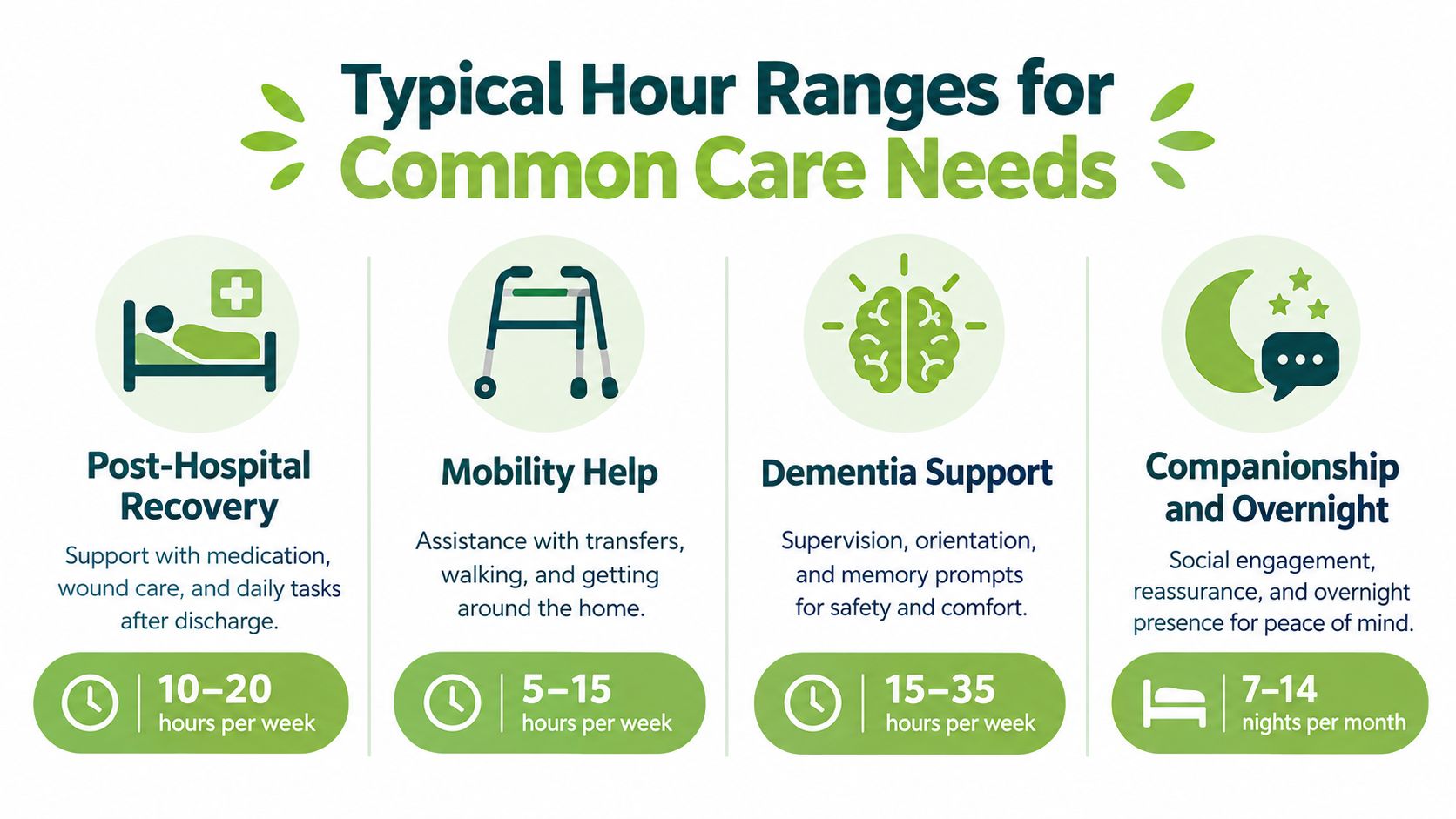
Typical Hour Ranges for Common Care Needs
Use ranges as a sanity check, never as a prescription. Two people with the same diagnosis can need wildly different support depending on mobility, cognition, continence, nutrition and who's already helping.
For context, people receiving publicly arranged home care in England needed an average of 14 hours and 23 minutes per week in 2024/25, up from 13 hours and 40 minutes in 2021/22, according to the ADASS Spring Survey 2025 report. That's roughly 5.2% more care on average. Treat it as a planning benchmark for Stoke-on-Trent and Newcastle-under-Lyme conversations, not a target. Half of all packages sit below an average by definition.
How Common Situations Tend to Differ
Post-hospital recovery usually starts high and steps down. Morning and bedtime calls, meal help and medication prompts dominate early on, then reduce as strength and confidence return. If hours aren't falling after several weeks, ask whether rehabilitation goals are being worked on during visits.
Mobility help clusters around transfers. Someone who is steady once standing may need short calls at predictable times, while someone at high falls risk needs cover whenever they move, which pushes hours up fast.
Dementia support is the one families consistently underestimate. The need isn't mainly physical tasks. It's supervision, orientation, prompting and someone noticing the cooker left on or the front door open. Gaps between calls become the risk, not the calls themselves. If you're unsure where practical daily help ends and clinical care begins, reading up on what non medical home care covers from Life Senior Placement will sharpen the conversation you have with any provider.
Companionship and overnight support flex most. Social visits can be longer and less frequent. Overnight presence is different. If someone needs supervision through the night, scheduled calls stop being the right tool and you should look seriously at 24-hour care options for continuous supervision instead of stretching daytime visits thinner.
The NHS illustrates the spread plainly. An assessment may conclude someone needs paid carer help for 2 hours a day or 2 hours a week, specifying precisely what the carer should do, as set out in the NHS guidance on paying for your own care. That gap between two hours weekly and two hours daily is the honest answer to how many hours are needed. It depends on assessed tasks and risks, not age or diagnosis alone.
Turning the Numbers into a Daily and Weekly Schedule
A weekly total means nothing until it survives contact with a real Tuesday. Map your hours onto mornings, mealtimes and bedtime, because that's when need concentrates.
Take a frailer person home after a hospital stay. A morning call covers washing, dressing, breakfast and medication prompts. A midday call covers lunch, a drink, toileting and a check that she's moved safely. An evening call covers a cooked meal and settling in a chair, and a shorter bedtime call covers undressing, continence care and getting into bed. Four short calls, none of them long, but each one removes a specific risk. Family might cover the evening visit at weekends, which reduces paid hours without leaving a gap.

Now take someone with early-stage dementia who is physically fit. She doesn't need help washing. She needs a morning visit that prompts medication, checks she's eaten and orients her to the day, then a longer afternoon visit a few times a week for shopping, a walk and a proper meal. The risk isn't transfers. It's skipped medication, an empty fridge and slow withdrawal from the world. Her schedule has fewer calls but longer ones, and that's correct for her.
Test the Gaps, Not Just the Visits
Write the gaps down explicitly. Who is responsible between the morning call ending and the midday call starting? If the answer is nobody, is that safe, or just hopeful?
- Morning to midday gap: Usually manageable if the person can toilet independently, reach a drink and use a pendant alarm.
- Evening to morning gap: The longest and riskiest stretch. Night-time toileting and confusion cause a large share of falls at home.
- Weekend gap: Family often cover weekdays in their heads but forget they've committed every Saturday indefinitely.
Practical rule: Every hour in the schedule should sit behind a named outcome. If you can't say what a visit achieves, cut it or move it somewhere it does something.
Don't fill spare time with generic companionship to reach a round number. Put hours where outcomes are at risk, leave deliberate gaps where family or community support is real and reliable, and review the pattern after the first few weeks. A schedule is a hypothesis. The first fortnight tells you whether it's right.
Funding, Family Care and the Hours Most Plans Miss
Here's the uncomfortable part most guides skip. Your paid-care estimate is probably built on top of an enormous, invisible family workload, and if that workload collapses, your tidy package collapses with it.
England's 2025 to 2026 carer survey found that 34.7% of adult carers, 108,060 people, provided 100 or more hours of care each week, as reported in the Survey of Adult Carers in England 2025 to 2026 commentary. Read that again before you assume a spouse or daughter can cover the gaps. Relatives cover nights, supervision, transport, meals and every emergency between calls. A plan that counts only formal visits understates total need by design.
So stop asking how many hours you can fund. Ask which hours must be reliably covered for this arrangement to stay safe and sustainable, then work out funding around that answer.
Money, Personal Budgets and Self-Funding
When a council recommends homecare and contributes towards the cost, it must provide a care and support plan setting out assessed needs, how they'll be met and the personal budget, which is the amount the council considers the care should cost, as described in the NHS guidance on care and support plans. Self-funders skip that funding route but shouldn't skip the assessment behind it, because it gives you a needs-led specification to take to any agency. Before signing anything, work through realistic local figures using a breakdown of how much in-home care costs so the weekly total doesn't ambush you later.
Families who are also juggling admin, appointments and paperwork sometimes buy in organisational help separately, and if that's you, it's worth taking time to compare virtual assistant packages from Approved Lux Personal Assistant rather than letting paperwork eat the hours you meant to spend resting.
Sometimes respite is worth more than extra routine visits. If the main risk is an exhausted spouse who hasn't slept properly in months, a regular break protects the whole arrangement better than another daytime call. Councils only fund respite after assessing both the person receiving care and the carer's own circumstances, so request a separate carer's assessment rather than hoping someone offers one.
Finally, plan for failure. As noted in the earlier section, ADASS recorded 118,673 home-care hours that could not be delivered in Spring 2025, although that was a 26% reduction from the previous year. Ask every provider what happens when a visit is delayed or missed, who reviews changing needs, and whether hours can increase temporarily after illness, a fall or discharge. A provider with no answer to those questions is selling you hours, not cover.
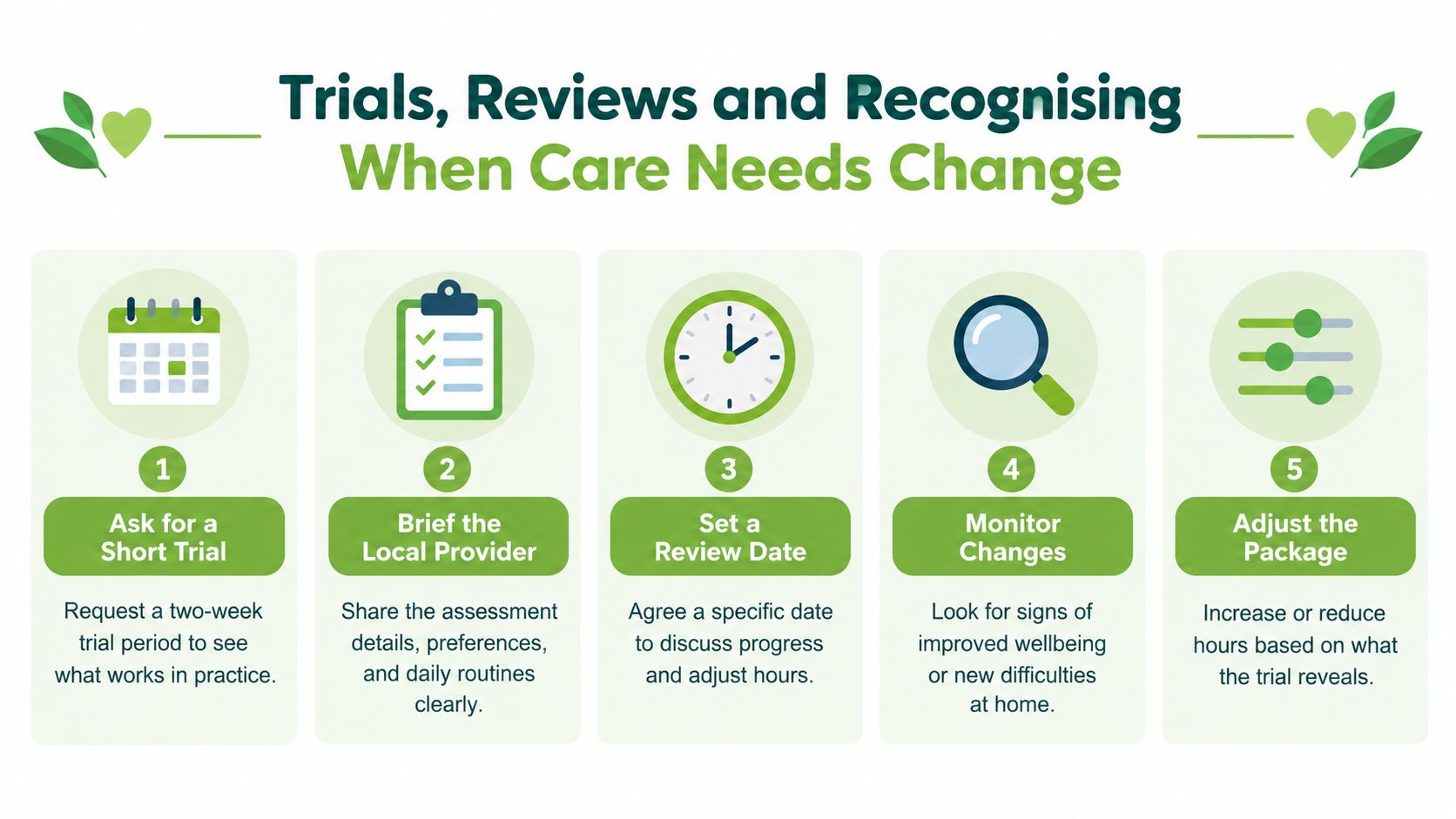
Trials, Reviews and Recognising When Care Needs Change
Don't commit to a permanent package on day one. Ask for a short trial, agree a review date before care starts, and brief the provider with outcomes, not a vague hour figure.
A good first assessment visit should feel nosy in the right way. The assessor should ask about routines, night-time habits, continence, medication, food likes and dislikes, who else helps, and what a bad day looks like. They should check the home layout, equipment and transfer risks. If the visit lasts ten minutes and produces a quote, that's a sales call, not an assessment. A local provider such as Cream Home Care, which arranges scheduled visits and respite across Stoke-on-Trent and Newcastle-under-Lyme, should be judged by exactly that standard, the same as anyone else.
Signs the Package Needs Changing
Care and support plans are usually reviewed within the first few months and then once a year, but you can request a review at any time if circumstances change or the care isn't working. Don't wait for the scheduled date if you spot these signals.
- Increase hours when: There are new falls, weight loss, missed medication, worsening continence, night-time wandering, or a family carer who is tearful, resentful or physically struggling.
- Reduce hours when: Recovery is progressing, new equipment makes transfers independent, rehabilitation goals are met, or visits regularly finish with nothing left to do.
- Change the shape, not the size, when: Total hours feel right but mornings are rushed and afternoons are empty. Moving thirty minutes often fixes what adding three hours wouldn't.
Know the ceiling of visiting care. NHS guidance distinguishes ordinary homecare from live-in care, noting that if someone needs 24-hour supervision, live-in care can be arranged instead of relying solely on scheduled visits, as explained in the NHS guidance on carer breaks and respite care. If you're adding calls to plug ever-smaller gaps, you've probably crossed that line already. Say so out loud and reassess properly.
Book three conversations first. The council assessment, the carer's assessment if family are heavily involved, and a provider assessment with your task log in hand. Everything else follows from those.
Three Questions to Settle on the Right Number of Hours
Return to that daughter and her father after hip surgery. Her original plan, one morning call, wasn't wrong because it was too few hours. It was wrong because it answered a question nobody should ask first. Once she worked through three better questions, the right package became obvious, and it wasn't much bigger. It was just pointed at the right moments.
Which tasks must be reliably covered for safety and dignity? Name them precisely. Getting up, toileting, medication, meals, getting to bed. These are essential and they get funded and scheduled first, even if that means fewer social visits than you'd like. Everything else is built around them.
Which of those tasks are family or community already covering, and can they keep doing it? Be honest about duration, not intention. A son who cheerfully covers bedtime for a fortnight after discharge may not sustain it for a year alongside work and his own children. Count only the family help that is reliable, willing and sustainable, and treat the rest as a gap that paid care or respite must fill.
What happens when needs change or a visit is missed? Ask who notices deterioration, how quickly hours can increase after a fall or discharge, and what the backup is when a carer is ill. If nobody can answer, your number of hours is irrelevant because the arrangement has no resilience.
The right number of hours is the smallest package that reliably covers the tasks that can't be missed, leaves the family carer able to keep going, and can flex when things change.
Use those three questions as a filter on every proposal you're given. A provider quote that survives all three is probably right, whether it lands at four hours a week or four calls a day. A quote that fails any one of them will fail your relative eventually, usually at 7am on a Sunday.
Treat the figure you settle on as a starting point with a review date attached, not a permanent answer. Needs after a hospital discharge, a dementia diagnosis or a bereavement don't stay still, and your package shouldn't either. Start with the tasks, protect the carer, plan for the missed visit, and the hours will take care of themselves.
If you're weighing up how many hours your relative needs in Stoke-on-Trent or Newcastle-under-Lyme, Cream Home Care can assess your situation at home, build a personalised schedule around the tasks that matter most and review it with you as needs change. Get in touch for a straightforward conversation about domiciliary care, companionship or respite, and leave with a plan based on your family's real routine rather than a generic package.