A fall, a hospital stay or a few missed meals can turn an ordinary family conversation into a difficult question: can Mum or Dad stay safely at home? In Stoke-on-Trent, the answer often depends on more than arranging a carer. Equipment, medication, transport, home adaptations, review dates and reliable visit times can decide whether a care plan works in real life.
Personal care at home can protect familiar routines while giving families practical support. This guide explains what the service covers, who may qualify, how funding works, what to demand from a provider and how to manage the first days after hospital discharge. For wider context on financing home care for older adults, families may also find it useful to consider the costs of remaining at home alongside the practical benefits.
When Staying at Home Becomes the Question
A daughter in Hanley notices that her father has stopped using the stairs. He says his knee hurts, but the larger change is confidence. He now waits for her to arrive before showering, preparing food or collecting medication. She works full-time, has children of her own and has started arranging visits around his routines. Nobody has announced a crisis, yet the family is already providing care.
That pattern is common. Home care often follows a fall, hospital admission, gradual frailty or an unpaid carer admitting that they're exhausted. The decision isn't just whether someone needs help. It's whether the right support can make daily life safer without removing abilities the person still has.
Practical rule: Start with the tasks that have changed, not with a label such as “elderly care” or “domiciliary care”.
Personal care may include bathing, dressing, grooming, toileting, mobility support, meal routines and medication reminders. Some people need one visit each morning. Others need several visits, companionship, respite for a family carer or short-term help while they regain strength after hospital treatment.
The choice between home and residential care deserves a proper comparison. Families weighing the options can read this guide to domiciliary care versus residential care before deciding what level of support matches the person's needs.
The rest of this guide focuses on personal care at home in Stoke-on-Trent, including local funding arrangements, discharge planning, provider reliability and the hidden dependencies that can make or break a care package. If your family is trying to keep someone safe, clean, nourished and connected at home, this is the right question to investigate.
What Personal Care at Home Actually Means
Personal care at home is hands-on or closely supervised support with essential daily activities, delivered in the person's own home. It differs from ordinary domestic help. Cleaning, laundry and shopping may form part of a wider package, but personal care centres on wellbeing, dignity and the person's ability to manage safely.
A carer might help someone wash, dress and move from bed to chair. They might prompt medication, prepare a meal, support eating or observe whether a person can complete a routine without avoidable risk. The exact tasks should appear in a care plan, with clear instructions about what the person can do independently, what needs prompting and what requires hands-on assistance.
Stoke-on-Trent's published figures show that this is a substantial, recurring service rather than an occasional convenience. The city's 2022/23 Adult Social Care Local Account recorded 764,094 council-commissioned home-care hours, averaging 14,694 hours each week and 13 hours per service user per week, rising to 25 hours where a dual call was required. Those figures are reported in the Stoke-on-Trent Adult Social Care Local Account.
Support should preserve ability
Good care doesn't automatically take over. It supports the person to retain existing skills in washing, dressing, toileting, nutrition, mobility and medication routines. A carer may lay out clothes rather than dress the person, offer prompts before providing physical help, or encourage safe participation in preparing breakfast.
This reablement approach matters because over-assistance can reduce activity and confidence. A useful assessment separates three categories:
- Independent tasks: The person completes these without help.
- Prompted tasks: The person needs reminders, supervision or reassurance.
- Assisted tasks: The person needs physical support or another person to complete the activity safely.
Visit frequency should change when needs change. A short-term package after illness may focus on recovery, while longer-term support may concentrate on personal hygiene, mobility, medication and companionship. Residential care involves moving into a setting where support is available around the clock. Home care brings planned assistance into the existing home, so the property and the gaps between visits must also be considered.
Types of Personal Care Available Locally
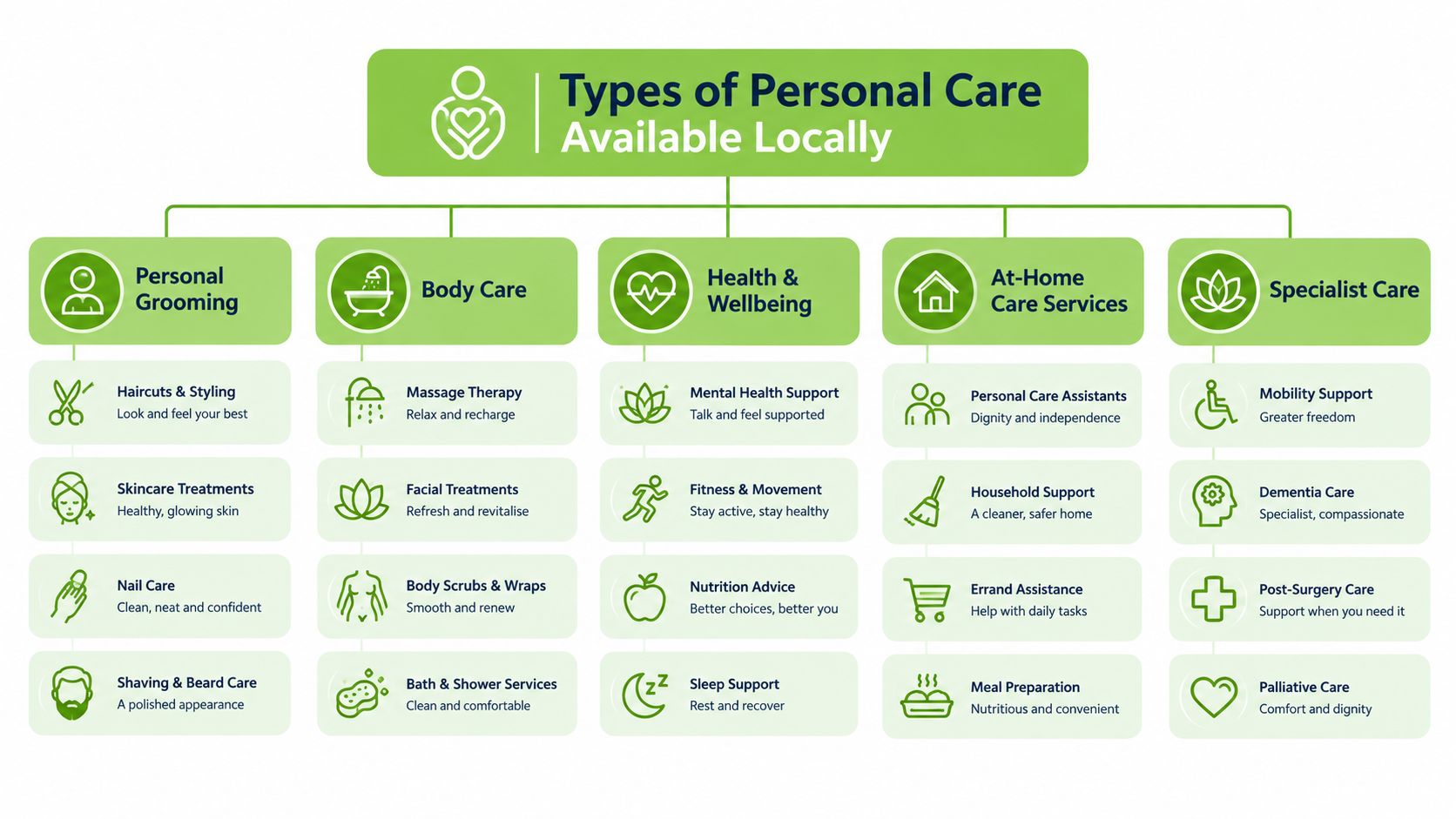
Families often ask for “a carer” when they actually need a combination of services. Being precise helps a provider build a safer plan and helps relatives recognise when a request falls outside ordinary domiciliary care.
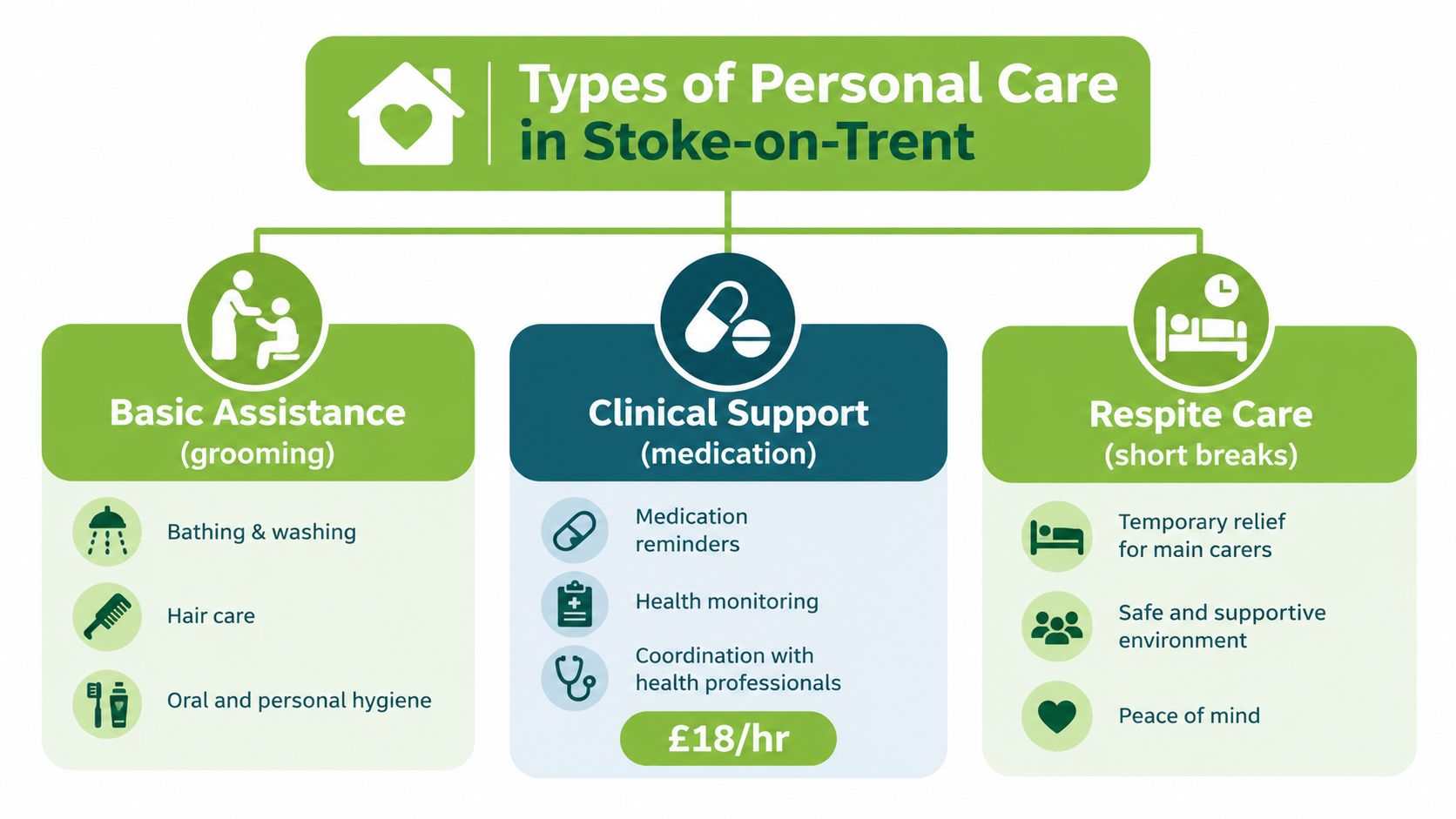
Personal hygiene and grooming may include bathing, showering, dressing, shaving, hair care, oral hygiene and toileting. These tasks require privacy and patience, especially where someone has reduced mobility, dementia, pain or anxiety. Ask whether carers have enough time to support the routine properly, rather than rushing through it to reach the next call.
Medication prompts and support can range from reminding someone to take prescribed medicine to observing whether medication has been taken in line with the agreed plan. Families should ask exactly what the provider is authorised and trained to do. A reminder is not automatically the same as administering or managing medication.
Companionship is more than sitting in the same room. A useful visit might involve conversation, a walk, a hobby, a meal or contact with friends and relatives. Emotional engagement can help someone maintain routines and confidence, particularly when reduced mobility has made the outside world feel less accessible.
Matching the service to the household
Domiciliary care usually means planned visits for ongoing daily support. Respite care gives an unpaid carer time away from caring responsibilities. Elderly care can combine personal hygiene, mobility, meals, companionship and household tasks, but the plan should still describe the actual outcomes expected.
Night-time needs need particular care. If continence is part of the problem, families may benefit from practical information in this night-time incontinence guide, while also asking a professional about skin care, equipment and clinical concerns.
The local market has meaningful scale. A 2026 Stoke-on-Trent market-sustainability report listed 35 home-care providers contracted with the council, 17,420 weekly community-based hours and 1,256 people accessing the provision. The choice is therefore not just between accepting a generic package and moving into residential care. Families can ask for a plan built around the person's routines, risks and abilities.
Who Pays and How Funding Works
Funding conversations become easier when families separate eligibility, health responsibility and choice of provider. Stoke-on-Trent families generally consider three routes: council-arranged support, NHS-funded care where the primary need is health-related, and private care paid for directly.
Council support begins with a needs assessment. If eligible needs are identified, a financial assessment considers what the person can afford. Stoke-on-Trent's charging policy confirms that community-based charges are linked to the hours commissioned in the care and support plan, that weekly charges can change when delivered hours differ from the planned amount, and that nobody can be asked to pay more than the assessment finds affordable. The policy is available in the Stoke-on-Trent charging policy.
NHS Continuing Healthcare is different. It may apply where a person's needs are primarily health needs, but families should ask the NHS team about the assessment route rather than assume a diagnosis automatically qualifies someone. Discharge-to-assess support is also distinct from a permanent funding decision. Immediate safety and recovery should come first, with longer-term eligibility considered afterwards.
| Funding Route | Who Pays | How It Is Assessed | Typical Family Contribution |
|---|---|---|---|
| Council-arranged care | Stoke-on-Trent City Council, subject to eligibility and assessed contribution | Needs assessment followed by financial assessment | May be nil or an assessed contribution based on affordability |
| NHS Continuing Healthcare | NHS, where the person meets the relevant health-need criteria | NHS assessment of primary health needs | No routine social-care contribution for eligible NHS-funded care |
| Private care | The person or family | Provider assessment and agreed care plan | The agreed private fee, based on commissioned support |
Ask for the hourly arrangement, planned visits, assessed contribution, review process and cancellation terms in writing. Charges normally depend on commissioned hours, and notice requirements can affect the amount charged if a service is cancelled. Don't compare providers on hourly price alone. A cheaper call that arrives late, lacks continuity or can't cover the agreed tasks may cost the family more in stress and emergency arrangements.
Coming Home from Hospital Safely
Hospital discharge is where a promising care plan can fail quickly. The person may arrive home before equipment, medication information or clear responsibilities have caught up with them. A family then discovers that nobody knows who is arranging the first visit, who is chasing a missing commode or who should be called when the carer doesn't arrive.
NHS England's Home First approach makes home the preferred setting for assessment where it is safe. Discharge-to-assess means the person can return home while professionals assess ongoing needs in familiar surroundings. That approach only works when the practical arrangements are explicit.
Healthwatch Staffordshire's 2024-25 hospital-discharge review reported that some new care packages were delayed, carers or nurses didn't always arrive as promised, and adaptations were sometimes installed only after the person returned home. The review recommended beginning discharge planning on admission. Families should read the Healthwatch Staffordshire hospital-discharge review and use its findings to ask sharper questions.
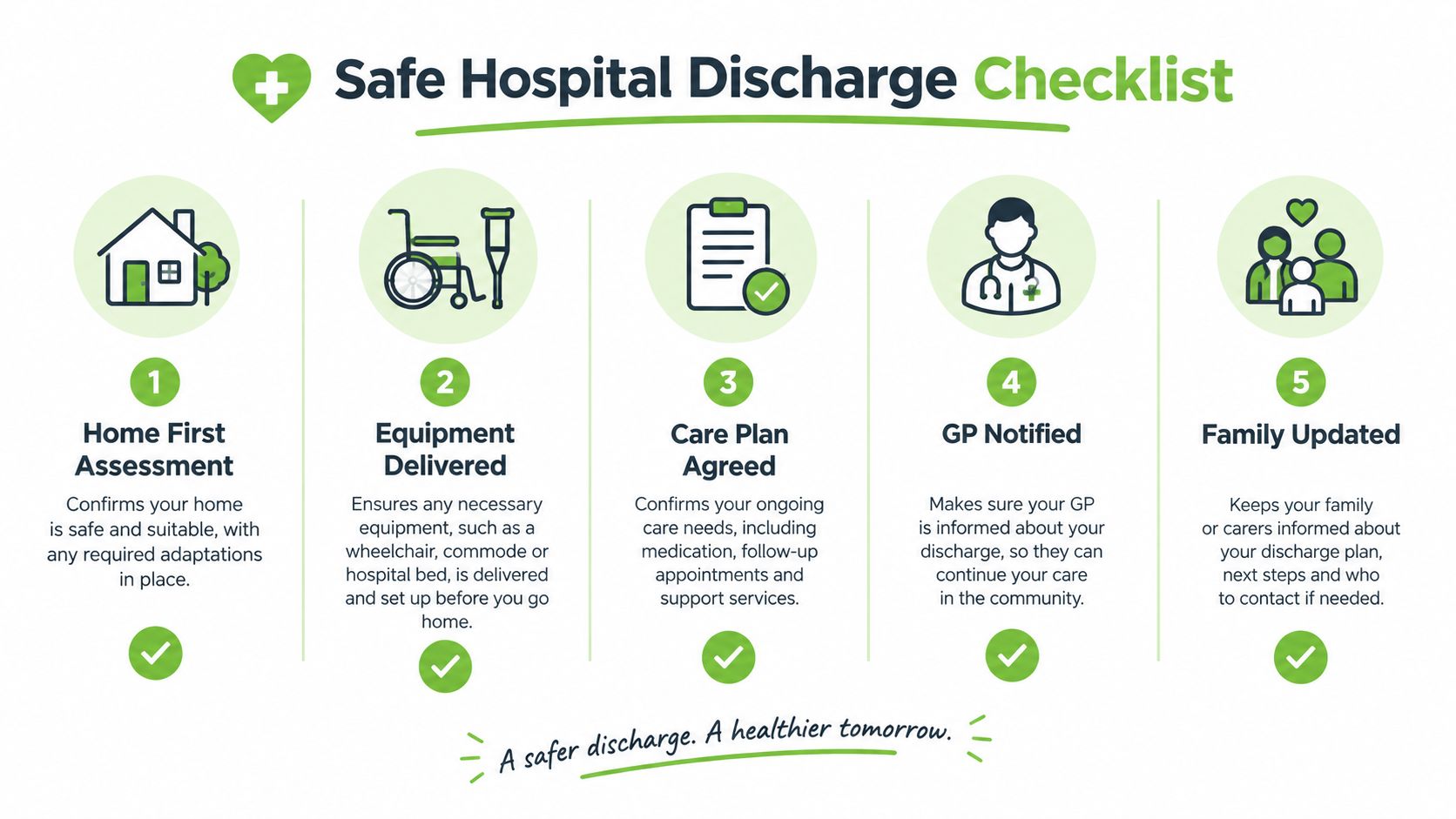
The first 72 hours
Before leaving hospital, obtain the written care plan and identify one named contact for each responsibility.
- Medication handover: Confirm what has changed, when the next doses are due and who will arrange prescriptions.
- Mobility risks: Ask how the person should transfer, use stairs, walk with equipment and manage the bathroom.
- Equipment: Check what has been delivered, what is still outstanding and whether temporary arrangements are safe.
- Visit details: Record the provider, arrival windows, visit frequency and tasks for every call.
- Escalation: Confirm who to contact if a visit is late, missed or unsuitable, including an out-of-hours route.
- Family role: Decide which tasks relatives can realistically provide. Don't build a care plan around indefinite unpaid labour if the family is already stretched.
The discharge plan should identify the treatment and support required, who provides it, how to make contact, when visits occur, how care will be reviewed and who to call in an emergency. If any of those details are missing, ask before discharge rather than trying to reconstruct the plan at home.
What a Good Provider Looks Like in Practice
A provider's headline number of care hours tells you little about whether your relative will receive dependable support. Reliability depends on staffing, travel planning, training, communication and the ability to respond when the original plan stops working.
The Care Quality Commission reported that homecare vacancy rates in England were just over 10% in March 2025, more than double the rate in care homes. It also reported a 4% year-on-year rise in demand for local-authority-funded social-care support and an 11% increase in homecare services. These national figures, reported in the CQC assessment of adult social-care access, explain why families must test operational capacity rather than accept a confident sales answer.
Questions worth asking before agreeing
Ask how the provider plans travel time between calls. Visits clustered geographically are more realistic than schedules that send carers across the city with no buffer. Ask whether the provider matches carers to competencies, such as mobility support, dementia care or medication tasks, instead of assigning whoever happens to be available.
Request clear answers to these points:
- Continuity: How many regular carers are likely to visit?
- Late calls: Who contacts the family when a carer is delayed?
- Missed calls: What happens immediately if a visit is missed?
- Competence: How does the provider check skills for transfers, medication or personal care?
- Reviews: When will the plan be reviewed, and who can request an earlier review?
- Safeguarding: How are concerns recorded, escalated and communicated?
A person living with dementia, sensory impairment or anxiety may struggle when unfamiliar staff arrive. Consistency isn't a luxury in those circumstances. It can affect cooperation, dignity and the person's willingness to accept help.
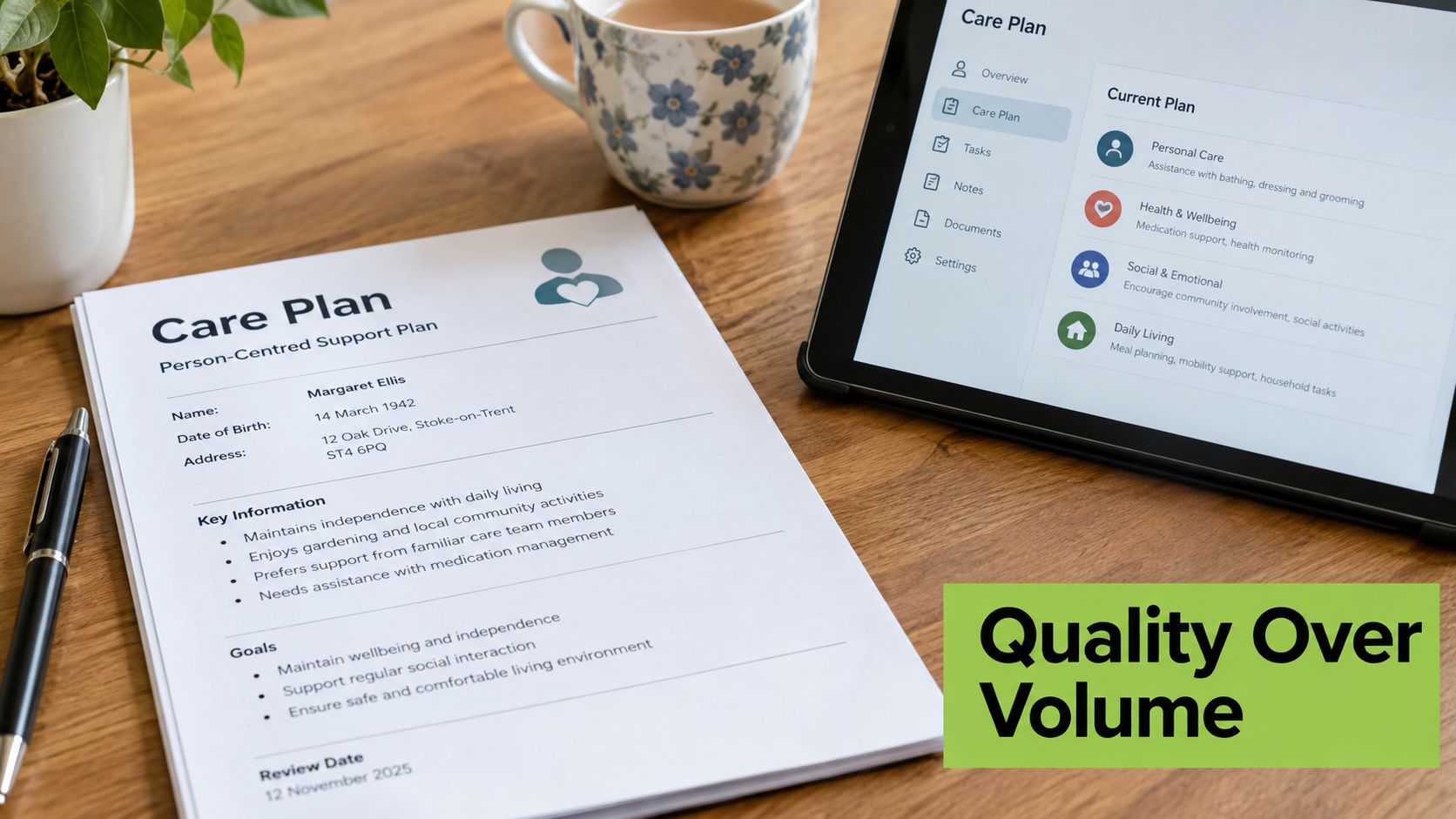
Good documentation supports good handovers. Providers reviewing digital record-keeping may find these AI scribe documentation resources useful for understanding how structured notes can support continuity, although any system must protect confidentiality and fit the provider's governance arrangements. Families comparing services should also use this practical guide on how to choose a home care provider, then ask each provider the same operational questions.
Practical Tips for Families in Stoke-on-Trent
Start with Stoke-on-Trent City Council adult social care if you're unsure whether support may be available. Describe what happens on a difficult day, not only what the person manages during a good visit from family. Mention falls, missed medication, difficulty washing, unsafe transfers, poor nutrition and the effect on the unpaid carer.
Take a written list to the assessment:
- What can the person do without help?
- What requires prompting or supervision?
- What needs hands-on assistance?
- Which tasks are unsafe when nobody is present?
- What equipment or adaptation is missing?
- When should the plan be reviewed?
Don't treat home care as a complete answer to every barrier. A person may receive reliable visits and still struggle because bathing access, grab rails, falls prevention or occupational-therapy input remain unresolved. A CQC assessment of Stoke-on-Trent's adult social-care service in June 2025 rated provision “good” overall, while identifying delays involving equipment, home modifications, assessments, reviews and occupational-therapy input. The local operating plan is available through this Stoke-on-Trent council document.
Compare providers on continuity, response times and care planning as well as price. Cream Home Care is one local option for Stoke-on-Trent and Newcastle-under-Lyme, based at 2 Victoria Square, Hanley, offering personal hygiene support, medication reminders, companionship, domiciliary care and respite care.
Questions Families Commonly Ask
How quickly can care start after hospital?
It depends on the assessment, provider capacity and whether the home is safe. Ask before discharge who is providing the first visit, when it will happen and what happens if equipment or medication is delayed.
Can we request the same carer?
Ask for a small regular team and explain why continuity matters. A provider may not promise one individual for every call, but it should explain how it manages absence, leave and emergency cover.
What should a discharge care plan contain?
NHS England guidance says it should identify the treatment and support needed, who is responsible, how to make contact, when support will happen, how it will be monitored and reviewed, and who to contact in an emergency. The NHS England discharge pathway guidance provides the relevant framework.
What happens if a visit is late or missed?
Use the provider's escalation route immediately and record the time, impact and response. If the person is at immediate risk, contact emergency services. Repeated failures should trigger a formal review, not a quiet adjustment by the family.
Cream Home Care provides personalised personal care, companionship, domiciliary care and respite support across Stoke-on-Trent and Newcastle-under-Lyme, with plans built around daily routines and independence. Visit Cream Home Care to discuss the support your family needs, the practical questions that must be answered and how care could begin safely at home.