Around 250 people begin to lose their sight each day, according to RNIB's UK sight-loss statistics. For a person living at home, the change may first become noticeable through an unread medicine label, an unfamiliar-looking doorstep or a conversation they can no longer follow.
Sensory impairment home care should make those everyday situations accessible, not just arrange for somebody else to take over. That means understanding how the person receives information, recognising when apparent confusion may be a communication barrier, and adapting support so they can still direct their day.
Defining Each Sensory Impairment and What to Assess
Visual impairment means reduced sight that glasses don't fully correct. It ranges from low vision to sight impairment that meets registration criteria, but registration alone won't explain what someone can see in their kitchen.
Hearing impairment ranges from mild hearing loss to profound deafness. Some people use speech, some use British Sign Language as their main language, and others combine methods. Dual sensory loss means combined sight and hearing loss, which can reach the level described as deafblindness.
Record what works in the actual home
Tactile impairment means reduced sensation, particularly in the hands or feet. Diabetic neuropathy can cause this, reducing warning of heat, pressure or contact with a wet surface. Don't assume touch is a reliable alternative when sight and hearing are limited.
The assessment should record each sense separately, then consider how they work together:
- Equipment: Note current spectacles and hearing aids, when they were last checked, and whether the person can use them comfortably.
- Useful distance: Check reading and conversation under the lighting the person uses.
- Sensation: Record reported numbness and support needed with water-temperature checks. Report pressure marks on heels or hips rather than attempting a clinical sensory examination.
- Communication: Specify large print, speech towards the better-hearing ear, tactile signing or another agreed method.
- Escalation: Name the GP, optometrist, audiology service or sensory team to contact when something changes.
For journeys beyond familiar rooms, Waymap's information about navigation for blind and low vision users offers useful context for discussing accessible wayfinding.
Put the practical answers in the care plan. The next carer should know what helps without asking the person to explain everything again.
Who Needs Sensory Impairment Home Care
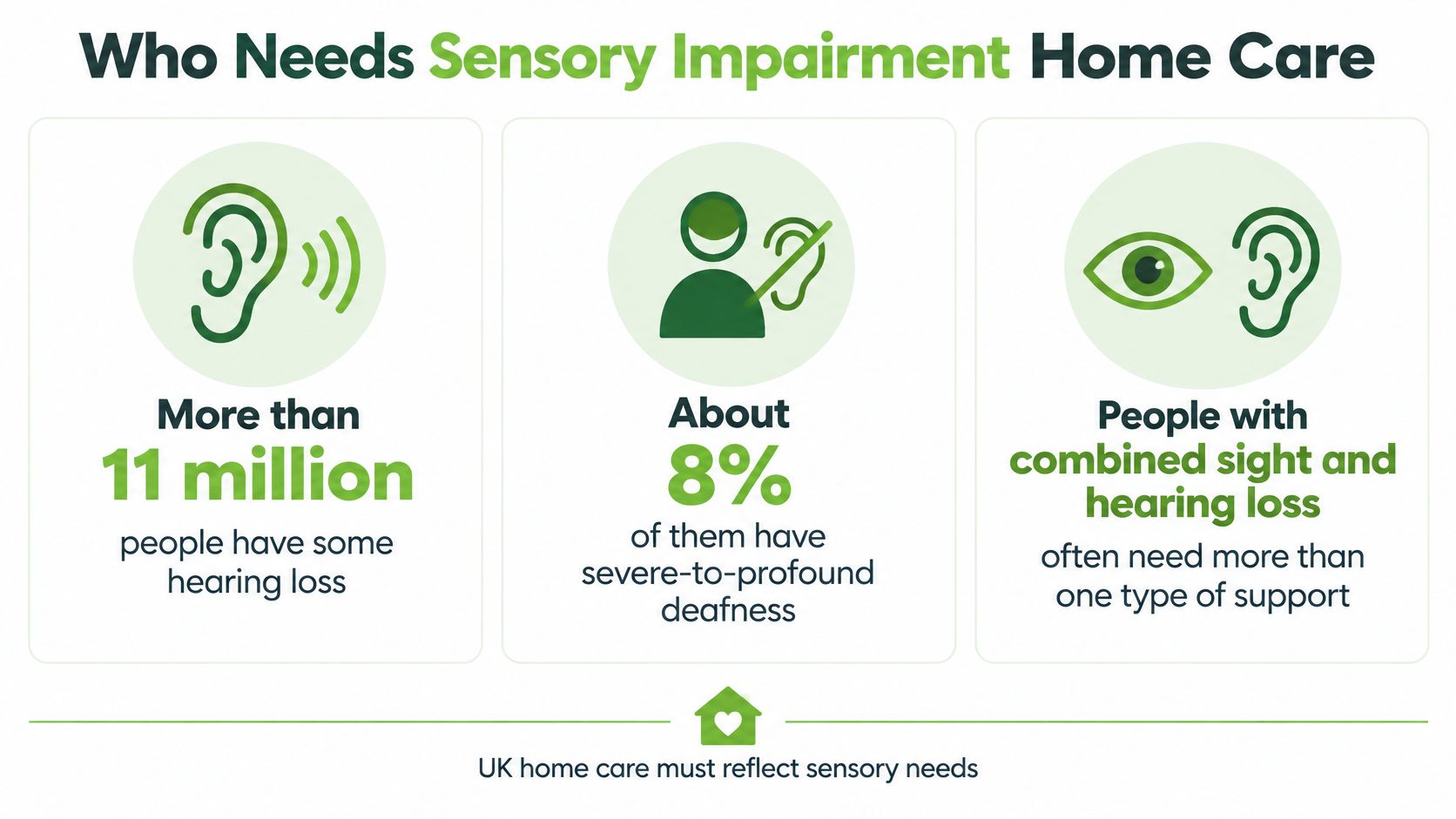
Sensory needs belong in ordinary home-care assessment, not only specialist provision. UK estimates in Brighton & Hove's sensory-loss needs assessment indicate that more than 11 million people have some hearing loss, approximately 8% of them severe-to-profound; among people aged 65 and over, an estimated 4.08 million have moderate or severe hearing impairment and approximately 109,000 have profound impairment.
The same assessment describes hearing loss increasing sharply around ages 45–50, more than 2 million UK residents living with sight loss, of whom more than 80% are over 60, and around 250,000 people with combined sight and hearing loss, 88% of them aged 70 or over.
These estimates describe different groups, not a single measure of dependency. Someone may need help following conversation but manage dressing independently. Another person may hear clearly but struggle to identify food, labels or a change in floor level.
Sensory impairments and the first home-care adjustment
| Impairment | Home risk | First care adjustment |
|---|---|---|
| Hearing loss | Missed speech, withdrawal, unsafe consent | Working aids, quiet room, face the person |
| Sight loss | Trips, unread labels, poor depth judgement | Even light, contrast edges, fixed layout |
| Dual sensory loss | Neither sense compensates; isolation | Consistent carers and a recorded communication method |
| Reduced touch | Burns, pressure marks, unnoticed spills | Temperature checks and clear, dry routes |
The hearing-loss row is about access to information. A person who doesn't answer a question may not have heard it, rather than chosen to ignore it. Begin by making the conversation accessible before interpreting the response.
The sight-loss row concerns usable visual detail. A bright room isn't necessarily an accessible room if glare hides a threshold or pale crockery disappears against a pale table.
For dual sensory loss, naming the communication method matters more than recording a broad diagnosis. Reduced touch needs its own attention too, because someone may not notice that bathwater is too hot or that footwear is rubbing.
Before the first visit: Describe the task that's difficult, not just the diagnosis. Difficulty finding the bathroom doorway gives a provider more useful information than poor eyesight alone.
Bring daily needs into the same plan
Medicines, washing, housework, movement around the home and social contact shouldn't be assessed as unrelated tasks. A person who can't identify their tablets may also struggle to read appointment letters or follow a telephone consultation.
Families in Staffordshire can use the table to brief a provider before support begins. Add what the person already does successfully, what they want help with, and which adjustments they don't find useful.
Why One Sense Cannot Cover for Another
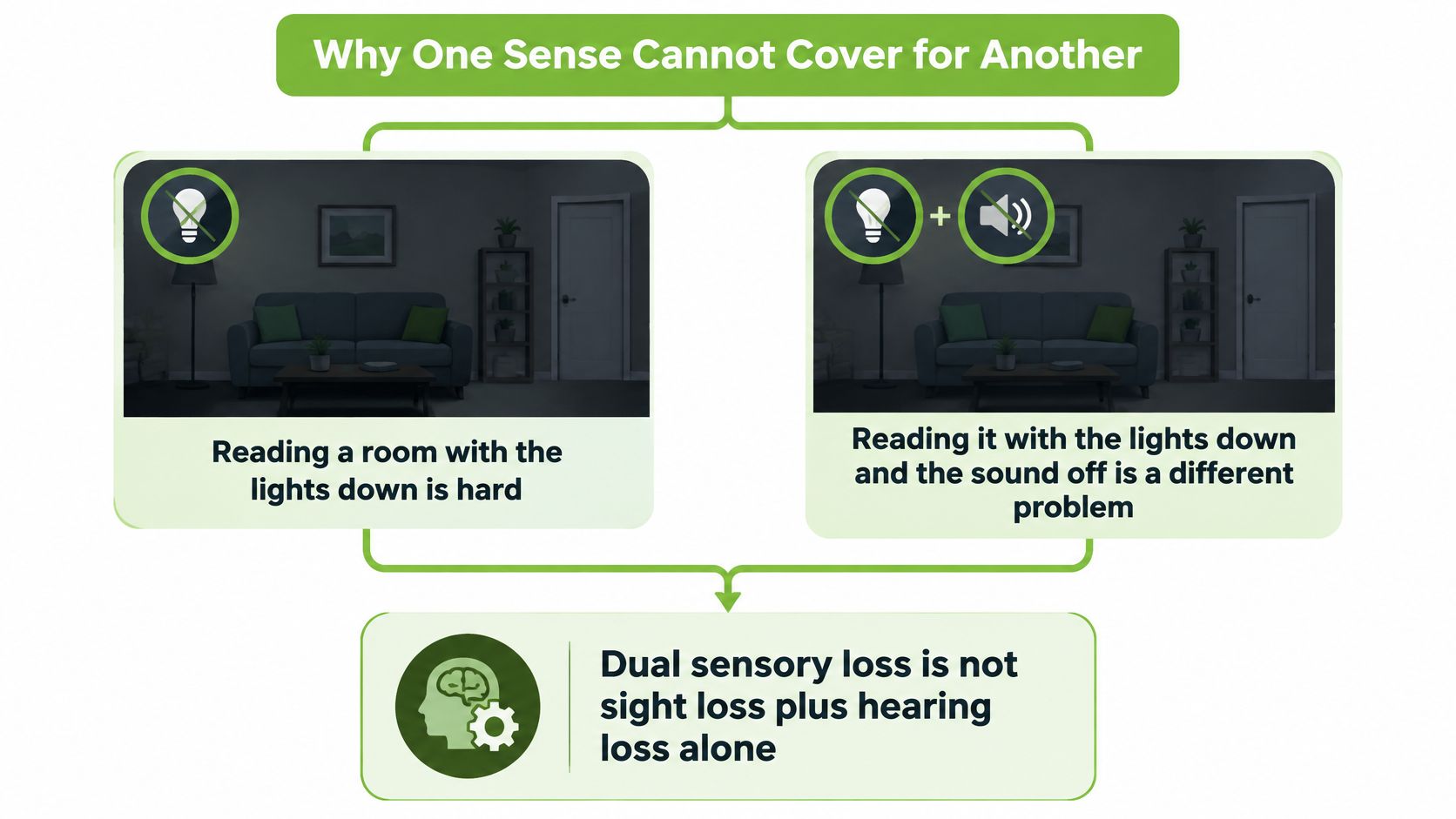
A person can use a voice, a footstep, or a visual outline to understand what is happening at home. When sight and hearing are both reduced, those clues may not be dependable. The difficulty is not just two separate losses added together: each sense can no longer reliably fill gaps left by the other.
That matters in ordinary moments. A carer's voice may not identify who has arrived, and a figure in the doorway may not be clear enough to recognise. The person needs an agreed way to know someone is there and to understand what is happening.
Dual sensory loss becomes more common with age and is often found alongside other long-term conditions. Painful joints or fatigue, for example, can make a task harder when communication and movement are already difficult.
Follow an ordinary morning
A carer arrives while the person is in the kitchen. Calling from the hallway may not make clear who has entered. Standing in the doorway may not give the person enough visual detail to recognise them. Agree how the carer will signal their arrival, then allow time for the person to acknowledge it.
At breakfast, the person may not see the cooker setting clearly or hear that a pan is boiling. If pain or tiredness also affects movement, preparing food becomes a task involving communication, mobility and safety at once.
Medicine brings another set of steps. The person needs to find and identify the packet, understand a prompt, and be able to raise a concern such as nausea or a missed earlier dose. A carer can make this easier by checking that each part of the task is accessible, rather than assuming that locating the medicine is enough.
Make familiarity a chosen aid
A different carer, a rearranged kitchen or unexpected touch can remove information the person relies on. Keeping familiar arrangements can help, provided the person has chosen them. Repetition should support independence, not impose an inflexible routine.
- Arrival: Agree how the carer announces themselves and waits for acknowledgement.
- Objects: Keep keys and essential equipment in places the person has agreed, and explain any changes.
- Movement: Follow the person's established route and use agreed speech or touch cues.
Familiarity supports independence when the person has helped decide what stays familiar.
Home care does not replace audiology, eye care or social work. It helps the person use advice from those services during everyday activities at home. The practical question is whether they can recognise what is happening and influence what happens next.
When Confusion Is Sensory Loss Not Dementia
Withdrawal, missed instructions and agitation don't establish that someone has dementia. A person may stop answering because conversation has become inaccessible, or resist help because they didn't understand who approached them.
The Scottish Sensory Hub's 2025 report on dementia assessments found that 71% of respondents reported no direct referral route between relevant services. It also highlighted substantial under-recording of sensory loss in official care-home figures compared with research estimates, showing why existing records may not tell the whole story.
Sensory loss and dementia can coexist. Better communication may improve participation without resolving every difficulty, so families shouldn't try to diagnose the cause through home observation alone.
Check access before interpreting behaviour
- Compare the records. With the person's permission, check the care plan against available GP and optometry information. Note missing assessments or changes that haven't reached the care record.
- Use the preferred format. Observe responses when the person receives information accessibly, rather than judging only their response to speech across a room.
- Adjust the surroundings. Improve lighting and contrast, reduce background noise, and note whether engagement becomes easier.
- Look for a pattern. Are instructions missed when the speaker is out of view? Does difficulty arise with small print rather than with the task itself?
- Request a coordinated review. Ask social care, audiology, optometry and a sensory specialist to clarify needs together rather than assuming extra visit time will solve them.
A domiciliary worker may notice that someone follows a discussion at breakfast but appears unresponsive when the television is on. Record the circumstances and date, not just a label such as confused.
Know when observation isn't enough
Sudden confusion needs urgent medical assessment. Don't delay help while testing whether a quieter room improves the response. Understanding delirium versus dementia can help families recognise why an abrupt change should be treated differently from a gradual difficulty.
Ask who will coordinate reassessment and whether any assessment can happen at home. Put the responsible professional, referral action and follow-up arrangements in the care record so concerns don't disappear between visits.
Making Rooms and Routes Safer
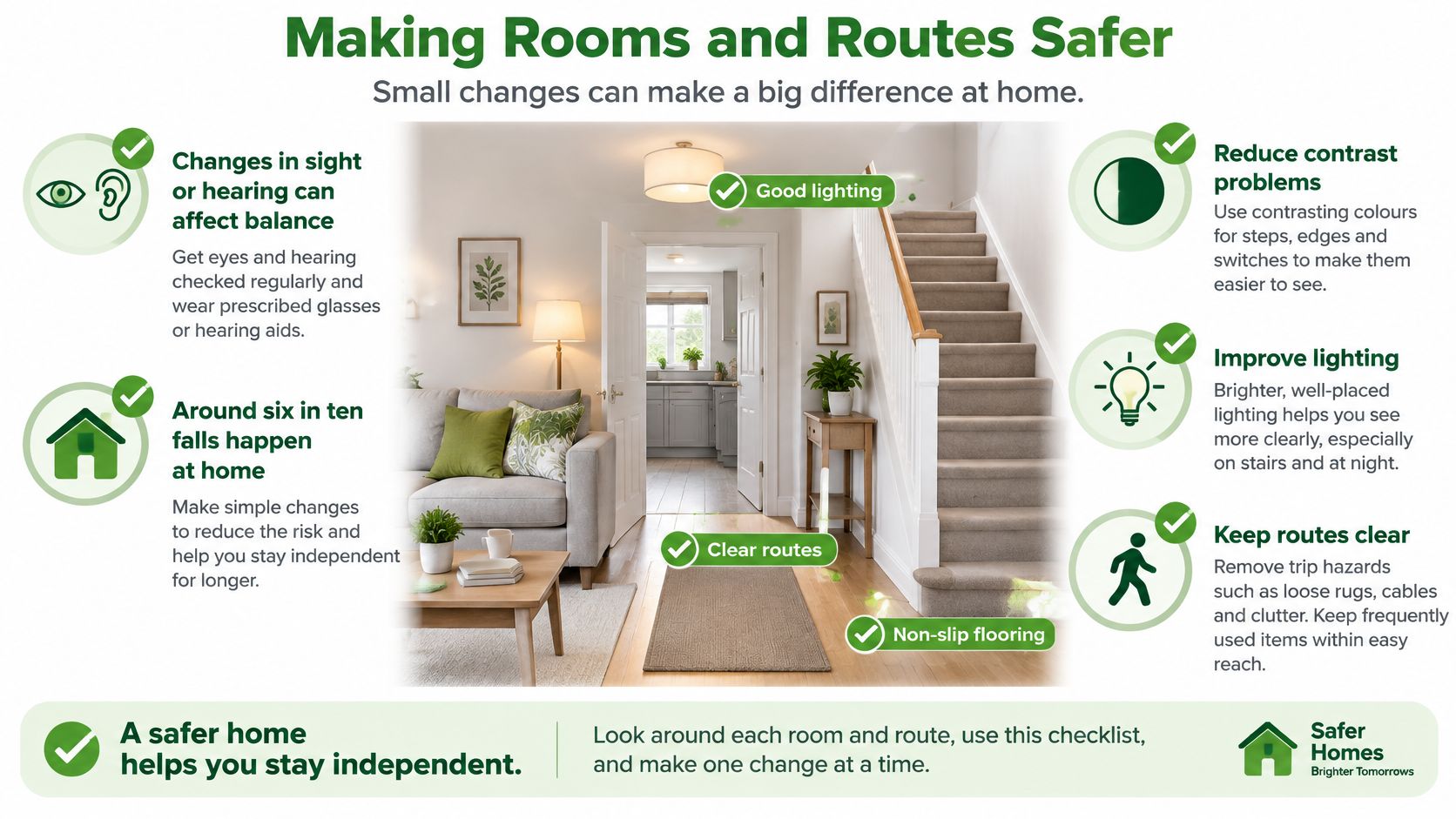
Around six in ten falls happen at home, according to NHS Gloucestershire's falls guidance, which also explains that changes in sight or hearing can affect balance. A familiar house therefore still needs checking when sensory abilities change.
Reduced contrast, impaired depth perception and visual-field changes can hide thresholds and obstacles, as described in NHS Gloucestershire's falls guidance for care homes. Cataracts, glaucoma and diabetic retinopathy are among the conditions that may require eye-care input, not just more assistance walking.
Walk the routes the person actually uses
Start with bed to toilet, chair to kitchen and any stairs they use. Check from their usual position and at the times they make the journey, rather than looking around an empty room in daylight.
- Clear the floor: Remove loose rugs, clutter and trailing cables from walking routes.
- Improve illumination: Provide even light in halls and on stairs without shining it into the person's eyes. Consider a night light or motion-activated light for bathroom trips.
- Show level changes: Use suitable high-contrast edging where a step or threshold is difficult to distinguish.
- Check practical essentials: Keep spectacles clean and suitable for the task. Review footwear and ask for a medication review where dizziness or balance concerns arise.
An occupational therapist can assess hazards and recommend adaptations. Options described in this guide to daily living aids for elderly people can support that discussion, but an aid still needs to suit the person and their home.
Don't tidy away someone's landmarks
A chair, side table or familiar doorway may help someone orientate themselves. Moving it without discussion can make a previously manageable journey harder, even if the room looks neater afterwards.
Practical rule: Explain before touching, ask before guiding, and agree before rearranging.
Offer a verbal description before physical assistance. Hand-over-hand guidance should only happen with consent, and a person who can complete part of a task should have time to do so.
New collisions, difficulty locating food or tablets, or a changed walking pattern need reporting to the GP, optometrist or relevant eye service. Sudden loss of sight or hearing needs urgent medical attention rather than a routine care-plan update.
Follow any orientation and mobility advice already agreed with vision rehabilitation. Carers should reinforce a workable route, not invent a different technique on each visit.
Speaking So the Person Can Direct Care
A care visit can become unsafe if the worker relies on speech the person can't hear, notes they can't see or a telephone call they can't follow. Accessible communication is part of delivering care, not an optional courtesy.
NHS England's commentary on hearing loss and dementia describes associations of approximately twice the dementia risk with mild hearing loss, three times with moderate loss and five times with severe loss, and supports asking people aged 55 and over hearing-screening questions with audiology referral following positive responses. These associations don't prove that hearing loss causes dementia.
Use a communication routine
- Check hearing aids with permission. Confirm that they're available, clean, correctly inserted, switched on and supplied with working batteries. Only provide device support you're trained or instructed to give.
- Reduce competing sound. Pause the television and avoid important discussions beside a running extractor fan or kettle.
- Make speech visible. Face the person, keep your mouth unobstructed and ensure light falls on your face. Use short phrases at a natural pace rather than shouting.
- Confirm meaning through teach-back. Invite the person to explain the agreed next step in their own words or communication method. Present this as checking your explanation, not testing them.
- Record the method that works. Include large print, communication cards, lip-reading support, tactile information or a qualified British Sign Language interpreter where required.
For example, after explaining a medication prompt, ask the person to show which medicine they understand is due. If they identify something different, pause and resolve the misunderstanding within the agreed medication procedure.
Keep consent with the person
A relative can help explain preferences, but staff should still address the person receiving care. Before washing or dressing, make the proposed assistance understandable and give time for an answer.
The same applies to emergency arrangements. A written contact sheet isn't useful if the person can't read it, and a spoken alarm isn't sufficient if they can't hear it.
If hearing has deteriorated, arrange GP or audiology review rather than repeatedly increasing your volume. When a communication method fails, change the method before assuming the person cannot participate.
Building the Personalised Care Plan
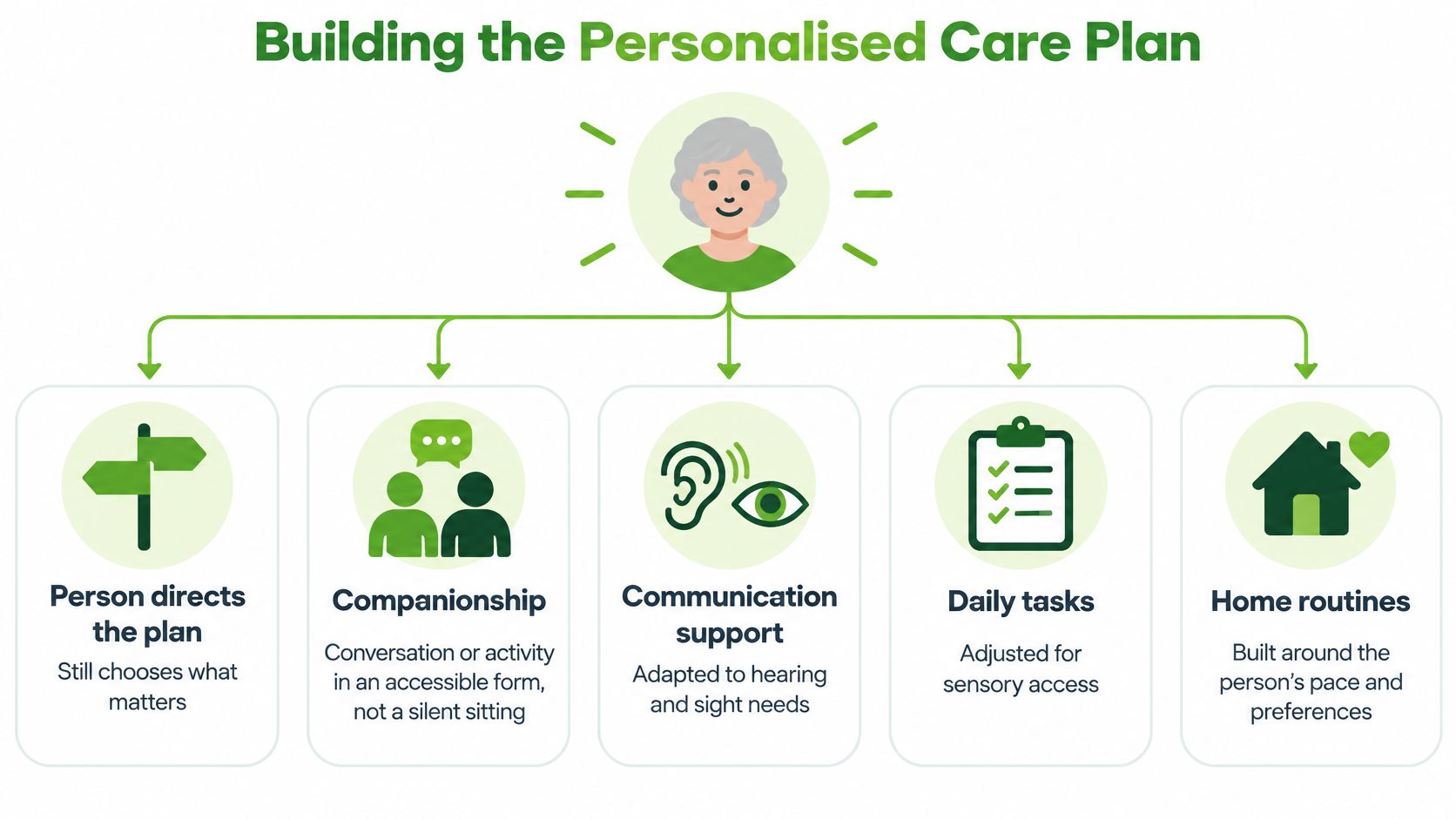
A useful plan describes what the person wants to do and how support makes it accessible. It shouldn't become a list of tasks performed around somebody who has no opportunity to choose.
The principles of person-centred care apply to ordinary decisions, including when to get dressed, what to eat and whether company means conversation, music or a shared activity.
Care-plan tasks adjusted for sensory loss
| Task | Sensory adjustment | What it protects |
|---|---|---|
| Companionship | Conversation or activity in the person's format | Connection and mood |
| Personal care | Consent first; guided help only if agreed | Dignity and hygiene |
| Medication prompts | Consistent place, accessible labels, teach-back | Correct doses |
| Household tasks | Items returned to the same spots | Safe navigation |
| Respite | Familiar routine kept while family rests | Continuity and carer rest |
Companionship shouldn't mean sitting beside someone who can't access the conversation. Personal care should include choices and explanations, while respite should give family carers a genuine break without leaving replacement staff to guess the routine.
Make medicine support explicit
RNIB's analysis of Health Survey for England data from 2015–2019 found that 34% of adults with sight loss reported bad or very bad general health, compared with 7% without sight loss, while 28% with sight loss only and 62% with sight loss plus other impairments took four or more medicines, compared with 8% without sight loss or another impairment.
These findings support careful planning, not an assumption that everyone needs medicines administered for them. Specify readable or tactile identification agreed with the pharmacist, consistent storage, confirmation of understanding and contact arrangements for an authorised relative or professional.
Carers must follow their agreed role. A medication reminder isn't permission to change doses, alter packaging or decide what someone should take.
Connect equipment, professionals and funding
Useful technology can include amplified or captioned phones, flashing or vibrating doorbells and smoke alerts, talking labels and large-print notes. Choose alerts the person can perceive, especially where touch is also reduced.
The wider team may include the GP, audiology, optometrist, occupational therapist and council sensory or adult social care team. RNIB's guidance for health and social care professionals describes vision rehabilitation that can include home assessment and orientation and mobility training.
Ask the local council for a needs assessment and a carer's assessment. Discuss council support and possible benefit routes, including Attendance Allowance or Personal Independence Payment, without assuming eligibility.
For Stoke-on-Trent or Newcastle-under-Lyme, confirm the responsible council, what it will fund and any personal contribution before agreeing care hours. Request written costs in pounds sterling (£) rather than relying on a general estimate.
Arrange Support Around Stoke-on-Trent
A useful next step is to prepare a short description of daily life before contacting a provider. Involve the person receiving support wherever possible, so their preferences aren't replaced by a list of family concerns.
Bring the information that will help somebody plan a workable visit:
- Sensory needs: The impairment, spectacles or hearing aids used, and the preferred communication method.
- Difficult moments: Rooms, activities and times of day that feel unsafe or tiring.
- Medicine concerns: Labels or packets that are difficult to identify and the support already agreed.
- Family capacity: Whether regular visits, accessible companionship or respite would help.
Agree how support will work
Cream Home Care is a local option for people in Stoke-on-Trent and Newcastle-under-Lyme, offering companionship, domiciliary support with washing, dressing and household tasks, medication reminders and respite. Its personalised planning can bring these activities together around the person's routines.
Ask how communication preferences will remain available to visiting staff, particularly after illness or a hospital stay. A discharge may change what someone can manage, so an older care plan shouldn't be treated as automatically sufficient.
Clinical tests remain with health services, and council assessments remain with the relevant council. Day-to-day support should complement those responsibilities, with a clear route for reporting concerns rather than expecting relatives to pass every message between services.
Before agreeing visits, ask:
- Communication: Can staff use the communication method the person already relies on?
- Continuity: Can familiar carers cover the main parts of the day, and how are replacement staff briefed?
- Reporting: How will changes in sight, hearing or balance be recorded and shared with the person, authorised family members and GP?
Cream Home Care offers personalised home support, companionship and respite for people in Stoke-on-Trent and Newcastle-under-Lyme. Visit Cream Home Care to discuss sensory impairment home care, bringing your communication preferences and daily routines so the conversation starts with what matters to you.