You're trying to organise help at home, but the practical questions keep multiplying. Who can cover the morning routine, what happens if a medicine dose is late, and should you call the council or the Parkinson's nurse first?
Arranging Parkinson's home care in Stoke-on-Trent means joining up clinical advice with reliable daily support. Start with what's becoming difficult, then agree who will deal with each problem rather than buying a block of hours and hoping it fits.
Local Routes Into Parkinson's Home Care
| Route | What It Provides | How to Access It |
|---|---|---|
| GP or Parkinson's nurse | Medication reviews and referrals to specialist teams | Start here after diagnosis or hospital discharge |
| Midlands Partnership NHS Foundation Trust Parkinson's Programme | Therapy-led assessment and intervention in Stoke-on-Trent and North Staffordshire | Referral from a health or social-care professional |
| Stoke-on-Trent City Council adult social care | Care Act needs assessment and funded support where eligible | Request when family cover is no longer safe |
| Parkinson's UK local adviser service | Advice on medical issues and benefits | Contact directly for practical guidance |
| Cream Home Care (private provider) | Personal care, companionship, medication reminders and respite | Arrange directly and combine with council support if eligible |
These routes serve different purposes. A care worker can help someone get dressed, but a clinician needs to review increasing stiffness or difficulties with medicines. After hospital discharge, ask the ward nurse or social worker to make any outstanding professional referral rather than leaving the family to identify the right team.
Stoke-on-Trent City Council reported 0 unmet adult social-care domiciliary hours in quarter 2 of 2024/25, down from 174 hours in 2023/24. That describes provision for assessed residents, not a guarantee that a particular visit time or Parkinson's-trained worker will be immediately available.
Make the first call specific
Have a short account ready: the diagnosis date, current medicines, any recent fall or hospital admission, and the help needed today. Explain what happens without that help, such as being unable to get safely from bed to the toilet.
For practical guidance alongside formal services, Parkinson's UK reports that its local adviser service supported more than 17,000 people in 2024, including with medical issues and benefits advice. Environmental information can also help families prepare: Trademaster Construction's resource on grab bars for safer bathrooms offers a starting point for discussing adaptations with an occupational therapist, rather than choosing rail positions unaided.
First-call rule: Contact the clinical route when symptoms are changing. Contact adult social care when the gap in daily support is widening.
What to Assess Before Hours Are Chosen
Hours should follow needs. Before accepting a proposed schedule, work out which activities require help, when they happen and whether the difficulty needs clinical assessment rather than another routine visit.
| Assessment Area | What to Record | Who Acts on It |
|---|---|---|
| Medication timing | Exact dose times, late or missed doses, and when symptoms wear off | GP or Parkinson's nurse |
| Mobility and balance | Transfers, freezing episodes, gait, recent falls and near-falls | Physiotherapist through the Parkinson's Programme |
| Daily living tasks | Which parts of washing, dressing and meals need help, and how much | Occupational therapist |
| Swallowing and saliva | Coughing or choking at meals, drooling | Speech and language therapist |
| Communication | Volume of speech, word-finding difficulty, reliance on written notes | Speech and language therapist |
| Mood and cognition | Low mood, confusion, changes in sleep | GP or Parkinson's nurse |
Record what happens, not just the diagnosis
For medicines, use the current prescribed schedule and record actual administration times separately. Add late or missed doses and when stiffness, slowness or other symptoms return before the next dose; the clinician can then assess the pattern without relying on memory.
For mobility, describe the movement that causes trouble. Getting out of a low chair, turning in a narrow kitchen and stepping through a doorway are different problems, even when the family describes all of them as poor walking.
Daily living notes should identify the assistance needed, not just mark a task as difficult. Someone may wash independently once supplies are laid out but need physical help with lower-body dressing, making a blanket assumption of full assistance unnecessary.
Separate support needs from referral needs
Coughing or choking during meals, changes in speech and troublesome drooling need specialist attention. Don't improvise food textures, thicken drinks or change medicine formulations without appropriate professional advice.
NICE's Parkinson's disease recommendations support regular clinical monitoring and referral to physiotherapy, occupational therapy or speech and language therapy when balance, motor function, daily activities, communication, swallowing or saliva cause difficulty. They also recommend an ongoing specialist point of contact, including home visits where appropriate.
Mood and cognition belong in the assessment too. Record specific changes, such as abandoning familiar activities, becoming muddled during the evening routine or struggling to follow instructions, rather than using labels that don't tell the clinician what changed.
The practical test is whether paid support can safely meet the need as it stands. If not, request clinical assessment alongside interim help; extra hours aren't a substitute for a safe transfer technique or swallowing plan.
Preparing the Home for Safe Visits
Someone gets up from a chair at night, feels dizzy and steadies themselves against the door frame. Moving a rug may help, but that moment also needs a conversation about symptoms, furniture and the route through the house.
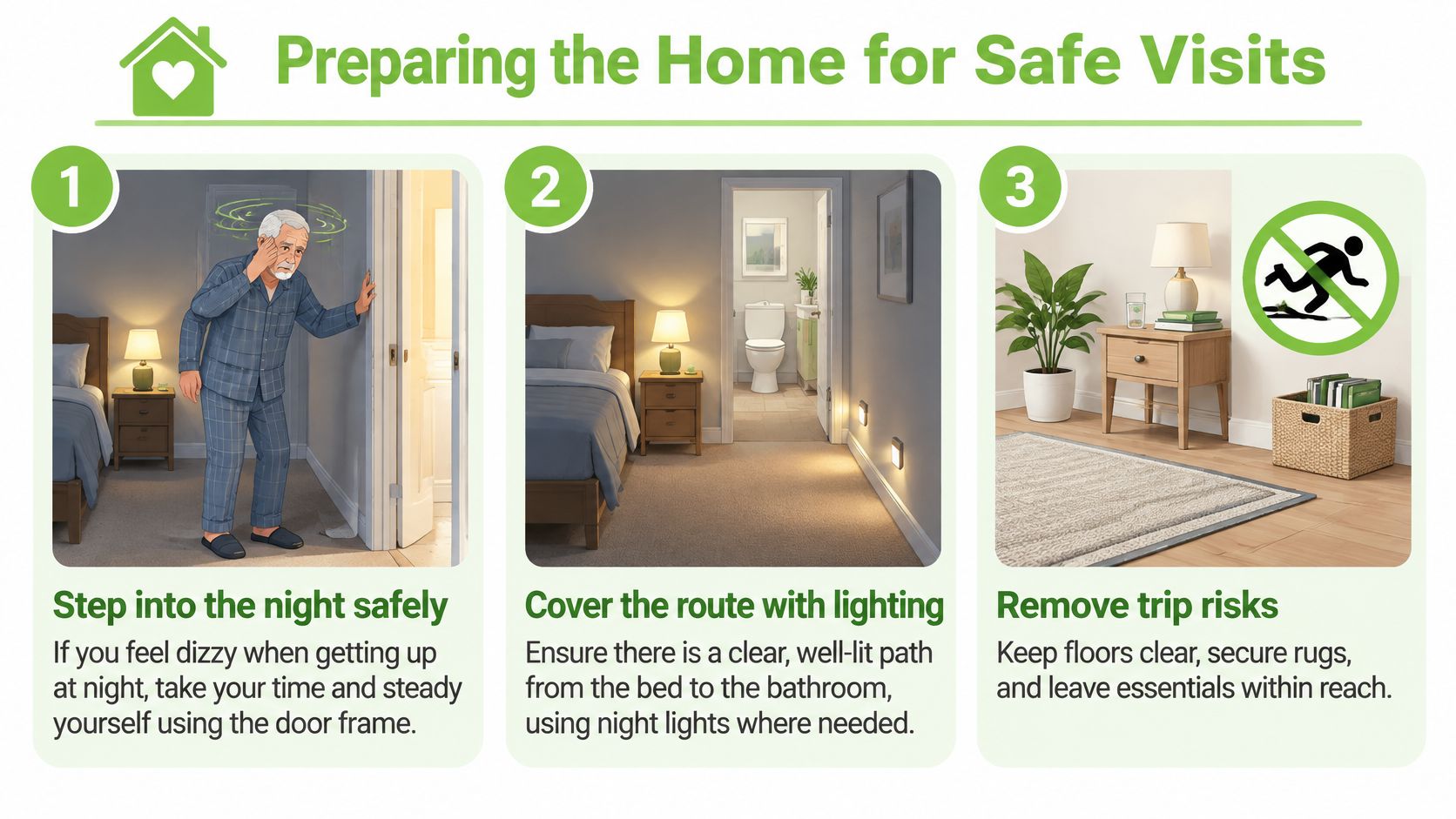
Walk the route the person actually uses
- Bed to bathroom: Provide accessible lighting without forcing the person to cross a dark room to reach a switch.
- Hallways and doorways: Remove loose rugs and trailing cables, and leave enough space for the prescribed walking aid.
- Bathroom and entrance: Ask about properly fitted grab rails beside the toilet, bath or shower and by the front door where needed.
- Chair and footwear: Choose a stable chair with arms and a suitable seat height, plus secure, well-fitting footwear rather than loose slippers.
A powered chair isn't automatically the right answer. Guynn Furniture & Mattress provides a guide to comfort and independence that can help frame questions about lift chairs, but an occupational therapist should assess suitability where transfers are difficult.
The same principle applies to smaller equipment. Use this overview of daily living aids to identify tasks to discuss, rather than buying several aids before checking whether the person can use them comfortably.
Treat dizziness as a symptom
NICE's Parkinson's disease guideline identifies orthostatic hypotension, a drop in blood pressure on standing, as a contributor to falls and injuries and recommends reviewing medicines that may contribute. Home carers mustn't change medicines themselves.
Help the person change position slowly and sit back down if dizzy, then report recurring symptoms to the clinician. During the first visit, walk the home together, identify the three highest-risk spots and write down who will address each one and by when.
How to Write a Care Plan Clinicians Will Use
A useful care plan explains what someone needs, how staff should help and who takes responsibility when something changes. A list of washing, dressing and meals doesn't give a visiting clinician enough information to judge whether the arrangement is working.
Healthwatch Stoke-on-Trent's 2023 engagement with 39 people found that nearly two-thirds received insufficient information at or after diagnosis. That local finding makes a shared, usable plan particularly important, especially when families are trying to coordinate support after discharge.
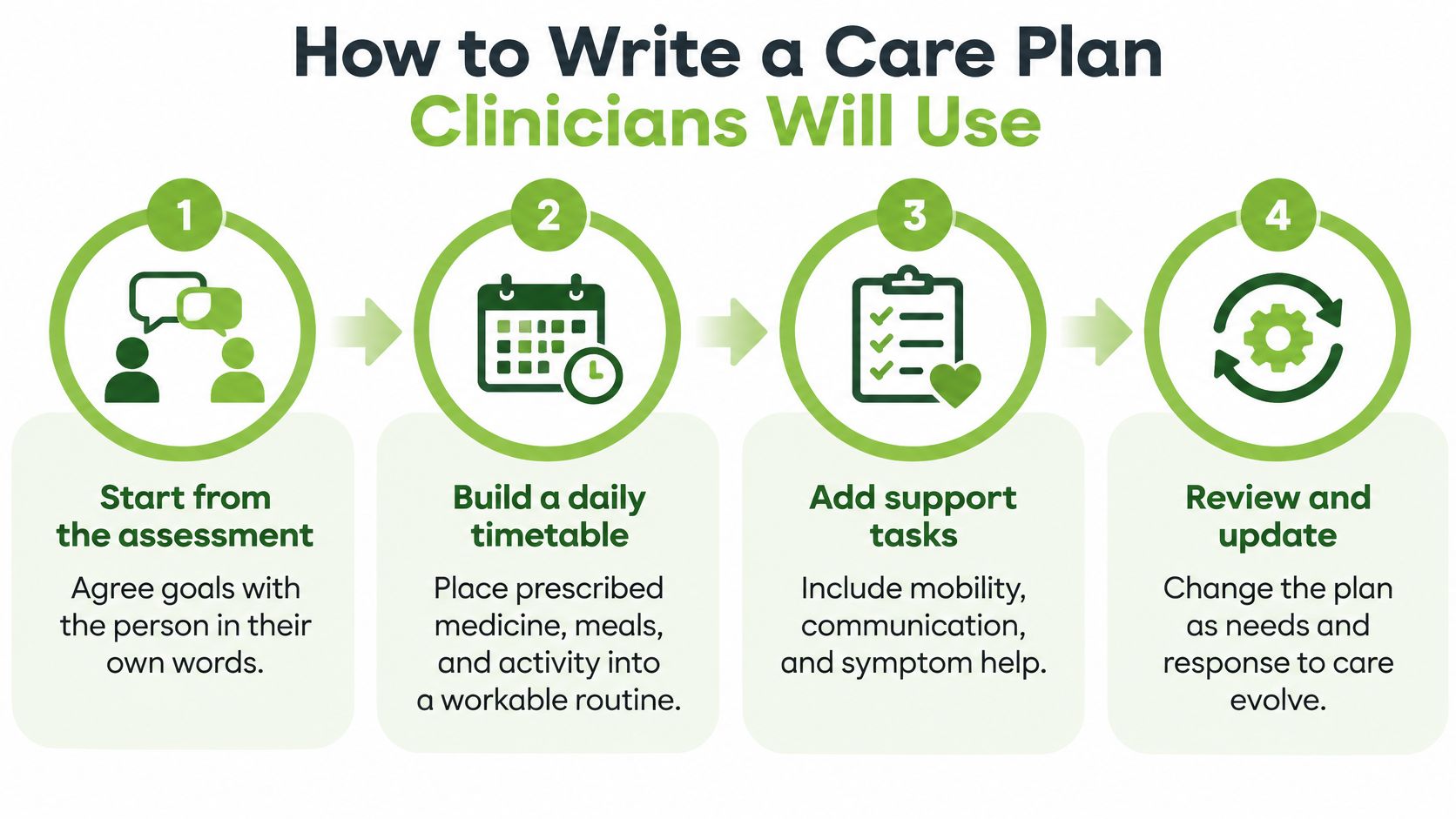
Build the working plan
Start from the assessment and agree personal goals. Use the person's own words, whether they want to make breakfast, reach the garden or dress with less help. Don't replace their priorities with a task list that removes activities they can still manage.
Build the timetable around prescribed medicine times. Place visits, meals and activities into a workable routine, checking any medicine-and-food instructions with the pharmacist. If the provider can't cover an essential time, resolve that gap before care starts rather than shifting the prescription to fit the rota.
Assign tasks and explain the reason. Record the agreed transfer prompt or communication approach and why it's needed, so unfamiliar staff don't substitute their own technique. For example, a prompt to pause before turning may form part of the therapist's movement advice, not merely a preference for doing things slowly.
Make responsibility explicit
Write escalation triggers in everyday language. Name the response to a new fall, coughing or choking at meals, or repeated missed doses, with the relevant GP, Parkinson's nurse, pharmacist or therapy contact. Include a separate emergency route for immediate danger, such as inability to breathe or serious injury, rather than directing every concern to an unattended office.
Share the current version with consent. Ask the person who may receive information, then coordinate with their Parkinson's nurse, GP, therapy team and agreed relatives through suitable channels. Date the plan, identify its owner and remove superseded copies so staff aren't following conflicting instructions.
Agree review dates and observable measures. Compare safe transfers, falls frequency and the assistance needed for daily tasks; use timed mobility only where a clinician has advised a suitable method. Ask what became easier or harder and whether the person's own goals remain relevant, rather than recording only that all visits took place.
After discharge, reconcile the plan with the latest medicine list, equipment arrangements and pending referrals. Mark unresolved items clearly, with a named person responsible for chasing them; a referral mentioned in conversation isn't the same as an appointment arranged.
A plan isn't coordinated simply because everyone has a copy. Each concern needs a named recipient and someone responsible for checking that a response arrives.
Treating Parkinson's support as generic elderly care can leave movement, swallowing and environmental risks unmanaged. Extra visits can help with the workload, but they can't replace specialist oversight or a clear division of responsibility.
Funding, Assessments and Local Support
Start with NHS care before assuming that every form of help must be bought privately. Parkinson's nurse reviews and clinically indicated therapy services are free at the point of use; paying for domiciliary care doesn't replace access to them.
Apply in a practical order
- Ask about NHS Continuing Healthcare: If needs are complex and long-term, ask the GP or Parkinson's nurse whether an assessment is appropriate. Eligibility concerns the assessed nature of the person's needs, not the diagnosis alone.
- Request a council needs assessment: Contact Stoke-on-Trent City Council adult social care and explain what the person can't manage safely. The Care Act needs assessment is free and establishes what support the council must consider.
- Clarify the financial assessment: If support is needed, the council examines income and savings to decide what the person contributes. Don't assume that having an assessment means all subsequent care will be free.
- Discuss direct payments: Where support is agreed, ask whether direct payments are available and what responsibilities come with choosing and paying a provider.
- Request a carer's assessment: The unpaid carer can ask for a separate assessment at the same time. Explain interrupted sleep, work commitments and tasks they can't safely continue, not just the hours they currently provide.
Check benefits and ongoing support
Attendance Allowance generally applies to eligible new claimants after State Pension age, while Personal Independence Payment generally applies to eligible new claimants below that age. Existing awards and individual circumstances can affect the route, so ask a Parkinson's UK local adviser to check entitlement rather than ruling anything out yourself.
Carer's Allowance may apply where the carer meets its conditions, but get a benefits check before claiming because awards can affect other support. Keep benefit letters, the proposed care schedule and any council correspondence together so an adviser can see the whole position.
For peer support, ask Parkinson's UK about local branches and support groups. Obtain current meeting and accessibility details directly, particularly if transport, fatigue or communication difficulties could make attendance harder.
Questions to Ask Before You Choose a Provider
A warm first meeting doesn't demonstrate Parkinson's capability. Use the same questions with every provider and score each answer as clear, incomplete or unresolved.
| Question to Ask | Strong Answer | Warning Sign |
|---|---|---|
| Do staff have Parkinson's training? | Named, Parkinson's-specific training, refreshed regularly | Generic elderly-care training only |
| How are medicine times handled? | A written process for prompts and recording missed doses, with clear limits on what staff do | Vague answer or no written process |
| What happens when symptoms change? | A written escalation route to the Parkinson's nurse, GP or therapy team | No link to clinical contacts |
| How are visits planned around stiffness and on-off periods? | Visit length set by the person's needs, with two-person transfers where required | Fixed short slots for every need |
| Will the same carers come each time? | Named core carers and written handover notes | Rotating unfamiliar staff on each visit |
| What are the rates and notice terms? | Written hourly rates in GBP (£), minimum visit length and notice period | Verbal quotes only |
Test the answer against a real task
Ask the coordinator to explain how staff would manage the person's hardest routine. For example, if getting washed becomes difficult during an off period, how would they avoid rushing, record the difficulty and arrange a review?
Check whether medication support means reminders, assistance or administration, and whether the proposed staff are authorised and competent for that level. For transfers, ask who assesses the handling plan and how replacement staff will learn it before their visit.
Cream Home Care, serving Stoke-on-Trent and Newcastle-under-Lyme, is one option to assess alongside other local providers. Its guide to choosing a home care provider can help you organise the wider checks around care arrangements.
Before agreeing: Get the answers, prices and cancellation terms in writing. A warning sign is a reason to ask a more specific question or choose another provider, not something to overlook because the meeting felt reassuring.
Compare at least two or three providers where practical. A cheaper hourly rate may not mean a lower usable cost if minimum visits, travel charges or unsuitable scheduling prevent the arrangement from meeting the person's needs.
Respite Options When Carers Need a Break
Respite is often sought when the main carer is already exhausted. Planned support is easier to introduce calmly and can protect the person's routines as well as give their carer time away.
| Option | Best For | Point to Check |
|---|---|---|
| Planned in-home respite | Regular short visits to cover breaks and maintain routines | Whether the worker understands fluctuations and medicine routines |
| Emergency cover | Sudden carer illness or a crisis | How quickly staff can start and what handover exists |
| Day centre | Daytime social contact and activities | Staff experience of Parkinson's and transport arrangements |
| Short residential stay | Full-time care for a few days or weeks | How medicines are handled and how familiar routines are kept |
Specialist charitable help may be available, but don't assume it can cover an entire care arrangement. Charity Commission accounts covering November 2024 to October 2025 recorded respite support for 42 families; that is charity-level activity, not a measure of availability in Stoke-on-Trent.
Trial enough time to make the break useful
I would try a two-hour visit around a meal or prescribed medicine time, then review after two or three sessions. That's a practical starting arrangement, not a clinical minimum: include enough time for handover and for the carer to leave without immediately needing to return.
Watch whether the worker follows the agreed routine and gives the person time to respond. Predictable visits can provide companionship, reduce rushed transfers and make changes easier to notice, whereas irregular brief calls may increase anxiety without giving the carer a meaningful break.
For emergency cover, prepare the access arrangements, contact list and handover notes before they're needed. Ask for the same worker where possible, and check proposed availability through the local respite care service.
Use the funding routes above to request both needs and carer's assessments before exhaustion becomes a crisis. Ask specifically whether council or charitable support can contribute to planned respite.
Book Your First Assessment This Week
You don't need a finished care package before making contact. Use the next five working days to turn concerns into appointments, written information and a proposed trial, without expecting every service to start immediately.
A manageable working-week plan
Day one: Call the GP or Parkinson's nurse to request a medication review. If therapy is needed, ask about referral to the Midlands Partnership Parkinson's Programme and establish who will send it.
Day two: Assemble the assessment notes, focusing on medicine times, falls, meal difficulties and the daily tasks that are hardest. Ask the person what they most want help to preserve.
Day three: Request a Care Act needs assessment if the family can't safely cover the gap. Ask for a carer's assessment during the same contact and record the next expected action.
Day four: Shortlist two or three providers, including Cream Home Care if a private option suits. Send the provider questions in writing so their replies can be compared without relying on impressions.
Day five: Arrange a short trial visit, subject to assessment and safe staffing. Agree the first review date and what would make you change the arrangement sooner.
Keep one contact folder ready
Bring the medicine list, falls record, discharge paperwork where relevant and names of professionals already involved to every discussion. Add the person's priorities and a contact log showing who has agreed to do what.
If the proposed schedule leaves an unsafe gap, say so plainly rather than accepting it as settled. Most families won't resolve everything in a week, but the first clinical and social-care calls can open the route to a workable arrangement.
Cream Home Care offers personal care, companionship, medication reminders and respite for families in Stoke-on-Trent and Newcastle-under-Lyme. Visit Cream Home Care to discuss a home assessment and how daily support could fit around your Parkinson's routines and existing clinical care.